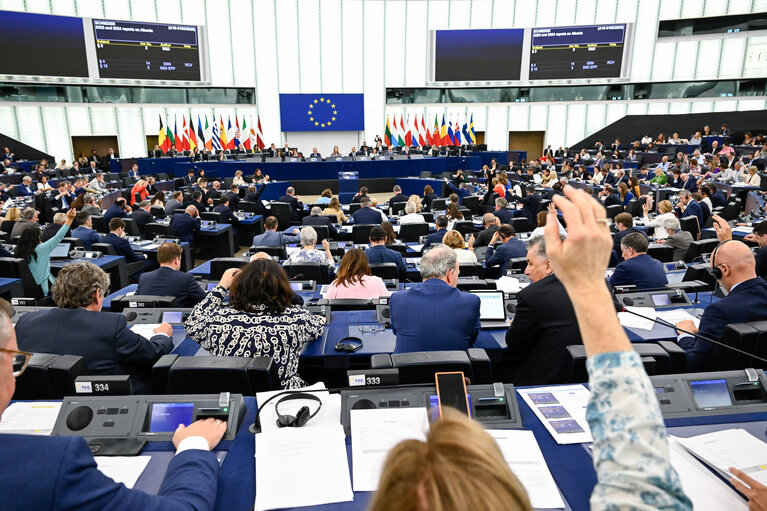
STRASBOURG – The European Parliament adopted the reports on Albania, Bosnia and Herzegovina and North Macedonia on 9 July, urging the three countries to step up the EU-related reports. MEPs praised Albania’s “steadfast commitment to the EU”, called for unity in BiH, and noted worsening trends in high-level corruption in North Macedonia.
“Albania needs more constructive and inclusive political dialogue”
The Report on Albania highlights the country’s broad political consensus and strong public support for joining the EU, alongside full alignment with the EU’s foreign and security policy. While welcoming Albania’s aim to complete accession talks by 2027 and the progress already made, MEPs stress the urgent need to intensify reforms.
In addition, the Report states that enhancing media pluralism and transparency remains crucial to build public trust, and notes ongoing political polarisation marked by confrontational rhetoric, calling for more constructive and inclusive political dialogue.
Andreas Schieder, the EP’s Rapporteur for Albania, called the country the “accession front-runner”.
“We welcome the rapid progress the ‘accession front-runner’ has made over the past years. Albania is a strong and reliable partner in foreign policy, and has taken remarkable steps in all areas such as justice, anti-corruption and environmental protection. To reach its goal of full EU membership by 2030, it is crucial to keep up the good work by broadening the economic model, creating jobs and improving the social welfare model, as well as implementing a comprehensive and inclusive electoral reform. Albania’s future lies within the EU”, said Schieder, a member of S&D group in the EP.
“BiH is in the most difficult situation in Europe, after Ukraine”
The Report on BiH calls for implementation of the necessary constitutional and electoral reforms, and for efforts to strengthen democratic institutions and the rule of law, and to fight corruption and organised crime. MEPs acknowledge key reforms but express concern over stalled progress and weak implementation.
At the same time, MEPs strongly condemn divisive rhetoric and secessionist policies, particularly those promoted by Milorad Dodik and the Republika Srpska leadership, calling on the EU to take decisive action, including targeted sanctions, to counter destabilising forces threatening the country’s stability and European security.
The Report also stresses concerns about malign foreign interference and disinformation campaigns by foreign actors, notably Russia and China, that erode public trust in the EU.
According to Ondřej Kolář, the EP’s Rapporteur for BiH, “the future of the Balkans lies within Europe, not under Russian domination”.
“Bosnia and Herzegovina is in the most difficult situation in Europe after Ukraine, and we must find a way to help it achieve full integration into Western structures. Developments in BiH demonstrate every day that we must strive for peace, stability, and development, because if we let up, we may once again face war and destruction”, stressed Kolář, a member of the EPP group in the EP.
“North Macedonia hard hit by foreign interference and disinformation campaigns”
The Report on North Macedonia urges the country to adopt a strong focus on reform implementation, particularly in public administration, governance, the rule of law, and anti-corruption policy. Noting worsening trends in high-level corruption and low public trust in the judiciary, MEPs call for stronger judicial independence, more accountability, and adequate resources for oversight bodies.
The Report states that the EP is “deeply concerned that North Macedonia and other EU accession countries in the Western Balkans are being particularly hard hit by foreign interference and disinformation campaigns”, and that it is “alarmed by the roles of the Hungarian Government and the Serbian Government in advancing China’s and Russia’s geopolitical objectives”.
This is the first report on the progress of North Macedonia that has been adopted by the European Parliament since 2022. The draft report on the country’s progress towards EU membership caused tension in Bulgaria because of the wording “Macedonian language and identity” contained therein. These references have been removed from the final version of the document.
Thomas Waitz, the EP’s Rapporteur for North Macedonia, said that he worked “tirelessly for a well-balanced and impartial report on the democratic progress of this country”.
“North Macedonia has been a frontrunner in the region, showing real commitment to EU values, including a historic name change and bold reforms. But its accession has been unfairly blocked for too long due to bilateral disputes, fuelling public frustration and disillusionment with the EU. I call on all political parties in North Macedonia to engage in constructive dialogue to reach the required consensus, which would strengthen the country’s multi-ethnic character and accelerate EU progress”, noted Waitz, a representative of the Greens in the EP.