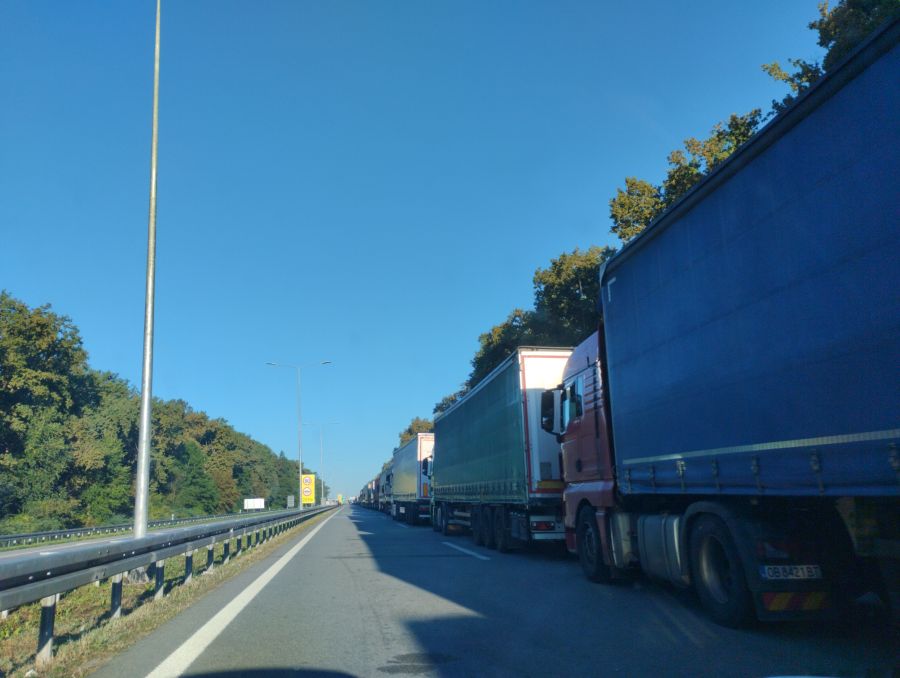
PODGORICA / BRUSSELS – Truck drivers from Montenegro decided to end the blockades of the freight border terminals towards the Schengen Area, after the today’s meeting with the representatives of the Government. RTCG reported that the representatives of the Association of Transport Operators said that the “solutions to a significant number of problems have been defined”, and that “the withdrawal of trucks from border crossings has begun”.
In addition, the European Commission presented today a new strategy on asylum and immigration policy, which, according to N1 European correspondent Nikola Radišić, also envisions the solution to the difficulties with which the truck drivers from the WB are faced up.
“As part of the new visa strategy presented at the EC in Brussels, truck drivers will not be exempted from the visa regime, which includes 90 days of stay in the EU within 180 days, but the EC recognizes this problem, considers it very serious and offers a special regime – an extended short stay”, Radišić told N1.
He clarified that it would imply that the days spent in the Schengen Area would no longer be strictly counted for the professional truck drivers.
“Thereby, the EC is trying to set a special limit for the truck drivers… It has not yet been defined, everything is in the proposal phase, but the EC is trying to find a solution to the problems faced up with the professionals, who, as they say, ‘are constantly circulating across borders’”, Radišić remarked.
Truck drivers from Bosnia and Herzegovina, Montenegro, North Macedonia and Serbia began a blockade of the freight border terminals towards the Schengen Area on 26 January, to protest the new EU Entry-Exit system (EES), which has been gradually implemented since October 2025.
Transport associations from the four countries in the region claim that the ESS “threatens their ability to work”, since a maximum stay of 90 days in the Schengen Area over a period of 180 days “is not sufficient for professional truck drivers from non-EU countries”. In this context, the EU is urged to grant truck drivers the status of cross-border workers.
Today, the representatives of the Association of Transport Operators from Montenegro told RTCG that the representatives of the Government had informed them that the VAT would be refunded “within the legally prescribed period”, and that they had been assured that “the transit period of imports of goods from Montenegro would be 72 hours”.
“We were assured that the proposal for beneficent employment would be send to the Government for a vote, and that the working hours of phytosanitary inspectors would be extended … The issue of the fuel excise has not been resolved, but we have been assured that all major topics, including the EES and the excise duty on diesel fuel, will be discussed with the European partners, to stimulate us”, the representatives of the Association of Transport Operators told RTCG.
On 28 January, President of Montenegro Jakov Milatović wrote a letter to Marta Kos, EU Commissioner for Enlargement, in which he pointed to the problems faced by the professional truck drivers due to the implementation of EES.
Milatović stressed the need “to find pragmatic solutions within the existing Schengen framework”, and expressed his readiness to continue a constructive dialogue with the European Commission and the member states, in order to define practical arrangements that would be in line with the Schengen acquis, and at the same time fair to all interested parties.
“This issue is closely related to wider efforts to strengthen the economic integration of Montenegro and the Western Balkans with the European Union, which represents a common interest”, Milatović remarked.