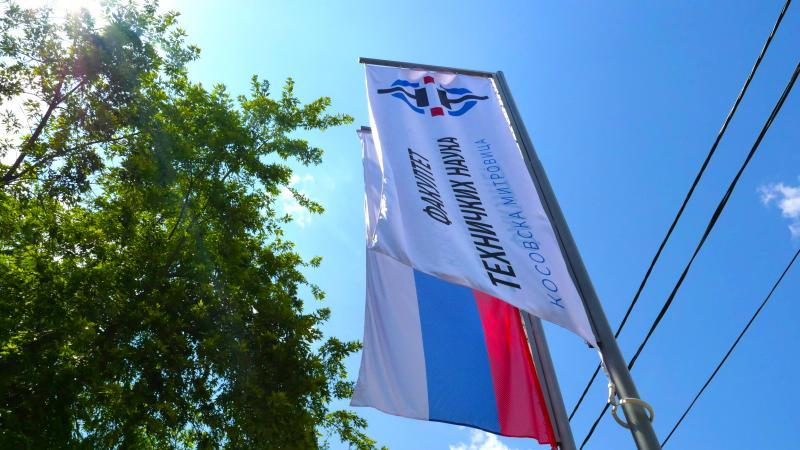
On 10 February, the Faculty of Technical Sciences, which operates within the educational system of the Republic of Serbia as part of the University of Pristina with a temporary seat in North Mitrovica, was given a deadline of 30 days to move out or sign a contract with the University of Pristina. According to Nebojša Arsić, Dean of the Faculty, both official Belgrade and the international community had been informed about this incident.
Arsić told KoSSev web portal that the representatives of the Kosovo-based University of Pristina delivered a written notice to the Serbian-run rectorate earlier in the day, demanding what the letter describes as the “voluntary release of an usurped property” or the initiation of a bilateral legal arrangement for the use of the building housing the Faculty of Technical Sciences.
The letter, signed by Arben Hajrullahu, Dean of the University of Pristina, was addressed to what it referred to as the “current illegal user of a plot owned by the University of Pristina of the Republic of Kosovo” and cited the cadastral service of the municipality of North Mitrovica.
Arsić claimed that the land plots, where the Faculty of Technical Sciences is located, had never been the property of the University of Pristina, not even before the war, but belonged to “Trepča” mining company.
On the same day, Acting Deputy Prime Minister of Kosovo Besnik Bislimi said that “five or six very important weeks” are ahead in which “it is necessary to be constructive” in order to “initiate the process of integration of educational and health institutions that still operate within the Serbian system, into the Kosovo system”.
In an interview with Radio Television Kosovo, he noted that Acting Minister for Local Self-Government Eljbert Krasniqi has invited all mayors of Serb-majority municipalities to a meeting on this issue, scheduled for 13 February.
“It takes time to incorporate these institutions into the legal framework of Kosovo”, Bislimi remarked.
“This is not a simple administrative issue, but a complex property-legal dispute”
Commenting on the latest events surrounding the Faculty of Technical Sciences and Bislimi’s statements, Aleksandar Šljuka, a researcher at the Mitrovica-based “New Social Initiative”, notes for EWB that according to the available information, the letter by the University of Pristina, demanding the Faculty to vacate the land plot within 30 days, “was handed over by persons in civilian clothes, without a clear institutional representation, which raises the question of the regularity and form of the procedure”.
“Further confusion is caused by the fact that the document lists the wrong plot, which constitutes a serious procedural omission. If it is true that the Faculty is located on the land plot which belonged to ‘Trepča’, the plot would have to be included in the official list of Trepča property, and the issue of its use of it can only be resolved through court proceedings in the Kosovo legal system. In theory, it is possible that at some point there was a change in ownership structure, but such information is not publicly available or confirmed for the time being”, Šljuka says.
According to him, “this is not a simple administrative issue, but a complex property-legal dispute, which would have to be resolved through a clear and transparent procedure, and not through letters with short deadlines and implicit threats of eviction”.
“This case cannot be observed in isolation. It clearly fits into a broader pattern of announcements and concrete moves by the Kosovo government, aimed at integrating the remaining systems of the Republic of Serbia in Kosovo – education and health, into the Kosovo system,” Šljuka remarks.
He notes that the fact that Bislimi has called the mayors of Serb-majority municipalities in Kosovo to be “constructive” and “accountable”, “leaves a strong impression of a conscious disregard for the political context in which issues of integration of education and health would have to be considered”.
“These issues are presented as internal ones, something to be solved by the central and local authorities, although these are the domains that are clearly part of the Belgrade-Pristina Dialogue, and are directly related to the obligation of Pristina to form the Community of Serb-Majority Municipalities. It normalises an essentially abnormal situation, in which deeply contentious issues of institutional survival and collective rights are presented as technical or administrative processes”, Šljuka states.
He stresses that “the process is additionally problematic, given the absence of a clear and public reaction from Belgrade, as well as the tacit approval of the international community”.
“In this sense, one gets the impression that this is a process whose outcome is presupposed – without substantive dialogue and without real integration, but with long-term consequences for legal security, institutional survival and the position of the Serb community in Kosovo”, Aleksandar Šljuka concludes.