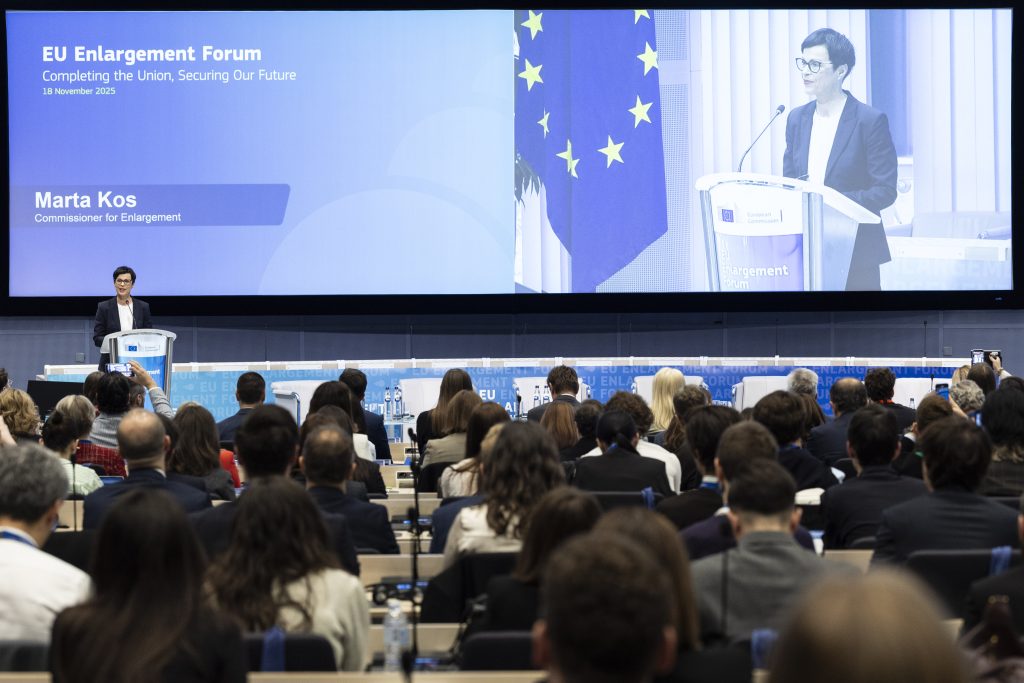
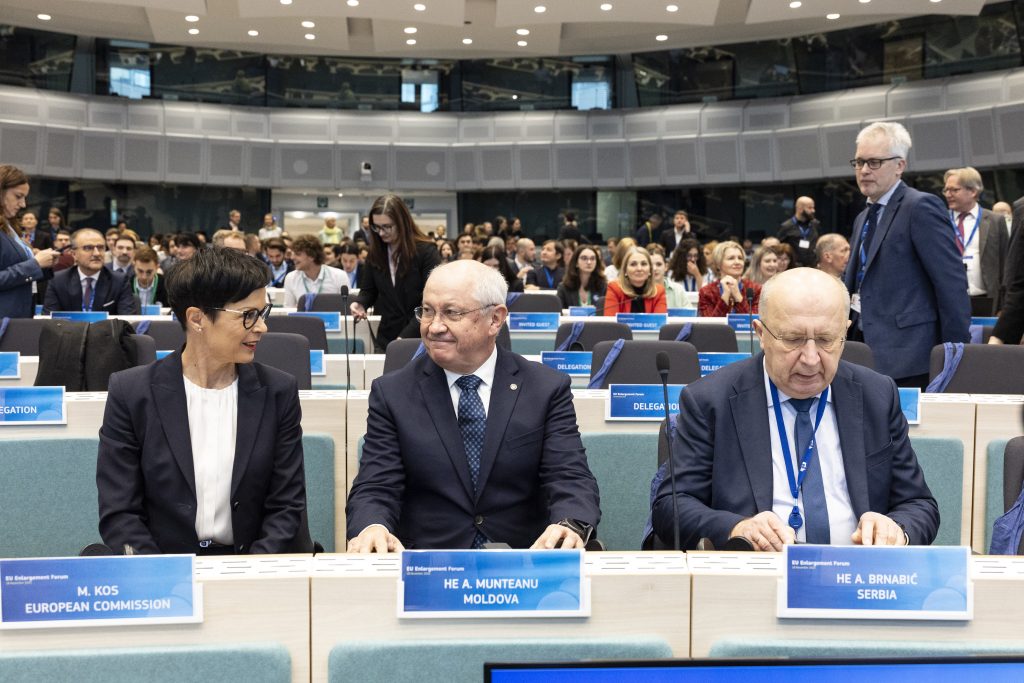
BRUSSELS – Three areas of work on enlargement in the coming period are credible progress from the candidate countries, the EU getting ready for new member states and “enlarging the enlargement”, said Marta Kos, European Commissioner, at today’s EU Enlargement Forum.
The Enlargement Forum, taking place today in Brussels, was announced by the European Commission as “a flagship initiative to elevate the conversation on EU enlargement as a shared political, societal, and generational project”.
“The Forum reflects a wider effort to bring enlargement closer to people and support a truly European conversation about the future of the Union”, the announcement reads.
The Forum was opened with a video message by Ursula von der Leyen, President of the European Commission. It consists of four panel discussions, the first of which focused on the geopolitical imperative for enlargement.
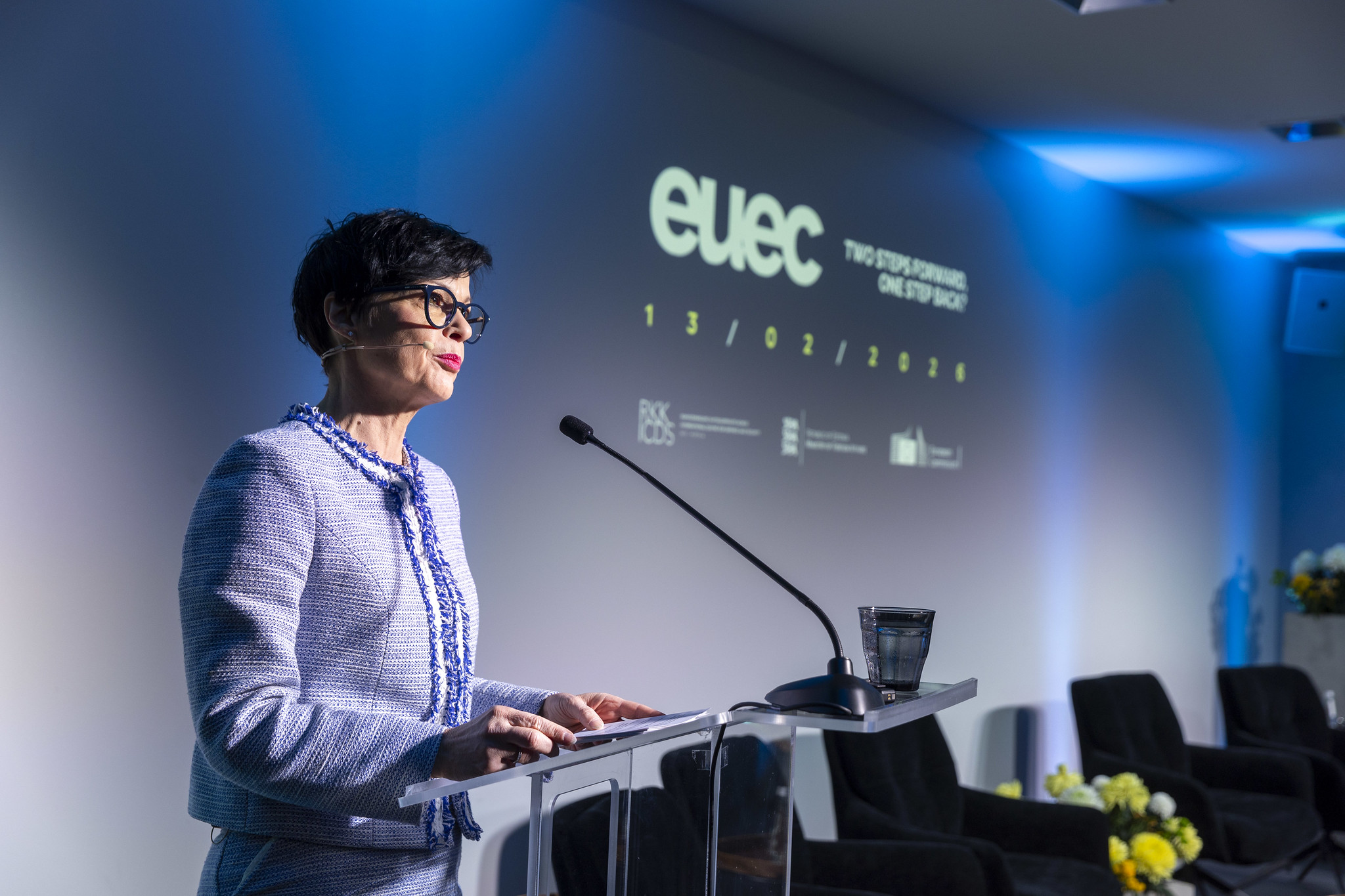
In her keynote speech, Commissioner Marta Kos stated that the enlargement policy had not only been a driver for change in the candidate countries, but also served as a firestarter to look at the EU and concerns of its citizens, be it regarding the social and economic models, migration, or corruption and organised crime.
“Despite all that enlargement has brought to our continent, it often comes with negative associations. We need to break these associations, and I need you to help me do this”, Kos said.
She added that these fundamental questions about Europe’s future require an open debate and that the EU Enlargement Forum is a part of the response.
According to Kos, there are three strands of work on enlargement going forward. Firstly, she said, any progress that the EU makes with candidate countries must be credible, and there can be no shortcuts.
“I am often asked, will those geopolitical arguments mean we should turn a blind eye and get new members no matter what. No, it is exactly the opposite. When democratic structures are weak and the rule of law is deficient, it can open the door to malign influence, to corruption and organised crime”, Kos said.
Secondly, Kos said, the EU needs to get ready for new member states. She said that the European Commission was working on pre-enlargement policy reviews, to be published next month, and also that there needs to be an open discussion about what kind of safeguards would be written in the future accession treaties.
“There must be safeguards that go unnoticed to our new member states when everyone respects their responsibilities, but they must equally be safeguards that can bite hard when the new member states do not respect those same rules”, Kos said.
Thirdly, Kos said, we need to “enlarge the enlargement” since the time needed for candidate countries to reform and member states to decide is often too long.
“We are already making Ukraine, Moldova and the Western Balkans part of pan-European value chains. By 2027, Ukraine and Moldova will be integrated into the EU energy market. We should not shy away from other initiatives and see how we can integrate our future member states into some other structures too”, Marta Kos said.
Speaking at the panel, Andrius Kubilius, European Commissioner for defence, said that enlargement is of vital interest for the EU for the reasons of security and defence.
“Currently in Europe, we have two battle-tested armies: the Russian battle-tested army, which is much stronger than it was in 2022, and the Ukrainian battle-tested army. Are we ready to face a battle-tested Russian army? And this is why I am saying that it would be a big mistake if we did not have on our side well-integrated Ukrainian defence capabilities”, Kubilius said.
He also said that the EU should not be ready to “live forever with threats coming from authoritarian, aggressive Russian regime”, but rather try to transform the situation.
“What can change the situation in that part of Europe – the success of candidate countries which are now aspiring to become EU members. This can have a major impact and send an inspirational example to the societies of Russia and Belarus”, Kubilius said.