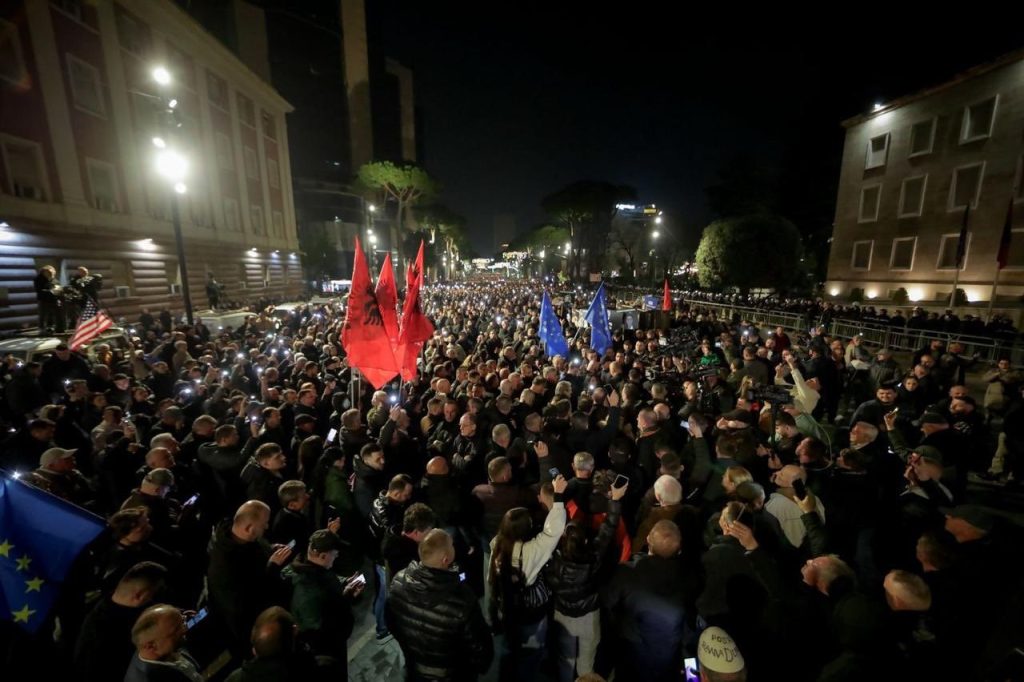
The current wave of protests in Albania, which erupted in December 2025, is primarily caused by discontent over systemic corruption and demands for the dismissal of Prime Minister Edi Rama’s government. The government has been heavily criticized for attempting to restrict the work of the Special Structure against Corruption and Organized Crime (SPAK), particularly after the parliament refused to lift immunity of Bellinda Balluku, a former Deputy PM and Infrastructure Minister, to allow her arrest. Balluku is accused of rigging public tenders and misusing funds.
During the protest which took place on 30 March, in the square outside the Prime Minister’s Office, a leader of the opposition Democratic Party (DP), Sali Berisha, accused Rama of protecting personal interests and those of his associates, including Belinda Balluku.
“In fact, he is protecting himself, protecting his family, protecting hundreds of millions and billions of funds stolen from Albanian taxpayers and placed in his accounts around the world”, Berisha claimed.
In spite of the fact that these protests often culminate in clashes with police, the use of tear gas, water cannons and Molotov, as it was the case on 23 March, analysts state for EWB that Albania is not yet in a deep political crisis.
“The opposition’s protest may succeed in drawing attention in Western capitals and media, particularly in Paris, Berlin, and Brussels, to allegations of corruption within the Rama government, as well as to the gap between the domestic reality in Albania and the carefully curated image of Prime Minister Rama abroad. It may also contribute to increasing public pressure on the government. However, it is unlikely to pose a serious threat to its solid parliamentary majority”, Professor Afrim Krasniqi, an Executive Director of the Albanian Institute for Political Studies (IPS) notes.
According to Blerjana Bino, a Co-Founder and Executive Director of the Center for Science and Innovation for Development (SCiDEV), based in Tirana, “what we are witnessing is better described as a chronic state of political polarisation that, over time, can become just as damaging as an acute crisis”.
“We have seen similar cycles before: protests that generate visibility and short-term momentum but do not ultimately shift political outcomes. These protests, while important, have not yet reached the scale or societal breadth of a broader civic mobilisation that would fundamentally alter the political balance. That said, they should not be dismissed. They signal a persistent dissatisfaction with governance, accountability, and the perceived lack of consequences for those in power”, Bino says.
Similarly, Franziska Tschinderle, a foreign journalist based in Tirana as a correspondent for German speaking media outlets, remarks that these kinds of protests are not new in Albania.
“The PD has been calling its supporters to take the streets for years, accusing Rama’s government of abuse of office and corruption. What is new this time is the fact the judiciary has charged high-ranking members of Rama’s government, among them one of the most powerful women in the country, Belinda Balluku. The irony is that Rama himself has set up this very authority (SPAK) that is now prosecuting his inner circle”, Tschinderle says.
Can the opposition make Rama resign?
The opposition, led by Democratic Party, accuses Rama of “state capture” and demands the formation of a technical government to prepare the country for early elections.
On the other hand, Rama initiated amendments to Albania’s Criminal Procedure Code (Article 242) to prevent courts from suspending top officials, including cabinet members and the Prime Minister, during investigations. These changes aim to shield the executive branch from judicial suspension measures, raising concerns regarding the balance of powers and judicial independence.
In addition, in late February 2026, Prime Minister carried out a major government reshuffle and dismissed seven ministers, including Belinda Balluku.
Commenting on these developments, Blerjana Bino, states for EWB that the current protests alone are unlikely to lead to the resignation of Rama.
“While they reflect genuine public frustration, particularly around corruption allegations involving high-level officials, the opposition remains fragmented, both politically and organisationally. It has not yet demonstrated the level of cohesion, credibility, or sustained mobilisation needed to translate public discontent into decisive political pressure. The opposition remains fragmented, both politically and organisationally. The Democratic Party continues to be the main oppositional force, but it faces persistent issues of credibility and internal division”, she stressed.
Bino adds that there are also efforts to create common ground, such as the Political Dialogue Forum, which aims to bring different opposition actors together around core issues, but these initiatives have not yet translated into visible political coordination or a unified front capable of shaping outcomes.
“Part of the limitation is structural. A widespread public perception persists that if Rama leaves, Berisha returns, and both are associated in the public perceptions, in different ways and times, with corruption. This symmetry of distrust is a defining feature of Albanian political life and significantly constrains the opposition’s ability to convert protest into a credible governing alternative”, she assesses.
According to Bino, “the recent cabinet reshuffle, replacing more than half of the government, including the foreign minister, may reflect internal pressures, but reshuffles are also a standard instrument for a majority government managing pressure”.
“So, while this may not qualify as a deep crisis in the classical sense, it reflects a deeper structural condition: a democratic system where formal compliance coexists with limited trust, weak accountability, and a growing gap between institutions and citizens. The risk is less about collapse and more about gradual democratic erosion and that is, in some ways, higher danger”, she says.
Franziska Tschinderle notes for EWB that these protests are of a completely different nature to those in Serbia.
“They are led by DP, the biggest opposition in the country. Its chair, Sali Berisha, is Edi Rama’s main internal rival. The protests operate on a top-down-logic: when Berisha calls on his supporters, they take to the streets. Additionally, what helps Rama is, that the protests turned violent a few times. This was criticized by the EU-delegation in Tirana, which was perceived internally as a backing of Rama. In addition, Berisha himself has come under investigation by the judiciary. In the wider public, he is therefore not perceived as a particularly credible leader of an anti-corruption movement”, Tschinderle underlines.
In Afrim Krasniqi’s opinion, “the opposition remains weak, not least because its main leader is currently facing judicial proceedings on corruption charges and has been sanctioned by the United States, while the leader of the second-largest opposition party is in prison on corruption-related charges”.
“The opposition’s failure to reform, renew its leadership, become electorally attractive, and position itself as a credible partner to the United States and the European Union reflects strategic miscalculations by its leaders and effectively constitutes a “free gift” to Prime Minister Rama’s government. At the same time, Prime Minister and his government are facing growing public pressure over corruption allegations, particularly following their refusal to allow legal action against Balluku. This comes in a context where another former deputy prime minister is internationally wanted on corruption charges, and Rama’s closest political ally, the Mayor of Tirana, is also currently imprisoned for corruption”, Krasniqi stresses for EWB.
He remarks that Albania “is experiencing a crisis of overconcentration of power and arrogance of personal power”.
“This represents a critical juncture for the country’s capacity to pursue and implement effective anti-corruption policies, and it also signals that the ruling majority, now in its fourth mandate, lacks both the will and the capacity to deliver meaningful, integration-oriented reforms”, Krasniqi states.
Albania risks facing consequences from the EU due to the ongoing tensions
There are widespread fears that ongoing corruption scandals and political instability will jeopardize Albania’s progress towards EU membership.
Commenting on the recent decision by the Albanian Parliament to block the arrest of indicted Belinda Balluku, a European Commissioner spokesman told Politico that “commitment to the rule of law and the fight against corruption are of paramount importance for the EU accession process”, adding that “ensuring a conducive environment for SPAK to effectively carry out its work is essential to credibly sustain Albania’s progress towards EU membership”.
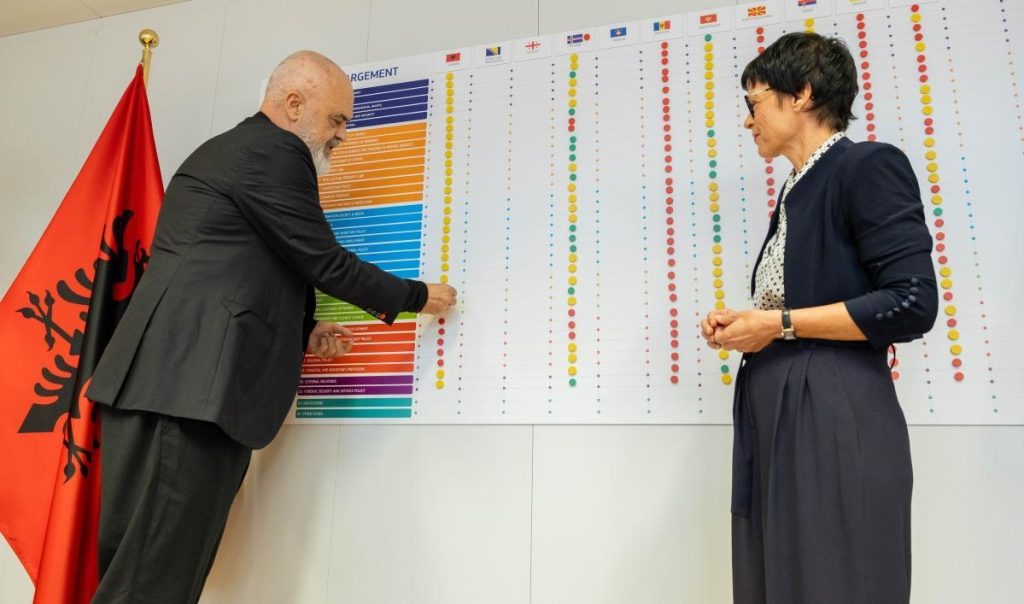
Franziska Tschinderle states that SPAK, supported by the US and the EU, is seen as a key reform linked to EU membership.
“The protests, led by Berisha, do not pose a threat to Rama, but SPAK certainly does. Why? SPAK is the most trusted institution in Albania – citizens trust it more, than the opposition and even the police. The Balluku case will certainly have an impact on how Edi Rama’s government is seen abroad. In fact, it already does. Rama’s image as a reformer and Albania’s fast-speed cluster-openings, has been overshadowed by recent developments. Rama’s Socialist Party has used its majority in the parliament to reject a request from SPAK to authorize the arrest of Balluku, who denies wrongdoings”, she stresses.
Tschinderle clarifies that SPAK cannot carry out its work effectively, “however, exactly that is a necessary condition to make progress in the EU-negotiations”.
In addition, she reminds that currently Albania is in a crucial phase, waiting a positive Interim Benchmark Assessment Report (IBAR) from the EU.
“This burden is key, because without it, Albania cannot close negotiation chapters. The Balluku case might lead to a delay in the negotiation process, as certain member states, among them Germany or the Netherlands, might not approve the IBAR report immediately – or link its approval to further reform conditions, whether one of them will be, that the immunity of Balluku has to be lifted by parliament in order for Albania to move forward, is unclear”, FranziskaTschinderle concludes.
In a similar vein, Afrim Krasniqi remarks that the EU and several of its member states, particularly Germany, “have been highly critical of Rama’s stance against the request of SPAK to initiate investigations into his deputy, as well as of the corruption scandal involving the state information agency (AKSHI), which operates under the direct authority of the Prime Minister’s Office”.
“If Rama does not adjust his approach, Albania risks facing consequences from the EU and a further escalation of protests, not only from the opposition. Conversely, if corrective steps are taken, either through a change in political conduct or through tangible progress by SPAK in advancing investigations and legal measures, the situation could be managed without high cost to the country”, he underlines.
Blerjana Bino reminds that Albania has made tangible advances in the accession process, opening all chapters in a record timeframe, “however, sustained political tensions, polarisation and recurring concerns around good governance point to a broader challenge: ensuring that formal progress is matched by meaningful implementation”.
“The risk is not necessarily a disruption of the process, but a growing gap between institutional reforms on paper to meet EU accession benchmarks and their application and impact in practice. What we see in Albania is that formal institutional architecture and the political will to allow it to function fully do not always move at the same pace. How the European Commission responds to moments like this will matter – The Interim Benchmark Assessment Reports under Cluster 1 will be the first real test”, she says.
Bino adds that it will show whether the Commission is willing to apply its own standards consistently, or whether Albania’s frontrunner status insulates it from the scrutiny that conditionality is supposed to guarantee”, she says.
She remarks that it appears that the EU will not block Albania’s accession path.
“What concerns me is the prospect of an Albania that arrives at membership having met the technical benchmarks, but without having fully resolved the democratic deficits those benchmarks were designed to address. The alternative is not to slow down or exclude, it is to insist that the process means what it says, and that closing chapters reflects genuine change rather than managed compliance”, Blerjana Bino warns.