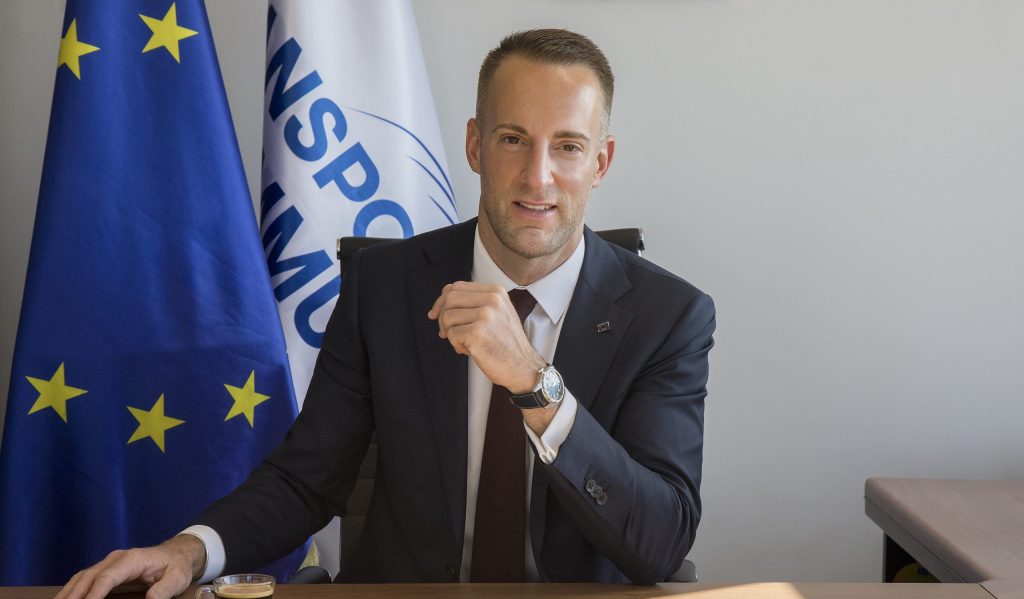
On 17-18 June, the Transport Investment Summit in Thessaloniki will bring together ministers, financial institutions, EU representatives, and private-sector partners to discuss how to advance key transport investments across the Western Balkans, Ukraine, Moldova, and Georgia. We spoke about this event, the ways of improving road safety in the region, the benefits of the “Green Lane” initiative, and the impact of the EU’s Entry/Exit System on cross-border transport with Matej Zakonjšek, Director of the Permanent Secretariat of the Transport Community, whose second term expires in July 2026.
The Transport Community is an international organisation in the field of mobility and transport, founded in 2017. It has 36 participants – the European Union member states represented by the European Commission, the Western Balkans Six, and the three observing participants – Georgia, Moldova and Ukraine. Among other things, the Transport Community is working on integrating Western Balkans’ transport markets into the EU by assisting these countries in adopting and implementing the EU legislation in the transport field.
European Western Balkans: What will be the key topics of discussion at the Transport Investment Summit? Do you expect any concrete agreements to be made during this event?
Matej Zakonjšek: The Transport Investment Summit will focus on one central question: how to accelerate the delivery of modern, sustainable and resilient transport infrastructure across the Western Balkans and our observing participants, while bringing the region closer to the EU transport system.
By bringing together governments, EU institutions, international financial institutions, infrastructure managers, chambers of commerce and private companies we will discuss the development of the TEN-T network, the implementation of the Western Balkans–Eastern Mediterranean European Transport Corridor, the preparation of mature and bankable infrastructure projects, and the need to improve coordination between governments, international financial institutions, donors and the private sector.
The investment needs are significant, and public funding alone will not be sufficient. This is why we want to use the Summit to improve the investment climate, strengthen donor coordination and open a more structured dialogue with private companies that can bring finance, expertise, technology and implementation capacity.
Finally, we believe that by gathering all the above-mentioned stakeholders together, we will allow greater exchange of information among them and enhance their networking, thus contributing to the coordination efforts needed to speed up project implementation.
Another important topic will be project delivery. In many cases, the challenge is not only to identify priorities, but to prepare projects properly, manage the project cycle, ensure spatial planning, deal with permits, procurement and implementation, and make sure that investments are aligned with EU standards, including sustainability, climate resilience and digitalisation.
The Summit’s purpose is therefore broader and, in my view, more important: to create a common understanding on priorities, bottlenecks and next steps. We expect the Summit to result in conclusions that can guide future work and be presented in the context of the Berlin Process and the Growth Plan discussions.
EWB: Preliminary 2025 road safety data, published by the Permanent Secretariat of the Transport Community in May 2026, show that road fatalities in the Western Balkans increased in 2025. According to the report, 1,287 people lost their lives in road crashes in the region last year, compared with 1,225 in 2024. What can be done in order to reverse this trend?
MZ: The data are deeply concerning. Behind every number there is a person, a family and a community affected. The fact that road fatalities in the Western Balkans increased from 1,225 in 2024 to 1,287 in 2025 shows that we cannot treat road safety as a technical issue only. It is a public policy priority and it requires stronger political commitment, better enforcement and more consistent implementation at all levels of government.
The Western Balkans average remains significantly above the EU average. This means that the region has already aligned many of its objectives with EU road safety policy, but the implementation has not yet produced the results that citizens deserve. The answer is therefore not to create new strategies for the sake of strategies, but to implement what has already been agreed through the Next Generation Road Safety Action Plan.
We need to move faster on the Safe System approach. That means safer roads, safer speeds, safer vehicles, safer road users and better post-crash response. In practical terms, this includes stronger enforcement on speeding, seat belts, drink driving and distraction, systematic inspections of high-risk corridors, better crash investigation, more protection for vulnerable road users, and stronger road safety management institutions.
Data is also essential. Without reliable and comparable data, it is difficult to design the right measures or evaluate whether they work. This is why integration with EU road safety data models, including CARE, CADaS and MAIS3+, is important. We also need progress on 112 and interoperable eCall systems, because faster emergency response can save lives.
Some partners recorded reductions in 2025, which shows that progress is possible. But the overall regional trend tells us that measures must be implemented more seriously, more consistently and with stronger accountability. The target of reducing fatalities and serious injuries by 50% by 2030 is still the right target, but it will not be achieved without a much stronger push from institutions, police, infrastructure managers, municipalities and society as a whole.
EWB: Road authorities and railway infrastructure managers from across the Western Balkans signed two Climate Resilience Annexes in Helsinki on 3 June, enhancing regional cooperation in protecting critical transport infrastructure from the growing impact of extreme weather events. Can you tell us more about such an initiative?
MZ: This initiative is very important because climate risks do not stop at borders. A flood, landslide, heatwave or snowdrift can disrupt a corridor that is essential not only for one partner, but for the entire region and its connection with the European Union. That is why climate resilience can no longer be treated only as a national issue. It has to be addressed regionally.
The two agreements signed in Helsinki build on existing cooperation frameworks: the Road Executives Network and the Regional Network of Railway Infrastructure Managers. Their purpose is to create a structured mechanism for cooperation when extreme weather affects critical road or rail infrastructure.
The vulnerability assessments for the Western Balkans show that transport infrastructure is highly exposed to climate-related hazards. Floods and landslides are among the main risks, while high temperatures, sea surges and snowdrifts are also becoming increasingly relevant. This is not a future problem. It is already affecting infrastructure planning, maintenance, safety and operations.
Through these agreements, road authorities and railway infrastructure managers commit to mutual support, real-time information sharing, joint capacity building and coordinated recovery. This can include technical expertise, workforce, equipment, materials, emergency teams and logistics support, depending on what is available and needed at the time.
The Transport Community will support the implementation of this cooperation, including through coordination, common reporting templates, training, simulations and exchange of best practices. The aim is simple: when a disruption happens, the region should be able to respond faster, recover stronger and reduce the economic and social impact on citizens and businesses.
EWB: The Transport Community Permanent Secretariat regularly holds meetings and workshops to address the impact of the EU’s Entry/Exit System on cross-border transport in the Western Balkans. To your knowledge, will the EU offer “a transitional model” anytime soon to address the concerns of professional truck drivers in the region? If so, what will be the essence of a solution?
MZ: This is an issue that we have been following very closely, because it has direct implications for professional drivers, transport companies, border crossing points and the flow of goods between the Western Balkans and the European Union.
At this stage, the decision on any transitional or specific operational model is on the EU side. The Transport Community does not decide on the Entry/Exit System, but our role has been to facilitate dialogue, collect the concerns from the region, explain the practical implications for transport flows and make sure that the voice of professional drivers and transport companies is heard.
I remain hopeful that a practical and workable solution can be found. The system must protect the integrity and security of EU borders, but it should also avoid disproportionate delays for professional drivers who cross borders regularly as part of their work.
Any solution should be pragmatic, predictable and supported by digital tools and pre-arrival information. At the same time, the Western Balkans need to continue adopting EU standards in this area in line with the Transport Community Next Generation Action Plans, demonstrating that the region is actively working on interoperability with the EU and on preventing future bottlenecks.
This is also why the Transport Community continues to support the Green Lanes initiative. In parallel with reforms and ongoing discussions, we are working with partners on updating information for the busiest border-crossing points, including procedures, infrastructure, traffic flows, waiting times and key bottlenecks.
EWB: What are the main challenges when it comes to the key reforms needed to build smart, sustainable and resilient transport systems in the countries of the Western Balkans?
MZ: The challenges differ from partner to partner, but several issues are common across the region. The first is administrative and institutional capacity. Transport reforms are complex. They require strong ministries, regulators, agencies, infrastructure managers and inspection bodies. They also require people who can draft legislation, prepare projects, manage EU-funded investments, supervise contracts and implement reforms over several years.
In many areas, the legal alignment with the EU is progressing, but implementation depends on having stable and capable institutions.
The second challenge is workforce. This is particularly visible in the railway sector, where many operators and infrastructure managers face a shortage of qualified staff. Modern rail systems require engineers, safety experts, signalling specialists, digital experts and operational staff. Without people, even the best reform plans cannot be fully implemented.
The third challenge is the absorption capacity for financing. The region needs major investment, but available financing has to be matched with mature projects. That means feasibility studies, environmental assessments, cost-benefit analyses, permits, procurement documentation and strong project management. Too often, the problem is not only access to money, but the ability to prepare and implement projects quickly and in line with EU standards.
The fourth challenge is sustainability and resilience. We are no longer planning infrastructure only for today’s traffic volumes. We are planning networks that must support decarbonisation, multimodality, digitalisation, road safety and climate adaptation. This requires a different approach to project selection and investment planning. A project should not only be judged by how many kilometres it builds, but by how it improves connectivity, safety, resilience, emissions and service quality.
At the same time, I want to underline that the region has made visible progress. Regional planning is much stronger today than it was six years ago. There is now a clearer understanding that corridors do not end at national borders and that investments must be planned as part of a wider European network. The challenge now is to turn this regional planning culture into implementation on the ground.
EWB: The Green Lanes initiative, led jointly by the Transport Community and CEFTA, speeds up border crossings in the Western Balkans. What have been the greatest benefits of this project so far?
MZ: The greatest benefit of the Green Lanes initiative is that it showed, in a very practical way, that regional cooperation delivers results. The initiative started during the COVID-19 pandemic, when it was essential to keep goods moving. At that moment, Green Lanes helped maintain supply chains, ensured the flow of essential products and saved a very significant amount of waiting time at borders. But its real value is that it did not remain only a crisis response. It became a long-term instrument for trade and transport facilitation.
The benefits are visible in several areas. First, waiting times have been reduced through better cooperation and the use of pre-arrival data exchange. Systems such as SEED+ allow authorities to receive information earlier, manage risks better and process goods more efficiently. This is important for businesses, because delays at borders increase costs and reduce competitiveness.
Second, Green Lanes have strengthened cooperation between customs, border police and transport authorities. This may sound technical, but it is essential. When authorities exchange data, coordinate procedures and trust each other, the entire region functions better.
Third, the initiative has brought the Western Balkans closer to the EU. The extension of Green Lanes to EU Member States, including through data-sharing arrangements, is a key step towards a more integrated European transport and trade network. This matters because the EU is the region’s main trading partner, and efficient connections with the EU are essential for economic growth.
Fourth, the initiative has put the modernisation of border crossing points higher on the political agenda. Dedicated lanes, better equipment, scanners, weighing systems, digital services, parking areas and improved inspection procedures can make a major difference for professional drivers, companies and passengers.
For me, Green Lanes are one of the best examples of what the Transport Community is about: practical cooperation, measurable benefits and gradual integration with the EU. It is not an abstract policy. It reduces waiting times, lowers costs, improves predictability and makes life easier for drivers, businesses and citizens.