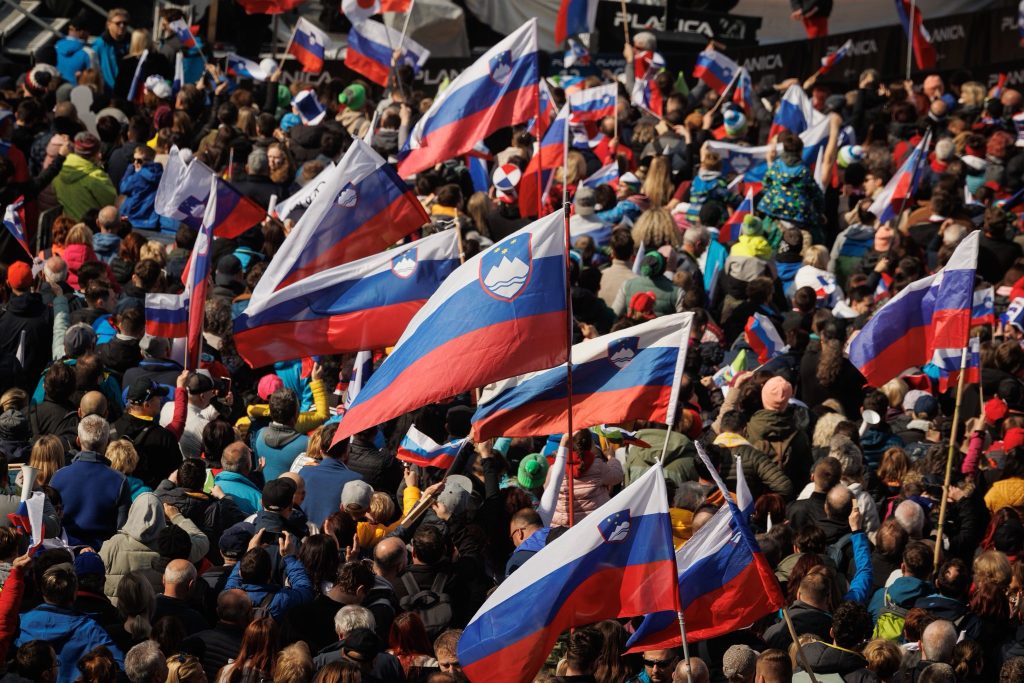
Slovenia’s parliamentary elections concluded with a narrow victory for incumbent Robert Golob and his liberal Freedom Movement party, in a race that highlighted deep political divisions in the EU member state.
Golob’s party secured 28.63 percent of the vote, translating to 29 seats in parliament, while the opposition Slovenian Democratic Party (SDS) led by Janez Janša followed closely with 27.95 percent and 28 seats. Neither party received the 46 seats required to secure a majority in the parliamentary chamber, meaning attention now turns to negotiations to form a governing coalition.
Seats were also won by the right-wing coalition of New Slovenia (NSi), the Slovenian People’s Party (SLS) and the Focus party with 9.29 percent, the Social Democrats (SD) and the Democrats with 6.70 percent each, the Left with 5.58 percent and the anti-system party Truth (Resnica) with 5.53 percent of the vote.
The candidates campaigned on sharply contrasting political platforms reflective of an ongoing divide in Slovenian politics between pro-EU liberals and right-wing populists. While Golob emphasized strengthening public services and maintaining alignment with EU priorities, Janša centered his campaign on tax cuts, reducing funding for welfare, and a tougher stance on migration.
These policy debates were overshadowed in the final stretch of the campaign by a political scandal involving leaked recordings that allegedly revealed prominent figures in the ruling party, including Golob, discussing misuse of state funds.
Janša called the recordings evidence of corruption among the Slovenian political elite. But findings made by Slovenian media and activists suggest the videos, allegedly leaked by the private Israeli intelligence firm Black Cube, may have been part of an influence operation aimed at undermining Golob. Golob and his allies have since framed the episode as an attempt by Janša to use foreign interference to sway the election.
Though the race was already tight, analysts say the controversy further polarized voters, turning the election into less of a contest between policy platforms than a vote to block the opposing camp. Voters were pushed toward the two leading parties, weakening support for smaller contenders, Janja Božič Marolt of Mediana told Delo.
As one analyst noted, the affair largely amplified existing political dynamics – namely an enduring fault line in Slovenian politics, as pro-European liberal parties and right-wing nationalist forces have long competed for influence.
Slovenia joined the European Union in 2004 after building a reputation in the early post-Yugoslav period as one of Central Europe’s most stable and outward-looking democracies. For much of the past two decades, Slovenian governments have supported European integration, NATO cooperation, and a model of governance tied closely to EU institutional norms.
At the same time, a nationalist current has remained a consistent feature of Slovenia’s political landscape, rooted in skepticism toward political elites, concerns about migration and border control, and debates over national identity, often framed around cultural cohesion.
Janša and the SDS are the dominant figures of this nationalist and center-right strand of Slovenian politics. The party maintains a consistently strong base of support, with Janša already having led three coalition governments.
This contest between liberal and right-wing forces mirrors a broader pattern across Europe, where pro-European political parties are increasingly racing against nationalist or right-wing challengers in recent elections. In this context, Slovenia’s election has been framed by onlookers as a test of whether liberal, pro-European politics can hold, or whether a right-wing pivot seen elsewhere in Europe is gaining ground in the country.
The election has also drawn attention as a potential indicator of whether illiberal governance trends observed in parts of Central and Eastern Europe could be taking shape in Slovenia.
Janša’s most recent stint as prime minister drew criticism from domestic watchdogs and EU officials alike for pursuing policies widely regarded as illiberal. During the COVID-19 pandemic, his government expanded executive authority – a move that prompted widespread public protests – and clashed with media institutions, including the Slovenian Press Agency and public broadcaster RTV Slovenija.
Janša has also cultivated close political ties with other illiberal leaders in the region, including Viktor Orbán and Aleksandar Vučić. In an interview with Politico, Golob said that Janša could serve as a key ally to Orbán within the EU, potentially helping Budapest resist collective pressure from other member states under mechanisms such as Article 7 of the bloc’s treaties, designed to discipline member states when their actions are deemed to be breaching core EU values such as democracy, rule of law, or human rights.
This backdrop underscores the broader significance of the election’s outcome, onlookers say. Slovenia “is not fated to democratic backsliding,” Slovenian writer Ana Schnabl wrote for the Guardian. “But the difference between now and Janša’s previous administrations is that the methods, narratives, and international alliances of illiberal politics are more consolidated than ever. There is precedent, validation and mutual reinforcement.”