The article was originally published on the BiEPAG Blog.
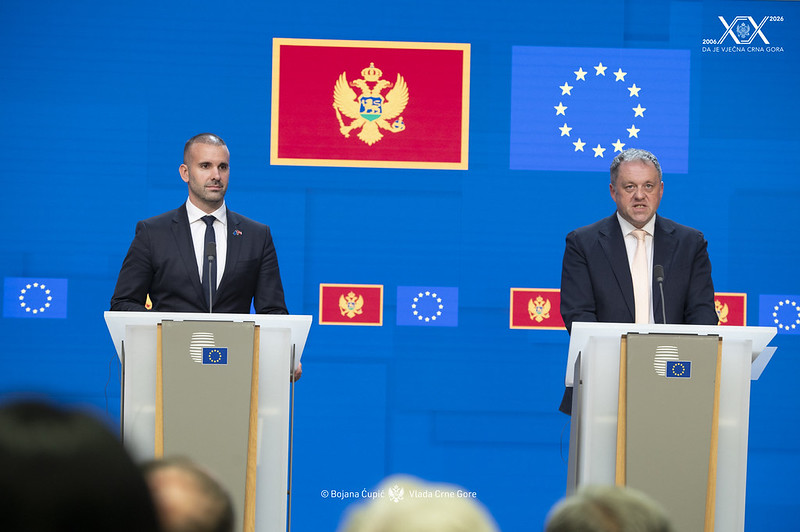
This year’s European Commission Report on Montenegro is defined by two political milestones. First, the Commission’s accompanying roadmap sets an unprecedented horizon: closing all remaining negotiating chapters by the end of 2026 and signing an Accession Treaty in June 2027. Second, there is the significant realization that this could very well be Montenegro’s final annual report, expected to be replaced next year by a post-treaty-signature monitoring mechanism. There is ample cause for satisfaction: Montenegro has firmly secured pole position in the enlargement race, boasting an overall progress score of 4.09 in 2026 and a readiness rating of 3.98 out of 5. Across the chapters, progress shines: very good progress was achieved in 9 chapters, good progress was registered in 18 chapters, including the crucial rule-of-law areas, while 6 chapters recorded some progress. In the final phase of European integration, with membership finally in sight, a rating of ‘four’ takes on the brilliance of a ‘five’ thanks to a strong political tailwind from Brussels. Yet beneath these macro-metrics lies a far more demanding reality, as the transition from technical completion to political ratification will be closely monitored to ensure durable reform.
A candid assessment of Chapter 23 (Judiciary and Fundamental Rights) highlights the persistent gap between adopting EU legislative frameworks and ensuring their effective enforcement. While statutory alignment is largely complete and the Special State Prosecutor’s Office (SDT) has demonstrated commendable proactivity in initiating high-profile investigations, the broader judicial architecture remains bogged down by systemic inefficiencies. Court proceedings suffer from severe backlogs and chronic delays, leading to a frustrating absence of final, enforceable convictions in high-level corruption cases. This track record deficit continues to draw sharp scrutiny from skeptical Member States. Compounding these structural friction points is a continuous stream of public criticism from political figures targeting prosecutorial decisions, alongside persistent understaffing in specialized judicial and investigative bodies.
Beyond the judiciary, public administration and sector-specific readiness pose additional hurdles that cannot be overlooked. In media governance, despite the adoption of modernized legislation guaranteeing a stable budget allocation of 1.34 percent of the state budget for the national broadcaster RTCG, concerns about merit-based governance and institutional instability remain pressing. Furthermore, five negotiating chapters, most notably Chapter 27 on the environment, continue to lag, with readiness scores between 3.0 and 3.5. Building progress within these complex chapters will require substantial financial resources, administrative capacity building, and sustained political capital before full membership can be realistically contemplated.
With all final (negotiating) positions submitted as of October 2026, the roadmap and Commissioner Kos’s statement confirms that technical conditions across chapters are being met. However, this technical completion marks a decisive shift in the center of gravity: the primary battleground is moving from the technocratic halls of Brussels to the political arenas of member state capitals. Technical compliance alone will not guarantee smooth passage through national parliaments or referenda, where bilateral disputes and domestic political imperatives frequently eclipse enlargement policy. One need look no further than Croatia’s hold on Chapter 31 (Foreign, Security and Defence Policy) in late 2024 to understand how vulnerable the final stretch is to single-member blockades, a dynamic that will demand sharp, proactive diplomatic maneuvering as Chapter 31 comes up for closure this December.
To reassure skeptical member states against post-accession backsliding, the EC’s Pre-Enlargement Policy Review advocates for enhanced monitoring and a sweeping institutional safeguard that could linger for up to fifteen years post-accession. However, proposals that open the door to suspending Council voting rights or keeping incoming members under multi-decade probation risk establishing an unacceptable two-tier Union that fundamentally undermines the principle of institutional equality. Applying lower procedural thresholds for political disenfranchisement to new members than those required for existing Member States under Article 7 TEU creates a hazardous legal double standard. Montenegro must actively fight for an Accession Treaty that preserves full institutional and political equality.
By pairing rigorous domestic performance with a sophisticated, time-limited safeguard framework in Primary Law, anchored in strict sunset clauses and objective indicators, Montenegro can offer member states ironclad assurances of treaty integrity while protecting its equal standing. All in all, while there is immense cause for pride and satisfaction in reaching this historic threshold, an enormous amount of hard work lies ahead for everyone to turn the final lap into full, uncompromised EU membership.