The surprise August 1 arrests of former Serbian state officials, suspected of corruption, have so far raised more questions than answers. The public, sceptical about the possibility of an independent investigation into high-ranking members of the ruling party, is divided over whether this represents a genuine turning point.
The officials were arrested on charges of abuse of office and are suspected of damaging the budget of Serbia by at least 115 million US dollars related to the project of the reconstruction of the Hungarian-Serbian railway line.
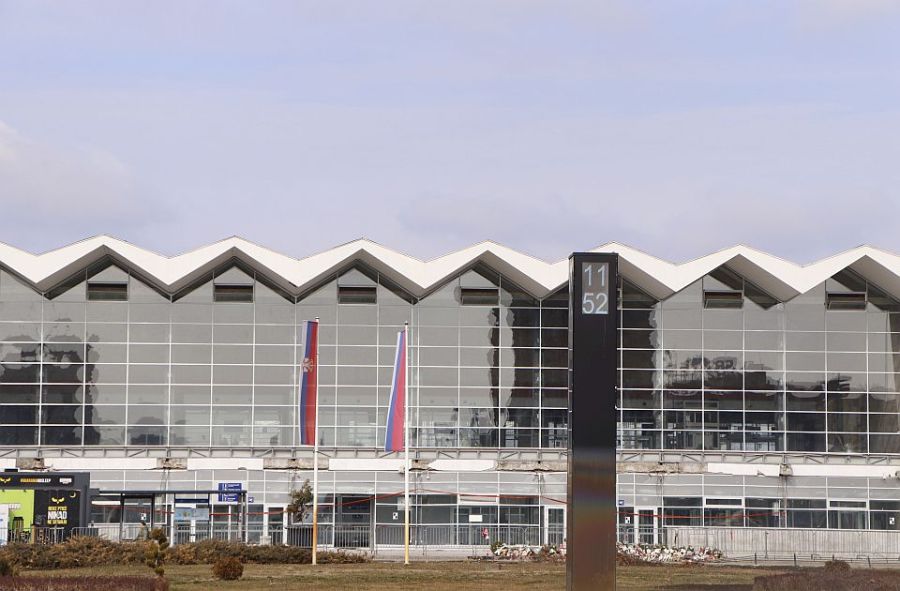
A part of the project in question involved the reconstruction of the main railway station in the city of Novi Sad. Less than four months after it had been open to the public, its canopy collapsed on 1 November 2024, resulting in the deaths of 16 people.
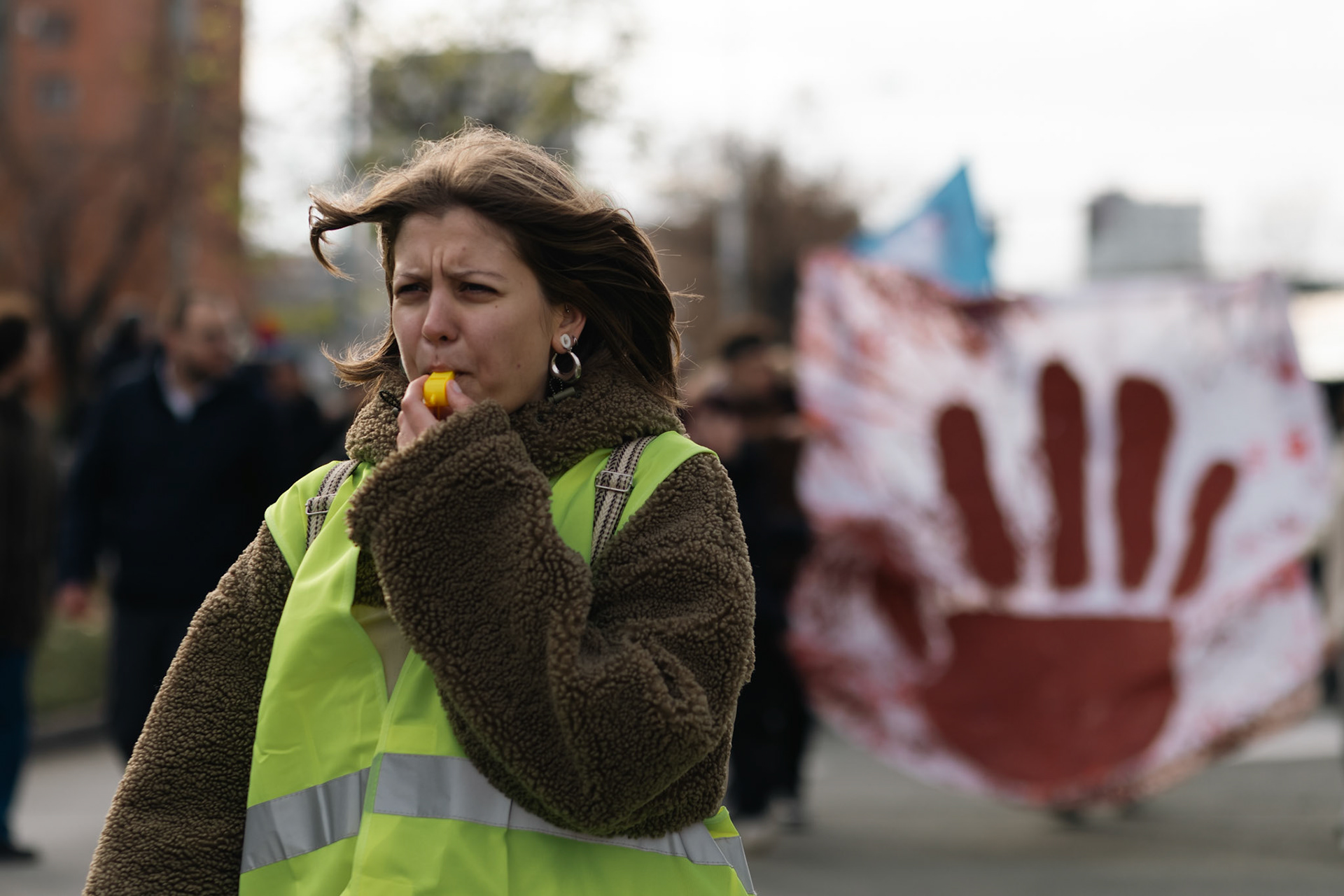
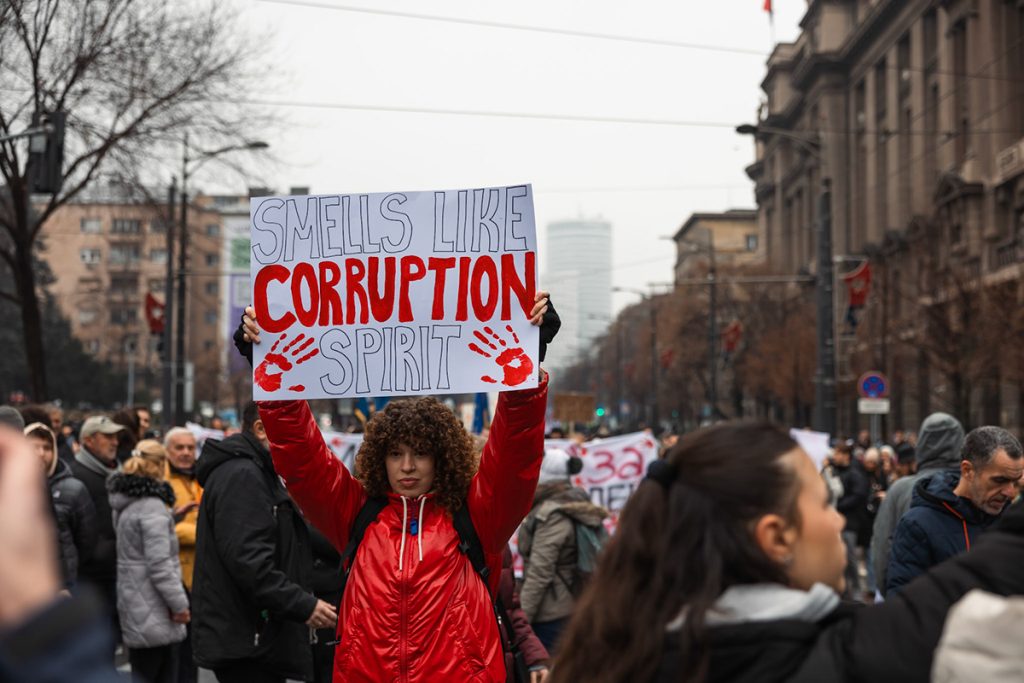
The tragedy incited massive anti-government protests and led to the formation of a student movement demanding justice and accountability.
Corruption suspected from the start
For years, there have been widespread claims that the major construction projects in Serbia are a source of corruption. The reconstruction of the railway was carried out without public competition by a Chinese consortium which hired local subcontractors close to the ruling party.
The price of the reconstruction of the Novi Sad station, 16 million EUR, has been described as potentially inflated by several experts. Now the prosecution claims that the entire railway project was potentially overpriced.
Following the tragedy, the spotlight also turned to the quality of works and their potential disregard for political expediency. The documentation released afterwards indicated that President Vučić’s office was involved in coordinating the project without authorisation, allegedly pushing for shorter deadlines.
Another fuel to the protests was the high level of scepticism that the judiciary would be able to hold members of the ruling party to account. There have been no convictions for high-level corruption under the Serbian Progressive Party (SNS), which came to power in 2012.
This was the environment in which the decision on 1 August was announced.
Lack of judicial results so far
Following the tragedy, the Higher Public Prosecutor’s Office in Novi Sad filed indictments against 13 individuals for a serious offence against public safety. These indictments have still not been confirmed by the court.
The investigation of the Novi Sad prosecution focused on the immediate causes of the canopy collapse, and not the wider picture of the financial flows in the project of the reconstruction of the Serbian-Hungarian railway. This part of the investigation was taken over by the Prosecutor’s Office for Organised Crime (TOK) in February.
It appears now that TOK has made progress with the investigation, issuing arrest warrants for 11 people, including former minister Momirović and his successor Goran Vesić, who is currently hospitalised.
Arguments for caution
Immediately after the arrests were announced, the doubts about their genuine character began to rise.
Sceptics pointed out that Mladen Nenadić, chief public prosecutor for organised crime who ordered the arrests, was appointed in 2016, during the rule of SNS, and that he failed to act on many previous occasions where serious allegations were made against the ruling party.
Another reason for caution was the habit of the ruling party to feign accountability when it suits them.
Earlier this year, President Vučić launched, as he put it, a major anti-corruption campaign. Analysts interpreted this as a response to the growing concern of the population about corruption, following the Novi Sad tragedy.
During the campaign, which lasted for several weeks, some public officials were arrested over relatively low amounts of money, but most of them were subsequently released. European Commission emphasised, in its July rule of law report on Serbia, that there are still challenges in establishing a track record in fight against corruption.
A genuine investigation?
Nevertheless, the reactions of the ruling party to the arrests of 1 August were quite different to the promotion of the fight against corruption earlier this year, suggesting that something more serious might be happening.
In fact, Informer television, a mouthpiece of SNS, accused the prosecution of carrying out a “coup”. Pro-government tabloids vilified Public Prosecutor Nenadić, claiming that the end goal is the arrest of President Vučić himself. In the weeks prior to the arrests, pro-government media had already started vilifying Nenadić.
An apparently increasing rift between the ruling party and the Supreme Public Prosecutor, Zagorka Dolovac, also became visible in recent months.
Dolovac, who has held this position since 2009, had her term renewed twice by SNS and was seen as an ally of the regime, allegedly preventing investigations into various scandals surrounding its members.
However, it was Dolovac who ordered TOK to start investigating potential corruption in the railway project in February.
Public attacks against Dolovac have since mounted in the pro-SNS media. The SNS members hinted on multiple occasions that they are planning an overhaul of the judiciary.
Media close to the ruling party are also claiming that Dolovac and Nenadić were colluding with the European Union, whose institutions are allegedly pushing for an investigation targeting Chinese companies in Serbia.
The reactions of the ruling party to the arrests, as well as the recent rift between SNS and parts of the judiciary, could indicate that there is more to this case than purely political theatre. Things may become clearer in the coming weeks.
This article was published as part of the project “Civil society for good governance and anti-corruption in southeast Europe: Capacity building for monitoring, advocacy and awareness-raising (SELDI)” funded by the European Union.