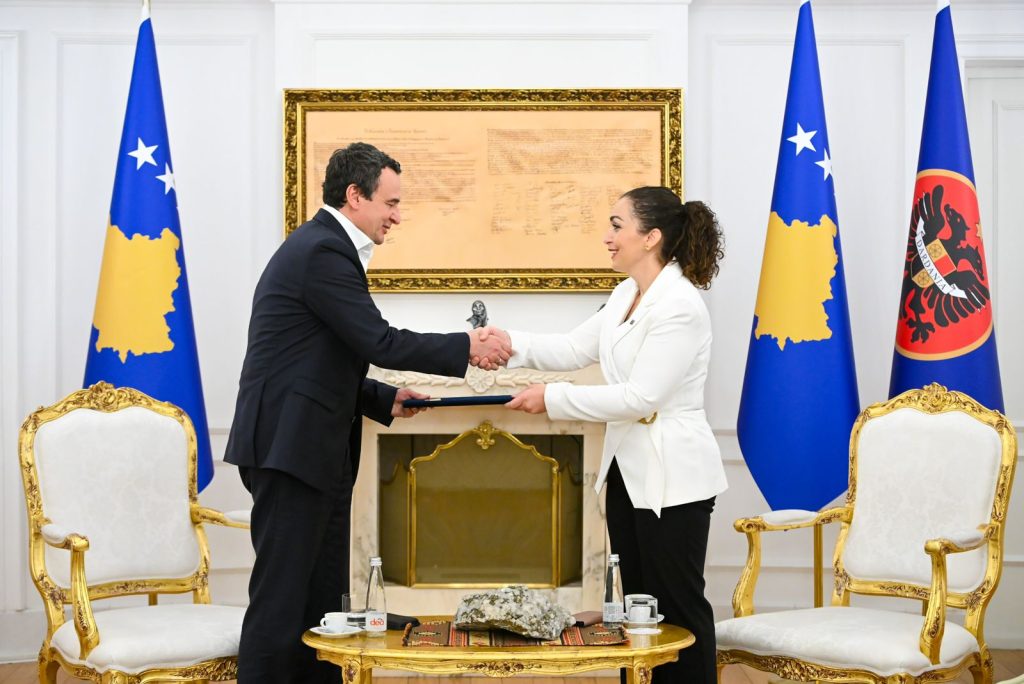
PRISTINA – This week, Kosovo’s Prime Minister Albin Kurti began a series of meetings with opposition party leaders to discuss the process of electing a new president, in an effort to avoid a new institutional crisis and the possibility of early elections, according to media outlets in Pristina. The Constitution of Kosovo states that a new president must be elected no later than 30 days before the end of the current president’s term, i.e. by 5 March, since the term of office of the incumbent President Vjosa Osmani ends on 4 April.
The president is elected by secret ballot in the Assembly of Kosovo. Election requires a two-thirds majority of all 120 MPs (80 votes).
Provided that no candidate obtains the required majority in the first two rounds of voting, a third round is held between the two candidates who received the highest number of votes in the second round. In this round, the candidate who receives a majority of the votes of the MPs present is elected. If the president is not elected even in the third round, the Assembly is dissolved, and new elections are called, which must be held within 45 days.
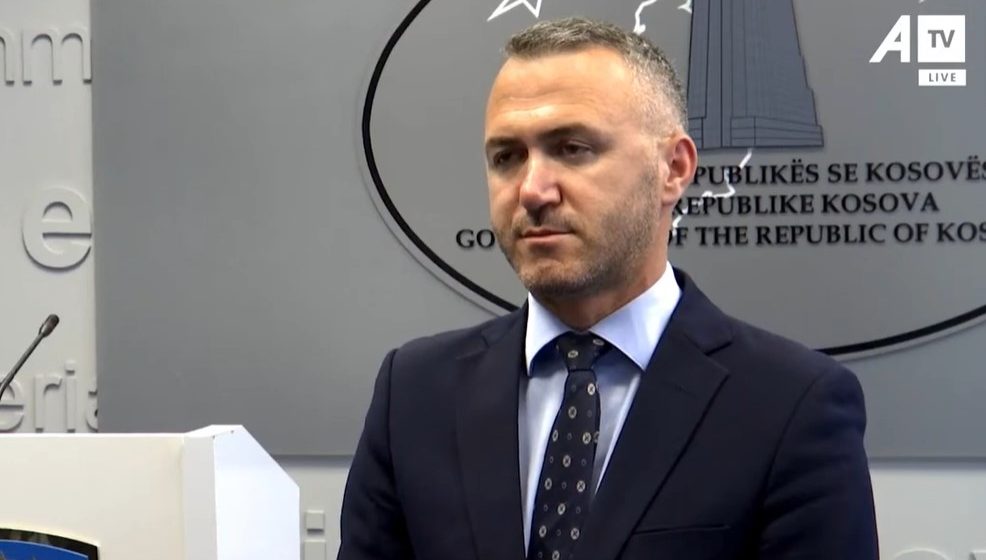
On 23 February, after meeting with the leader of the Democratic League of Kosovo, Lumir Abdixhiku, Albin Kurti stated that he currently did not have a specific name for the post of president.
Asked whether Vjosa Osmani could be nominated again, he did not give a definitive answer, emphasising the lack of sufficient votes to guarantee the election, Reporteri writes.
“We have not collected signatures for anyone, because even in the best-case scenario, we can reach 66 votes, but not 80. We can nominate a candidate, but 66 is very far from 80. It would be harmful to nominate a candidate while we are stuck with this number”, Kurti stressed.
On 26 February, Ramush Haradinaj, a leader of the Alliance for the Future of Kosovo, criticized Kurti, claiming that “the presidential election process is being used as a tool to lead the country towards new elections”.
“Everything he has taken from Vjosa, he is not investing in Vjosa at all… And I have told the President not to collect signatures at all, because it will only delay, humiliate, and weigh her down… Kurti has no political mercy towards anyone, because he wants complete control”, Haradinaj remarked, Gazeta Express reported.
At the same time, Haradinaj denied the claims by some media outlets that he would run for president.
Commenting on the current uncertainty regarding the election of a new president, Donika Emini, a Research Fellow at the University of Graz, and a member of the Balkans in Europe Policy Advisory Group (BiEPAG), says for EWB that she expects “continued tactical manoeuvring rather than a quick resolution”.
“The governing party (VV) appears comfortable prolonging ambiguity around the presidential question, preserving flexibility until the last possible moment. This allows it to test the political waters, measure internal dynamics, and assess the cost-benefit of endorsing Vjosa Osmani or advancing an alternative. As for Vjosa Osmani’s re-election, it is far from guaranteed. In Kosovo, a candidate for president must first secure 30 signatures from members of parliament to be formally proposed, and then the election requires a quorum of 80 votes in the 120-seat parliament”, Emini clarifies.
She adds that “these procedural requirements mean that even a well-known and internationally visible figure like Osmani is not automatically assured a candidacy for a second mandate; the process is highly dependent on political calculations and parliamentary alliances”.
“The core issue is whether the ruling party, Vetëvendosje, is willing to back a politically active, internationally visible president for a second term or prefers a more politically aligned figure. The opposition, however, is not in a strong position either. Despite occasional criticism of the current presidency, it has not demonstrated unity around a credible alternative candidate, nor articulated a coherent vision for the role. In a fragmented opposition landscape, the numbers alone make it difficult to advance a candidate without cross-party coordination, weakening its leverage in negotiations”, Emini remarks.
According to Donika Emini, “excluding Osmani carries political risks”.
“If she is not re-elected, she would remain a significant political actor with established international credibility, potentially reshaping opposition dynamics in a context where leadership remains fluid. Her presence outside the presidency could energize the opposition and introduce new balances in Kosovo’s political scene”, Emini concludes.