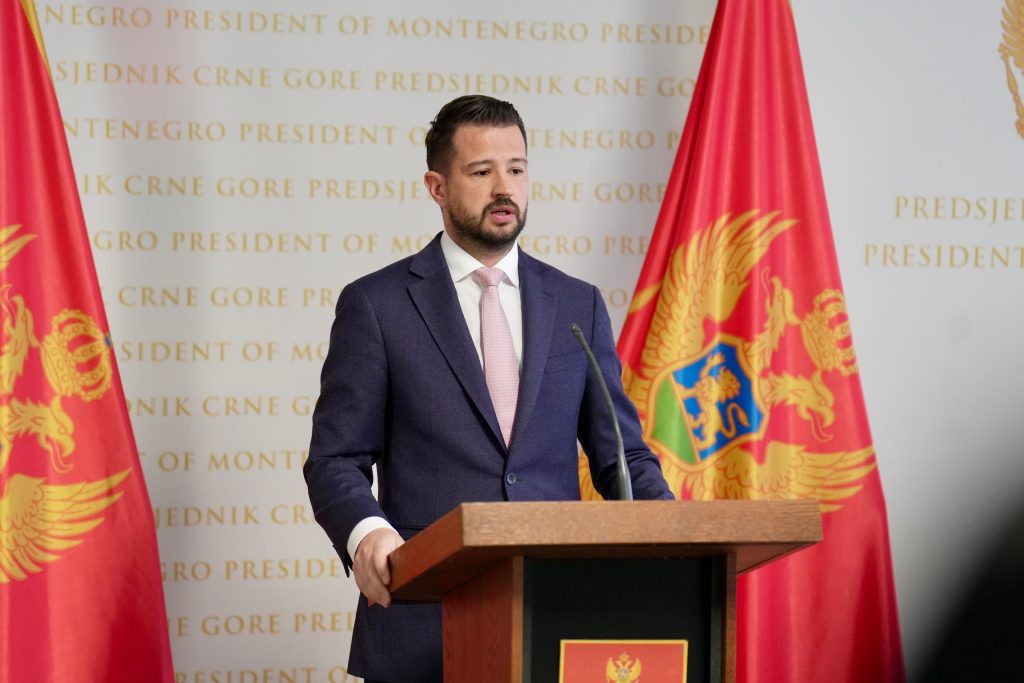
PODGORICA – President of Montenegro Jakov Milatović has returned the Law on Amendments to the Law on Internal Affairs to parliament for reconsideration, after it was adopted by the Montenegrin Assembly on 6 March.
“I stress that I fully understand and strongly support the need for this law to establish the normative framework for improving the personnel structure of the police system. I also support efforts aimed at decisively ‘cleaning’ the service of individuals whose actions undermine the integrity of the police profession and obstruct the fight against crime,” Milatović said.
He assessed that the fight for a professional and honorable police force is the most important prerequisite for the effective functioning of the police service, as well as a foundation for the stability of the state as a whole.
“The fact that, during the previous regime, parts of the security sector became criminalized further obliges us to carefully choose the legal mechanisms for improving the system, while respecting Montenegro’s Constitution and the democratic standards that apply in EU member states,” Milatović said in an explanation sent to parliament.
He concluded that, after reviewing the content of the adopted law and considering numerous objections raised by the European Commission, the Montenegrin Lawyers’ Association and relevant civil society organizations (MANS, the Institute Alternative, and others), it was his duty to point out the problematic nature of certain provisions.
On 6 March, the Montenegrin parliament adopted two laws, which were criticised by the opposition and civil society.
According to Vijesti, the adoption of the laws means that the National Security Agency (ANB) will no longer need the police as an intermediary when collecting intelligence information.
In the Law on Internal Affairs, a controversial provision allows employment in the police without a public competition in certain situations, which some individuals interpreted as creating room for party-based hiring.
The Ministry of Interior will also be given greater authority to decide on “security obstacles” for working in the police without disciplinary proceedings, which Vijesti describes as a provision that probably caused the most criticism.
In its statement from 26 February, the Government of Montenegro announced that changes to the laws are being made after consultation with the European Commission, for the purposes of the implementation of the EU Directive relating to GDPR, i.e. the protection of personal data.
“The amendments fully enable the alignment of the aforementioned legal solutions with the GDPR as an obligation in the part of closing negotiation chapters, in accordance with the request of the European Commission”, the Government said.
Speaking in the parliament last week, the Minister of Interior Danilo Šaranović made similar arguments, adding that there was no intention to create a “police state”, as some critics were claiming, RTCG reported.
However, the opposition remained highly critical of the laws and one of the members of the ruling party, Europe Now Movement (PES), Miodrag Laković, resigned from his party membership due to the adoption of the laws.