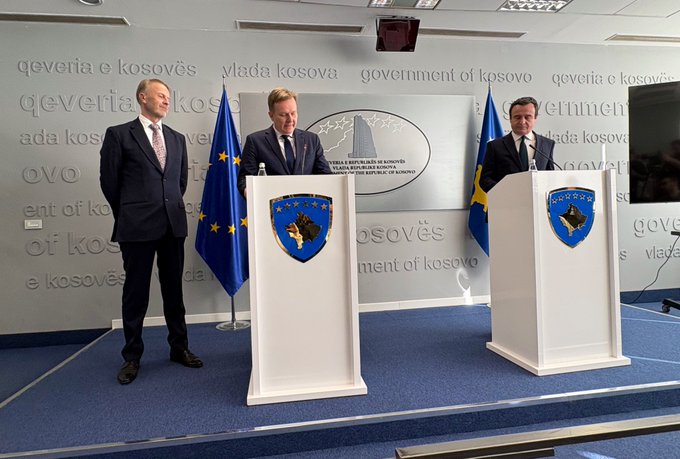
PRISTINA – After the EU’s special envoy for the Belgrade-Pristina dialogue, Peter Sørensen, called on the Kosovo government to grant residence permits to education workers and students for an initial period of 12 months, the implementation of the Law on Foreigners in Kosovo has begun. The measure is intended to prevent disruptions to health care and education services.
On 14 March, Sørensen said that mayors of municipalities with a Serb majority will submit lists of health care and academic staff working in Kosovo to the Kosovo government, after which the Kosovo Ministry of Internal Affairs will issue them temporary permits.
At the start of his address, Sørensen first referred to his meeting with Kosovo Prime Minister Albin Kurti, describing it as “good.” He also welcomed what he described as Kosovo’s gradual approach to implementing the Law on Foreigners and the Law on Vehicles, which was criticised by the Serbian government.
He added that the plans of the Kosovo government to integrate Serbian-run services and institutions into Kosovo’s legal system had also been taken into account.
“We take note of the plans of the Government of Kosovo to integrate services, law enforcement, and health and education institutions into the Kosovo system in order to fully align them with previous agreements reached in the dialogue and with other agreements and obligations toward the European Union. We also acknowledge the commitment of our final group to implement the aforementioned laws while ensuring the uninterrupted provision of public services within the system. This is a comprehensive and verified process within all relevant agreements reached through the EU-facilitated dialogue and other EU agreements,” Sørensen said.
However, he emphasised that consultations with representatives of the Serbian community, as well as close cooperation with the EU, must take place throughout the entire process.
He then referred to the Law on Foreigners, which entered into force on 15 March, but with additional measures.
“We considered it a key priority for the Government of Kosovo to provide residence permits for workers and students for an initial period of 12 months in order to prevent any disruption of health care and education services. To ensure continuity of services, we have asked Kosovo to allow the use of identity cards issued by Serbia, at least until 15 March 2026, for those living in Kosovo, as a means of identification in administrative procedures,” Sørensen said.
Alongside the issuance of residence permits, Kosovo authorities should also register all persons who meet the legal requirements in the central civil registry, Sørensen noted, so that their data can be officially recorded in accordance with Kosovo law.
He added that the Kosovo government will offer 12-month residence permits to Serbian students and workers.
Sørensen explained that mayors of Serb-majority municipalities will provide the Kosovo government with lists of health care and academic staff working in Kosovo, after which the Kosovo Ministry of Internal Affairs will issue them temporary permits.
Prime Minister of Kosovo Albin Kurti stressed that it is not in Kosovo’s interest for the implementation of the law to disrupt the provision of services, but added that Kosovo’s position remains that “there can be no illegal mechanisms in Kosovo.”
“The government will receive lists from local leaders of health and academic staff providing these services. The lists will serve as the basis for issuing temporary residence permits to foreign nationals who apply to the Ministry of Internal Affairs. The same applies to foreign students residing in Kosovo, for whom municipal leaders will submit a complete list. The Ministry of Internal Affairs will issue these students temporary residence permits for 12 months, with the possibility of extension,” he said.
Kurti also added that Serbian citizens will have three months to register their civil status.
“The government will also open a new three-month deadline to allow Serbian citizens to register civil records that, until March 15, 2026, were recorded by illegal structures. During that period, applicants will be allowed to use identity cards issued by illegal structures as a means of identification.”