Lawmakers in Washington are raising concerns over reports that the Trump administration is considering scaling back US forces in Kosovo.
In a letter to US Secretary of State Marco Rubio, bipartisan legislators serving on key foreign policy committees – including senior figures in US foreign affairs such as Jeanne Shaheen and Gregory W. Meeks – urge Rubio to maintain the current US troop levels in the Kosovo Force (KFOR). “A premature reduction of the US presence risks destabilizing not only Kosovo, but the broader region, especially Bosnia and Herzegovina,” the letter says.
NATO officials say no changes to the KFOR mission are currently under consideration. Even so, analysts tell European Western Balkans that the episode underscores a shift in the US foreign policy posture toward Balkans, one that is departing from a decades-long precedent of multilateral Euro-Atlantic cooperation and unilaterally pursuing US strategic interests.
A shift in Washington’s security priorities
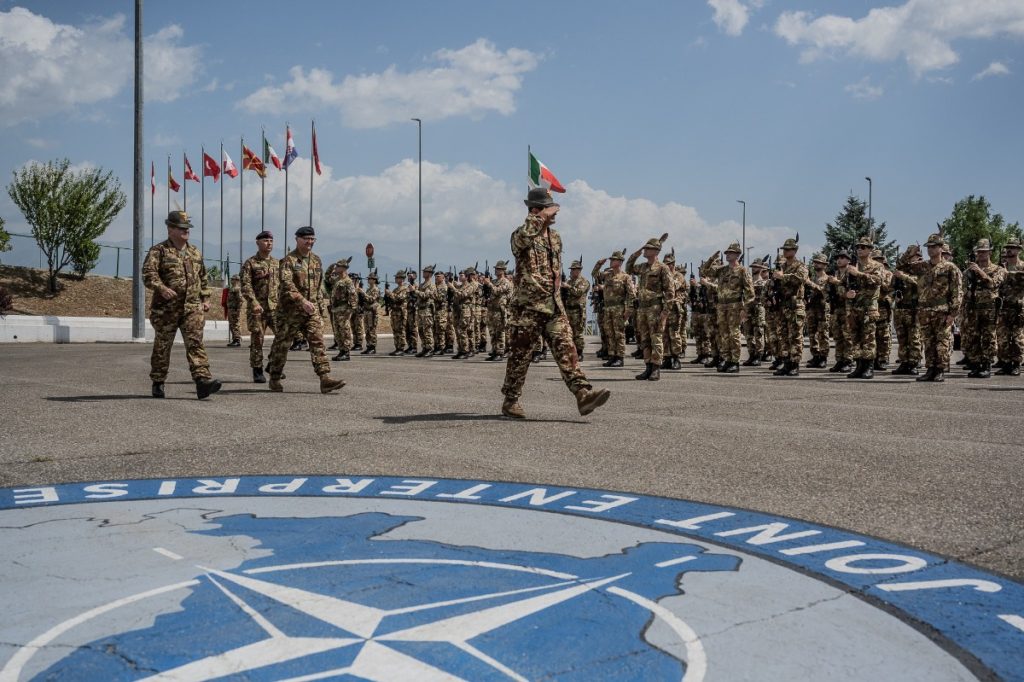
KFOR has been present in Kosovo since 1999, when it was established under the mandate of UN Security Council Resolution 1244 following the end of the Kosovo War. The multinational mission was tasked with maintaining a secure environment and preventing renewed conflict in the province, and operates under that same mandate today.
American troops make up approximately 10 percent of KFOR – between 500 and 600 of the estimated 5,000 troops in the force. But the US wields disproportionate influence given its political weight in the region, says Engjellushe Morina, a senior policy fellow at the European Council on Foreign Relations and analyst of Kosovo-Serbia relations.
“In Kosovo, the US is seen as the main supporter of independence and security,” Morina says for EWB. “KFOR is the US, if you ask many Kosovars.”
Talk of reducing this presence reflects a shift in Washington’s security priorities, with Europe’s role expected to grow as the US focuses on other regions it deems vital to its national security, says Gëzim Visoka, associate dean for research at Dublin City University.
“As the Balkans enjoyed a sustained period of stability over the past two decades and gradually integrated into Euro-Atlantic structures, the US has shifted its attention to other conflict hotspots and immediate concerns,” he says for EWB.
Edward Newman, a professor of international security at the University of Leeds, adds that shifting geopolitical dynamics could prompt a reassessment of military deployments and foreign aid, meaning “engagement in Kosovo is going to be reassessed and perhaps reduced.”
Reducing the US’s military presence in Kosovo would not be a departure from past policy. Washington has been gradually disengaging from Kosovo since the end of the Yugoslav wars, with the US and Brussels aligned on the expectation that the US would reduce its commitments as the security situation stabilized and EU countries assumed a larger role in stabilizing their European neighborhood. This trajectory is reflected in KFOR’s troop levels over the years: the force has been steadily reduced from roughly 50,000 troops at the start of the mission to the 5,000 on the ground today.
In this context, proposing a further reduction of troops is not unusual, experts say. What stands out is that the proposal is coming from an administration increasingly operating outside the multilateral frameworks that have historically guided Euro-Atlantic cooperation on missions like KFOR.
Trump dissatisfied with NATO allies
Before Trump, US administrations worked in coordination with European allies to resolve open issues in the Balkans, says for EWB Vesko Garčević, a former Montenegrin ambassador to NATO.
Visoka points to the KFOR mission as an example, as it was a “successful peacekeeping operation where NATO, the UN, and the EU have collaborated closely to maintain peace and security in Kosovo.” The US presence in the force, he says, has signaled support for alliance politics within a multilateral framework.
This has changed under Trump, according to Garčević, as the US now shows little inclination to act in concert with the EU, preferring to instead pursue its strategic interests unilaterally. That is evident in the case of the proposed drawdown of KFOR, in which the US is doing more than signaling a desire for European allies to take on a greater security role, a longstanding expectation in the region. “It’s about the fact that the US and EU do not work in synergy anymore, as has been the case so far”, Garčević says.
Kurt Bassuener of the Democratization Policy Council echoes that Trump’s shift away to multilateralism informs how the proposed KFOR drawdown can be read. He points to recent remarks by Trump in which the president suggested the US might reconsider its participation in NATO, after alliance members refused to aid the US in its war with Iran.
Talk of a drawdown, Bassuener says for EWB, appears to be more than just a signal for Europe to take on a larger role in securing Europe. “In this context, it may very well be used as a venue to signal displeasure with European allies over things that have nothing to do with the Balkans or Europe,” he says.
While the US may be engaging less in the arena of multilateral diplomacy, Morina says the Trump administration and family appear to be pursuing deeper engagement in business opportunities in the Balkans. US companies plan to lead the construction of a gas pipeline connecting Bosnia to Croatia, and Jared Kushner recently received approval to develop a luxury resort in Albania.
These business pursuits highlight a transactional approach to the Balkans, with US interests in the region being more economic than political or ideological, Garčević says. “A project that will involve direct economic interest improves your chances to work with this administration and to be seen as a preferable partner in the Balkans,” he says.
Whether or not any changes are made to KFOR, the contours of a changing US foreign policy toward the Balkans, one that operates outside familiar frameworks of multilateral cooperation, are taking shape. Europe is left to interpret the signals and decide how it is prepared to respond.
“The bottom line is,” Bassuener says, “Europe needs to be prepared to protect its own interests and values in this area that it claims to want to adopt.”