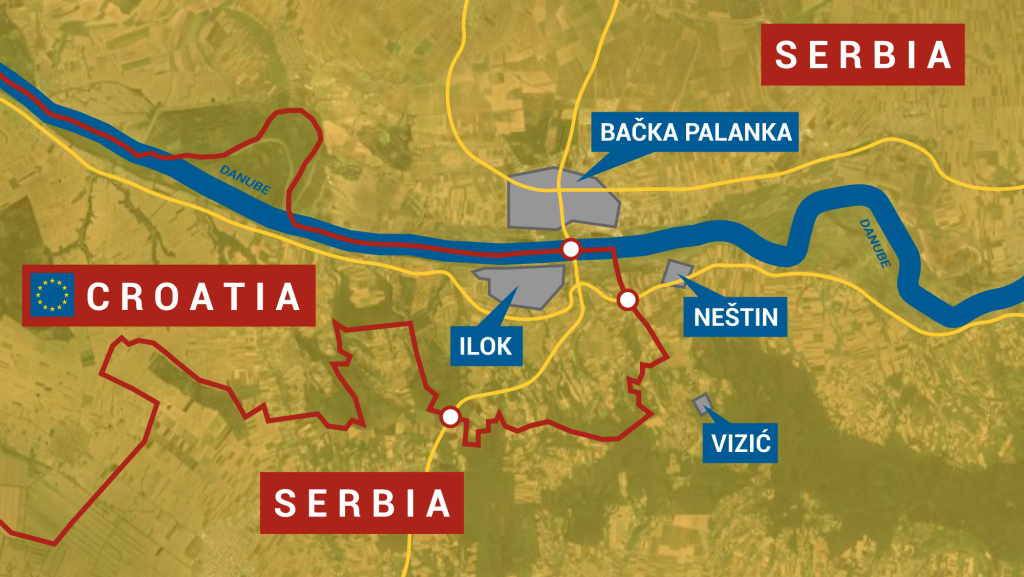
While Serbia’s political elite and public debate have focused for weeks on the impact of the European system for registering entry and exit into the Schengen zone (EES) on business activities, those most affected in everyday life remain overlooked. The villages of Neštin and Vizić in Serbian Bačka Palanka municipality are a prime example.
The small Srem villages, nestled between Fruška Gora and the Danube, belong administratively to Bačka Palanka on the opposite side of the river. Between them lies not only the Danube but also Croatian territory, clearly visible on maps of Vojvodina.
For decades, residents have crossed another country’s territory daily to reach schools, doctors, or other public institutions. The shortest route leads via the Bačka Palanka–Ilok border crossing, a 9-kilometer trip from Vizić and 13 kilometers from Neštin.
Before the introduction of the EES system, life in these villages flowed without major obstacles, a local resident tells Savremena politika. Villagers crossed Croatian border daily through quickly filling passport stamps often forced many to renew their documents ahead of schedule.
The situation changed after Croatia joined Schengen Area in 2023, and became even more complicated with the implementation of the European Entry/Exit System (EES). The system digitally logs every entry and exit of third-country nationals into the Schengen zone, strictly applying the rule of a 90-day stay within 180 days.
Even though residents of Neštin and Vizić pass through Croatian territory only in transit, and usually for just a few minutes, each crossing is formally counted as a one-day entry into the Schengen zone. This means locals quickly reach the permitted limit, despite never actually staying in Croatia or other Schengen country.
“We travel a few kilometers just reach our own side. Now, if each passage counts as entering Schengen, we’ll have to start counting how many times we go into town”, says a Bačka Palanka resident.
According to municipal data, Vizić is home to 240 residents, while Neštin has 613. Most commute daily to Bačka Palanka, on the other side of Danube river.
“Residents of these villages are mostly employed in Bačka Palanka. All administrative, healthcare, and other needs are handled there, and older elementary and high school students attend school in the town”, Bačka Palanka authorities explain.
Eight elementary school students travel from Neštin to Bačka Palanka, and five from Vizić. A total of 24 students from both villages attend high schools in town.
The new Schengen rules have prompted consideration of alternative routs. One possible route, according to a local, would take residents via Banoštor on the Srem side of the Danube, then across the river by ferry to Begeč on the Bačka side, before continuing to Bačka Palanka.
However, this detour significantly lengthens travel: a journey of 9 kilometers from Vizić – or 13 from Neštin, becomes 36 to 42 kilometers with the ferry crossing dependent on weather, water levels, and traffic schedules.
The long-promised bridge as a solution
The Bačka Palanka municipality has repeatedly highlighted the challenges faced by residents of these two settlements over the past decade.
Plans for a new bridge over the Danube near Bačka Palanka have existed for years, frequently cited as a permanent solution. Various governments in Belgrade have announced the project, but never set concrete start dates.
In late December of last year, a contract for the bridge’s construction was signed in Belgrade with the Spanish company Centunion.
Construction Minister Aleksandra Sofronijević emphasized that the bridge will be of major importance for all of Vojvodina, improving quality of life on both sides of the river.
The 2026 Serbian state budget lists the bridge as a priority investment, allocating roughly 15 billion dinars for the project. The planned bridge will span over 1,857 meters, with construction expected to take four years.
Until then, daily life in Neštin and Vizić depends on a border crossing that is simultaneously an international checkpoint and a local road.
Selaković: Bačka Palanka a symptom of poor planning
Bojana Selaković, coordinator of the National Convention on the EU (NKEU), says Bačka Palanka is not a technical incident but a political consequence of years of stagnation in European integration.
“When the negotiation process stalls, when integration is used rhetorically rather than as a real reform process, citizens end up suffering because of predictable European rules. For the same reason, Serbian farmers still cannot export milk, eggs, and poultry, and blame the EU for their problems. Bačka Palanka is a symptom of this,” she explains.
According to Selaković, the introduction of the EES system is not an unforeseen crisis, but reflects inadequate planning and a lack of political will to anticipate problems.
“The EU will not change its systems for two Serbian villages, but the candidate state has an obligation to negotiate and ensure its citizens are protected. Local arrangements and infrastructure solutions should be in place before a system starts harming residents. This is possible for the villages of Bačka Palanka,” she says.
She recalls a similar situation in which authorities in Belgrade and Pristina “forgot” about 18,000 Serbs holding passports from the Coordination Administration of Serbia, who could not use the visa-free regime when Serbia received it in 2009 or when Kosovo joined in early 2024.
“The National Convention on the EU was the only body strongly advocating for their inclusion, facing pushback from some Kosovo officials. Efforts only succeeded at the end of 2024, thanks to strong support from certain Members of the European Parliament, especially Slovenian Matijaž Nemec,” Selaković adds.
She notes that Serbia has not opened new negotiation clusters for years due to a lack of progress in Chapters 23 and 24, while political alignment with the EU’s common foreign and security policy remains partial.
“And yet, high levels of trust and flexibility are expected on technical, sensitive issues. Credibility in Brussels is not built through conferences or communication with a narrow circle of lobbyists. The EU is a complex decision-making system, combining technical requirements from the European Commission with the political will of 27 states. Trust in such a system can only be built through reforms, consistency, and adherence to the rules you aim to implement,” Selaković concludes.
The article was originally published in Serbian on Savremena politika.