In the latest snap election in Kosovo, held on 7 June, Vetëvendosje Movement (VV), led by Albin Kurti, won the most votes. However, the party received significantly lower support than in previous vote (42.91%, in comparison to 51.1% in December 2025), which implies that it failed to secure the absolute majority in the parliament and remains far from the two-thirds majority necessary to elect a new President of Kosovo.
According to the preliminary results, the opposition Democratic Party of Kosovo (PDK) won 21.12% of the vote, while the Democratic League of Kosovo (LDK) was backed by 17.58% of the voters, and the Alliance for the Future of Kosovo (AAK) secured 7.16% of the vote. Finally, the Serb List, loyal to the government in Belgrade, was backed by 6.18% of the voters.
Voter turnout was considerably lower than in the parliamentary elections held on 28 December last year – only about 36.8%, in comparison to 45%.
Kosovo went to the polls for the third time in a short period due to a prolonged political blockade and parliament’s inability to elect a new president by a constitutional two-thirds majority (81 MPs) after Vjosa Osmani’s term expired in April.
Since 61 MPs are needed to form a government, analysts point out that Albin Kurti and VV are forced to form a coalition with one of the major Albanian opposition parties in order to avoid a new snap election.
“The results confirm that Vetëvendosje remains the strongest force, but without a majority to govern alone. Losing nearly ten seats from its previous historic result is a significant setback, and the decline in turnout adds another layer of concern. Voters are not simply switching allegiances – many are withdrawing from the process altogether, which signals a deeper disappointment with politics beyond any single party or election cycle”, says Donika Emini, a research fellow at the University of Graz.
According to Aleksandar Šljuka, a researcher at Mitrovica-based “New Social Initiative”, even though VV has not won enough seats to form a government on its own, it is still not completely certain that it will not be able to secure a parliamentary majority.
“It is necessary to wait for the final results to be declared, including the counting of votes from the diaspora and conditional votes, after which the final distribution of mandates will be known. It is not excluded that Vetëvendosje will win another mandate, which would make it easier for them to try to form a government with the support of certain MPs from the ranks of non-majority communities. Such a scenario is not the most likely, but it is still theoretically possible”, Šljuka clarifies.
“Coalition options exist on paper, but each carries substantial political costs”
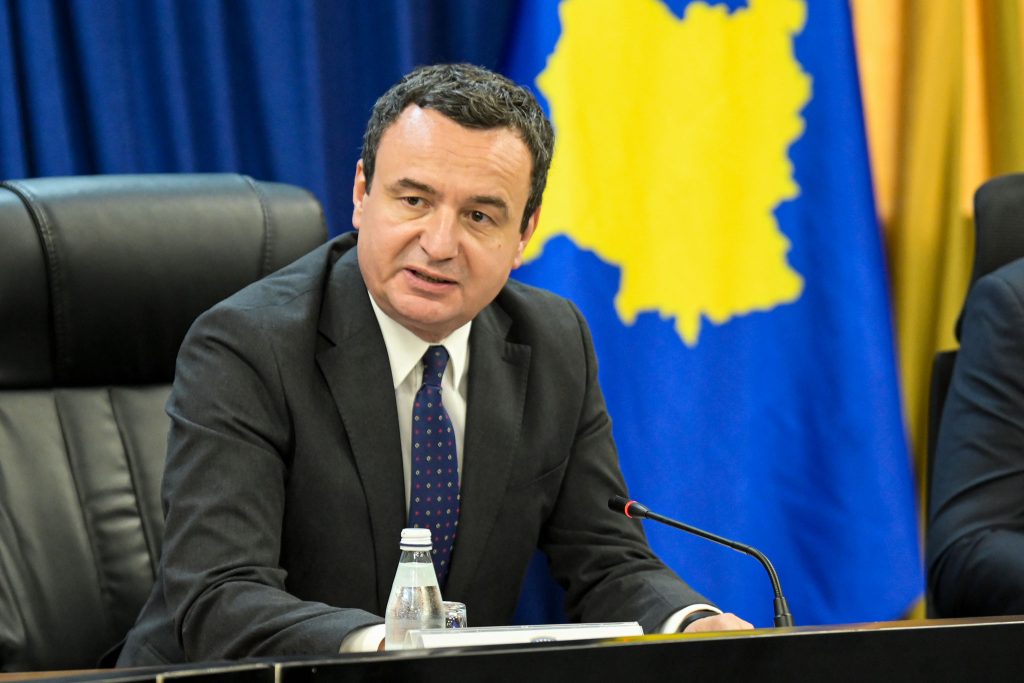
Kurti declared victory in the election on Sunday night and expressed his readiness to cooperate with other parties that had previously been in opposition.
“With VV, citizens are guaranteed good governance and that the state is in safe hands…The Republic of Kosovo lacks a functioning Assembly… In the coming weeks, my team will engage and cooperate with all political parties, prioritising the public interest and the service of a sovereign and independent Kosovo…. There has been no challenge his government has not managed to overcome, including in circumstances that appeared insurmountable”, he claimed, news agencies reported.
On the other hand, LDK’s candidate for prime minister, Lumir Abdixhiku, stated that the party is aware that after the election results, the first issue to be discussed will be the Presidency. For this position, he added that LDK has its own candidate, former President Vjosa Osmani.
“We are interested in institutional stability. We have been ready for talks with all Albanian parties, except the Serbian List. And we are aware that the issue of the president will be the first to be discussed. We have our candidate, and that will be the starting point of any discussion… There will be no compromise”, Abdixhiku noted.
Commenting on the prospects for the post-election alliances, Donika Emini remarks that “the message from these elections is clear – no single party can dominate Kosovo’s political system indefinitely”.
“The constitutional framework is designed to require cooperation, and this result makes compromise unavoidable. Vetëvendosje now faces a profound irony having to negotiate the establishment of the institutions from a seemingly worse position from the one after the December 2025 elections. How it manages that tension between its founding political identity and the pragmatic demands of coalition building will be one of the defining political stories of the weeks ahead”, she stresses.
In Emini’s opinion, “coalition options exist on paper, but each carries substantial political costs. A coalition with PDK faces deep mutual mistrust, longstanding tensions over the Hague process, and significant internal fragmentation within PDK itself, which makes identifying a unified negotiating position more difficult”.
“A coalition with LDK brings a different but equally significant challenge: the unresolved question of the Presidency, which has derailed previous negotiations and remains the most sensitive institutional issue on the table. In this case, VV will have to face Vjosa Osmani again, but now in a worse standing from the one of December. Any serious agreement must address the full institutional package from the outset, covering the government, the parliament speaker, and the presidency simultaneously. Attempting to form a government first and defer the presidential question, as has been tried before, will only reproduce the same crisis months down the line. Kosovo has already paid that price. It cannot afford to repeat it”, she assesses.
Emini adds that “the strongest incentive for compromise this time is not political goodwill but a shared awareness of the cost of failure”.
“All parties lost something in this cycle. Voters are visibly fatigued, and another round of deadlock would deepen the disconnect between citizens and democratic institutions at a moment when Kosovo needs functioning governance more than ever. The EU integration process, the dialogue with Serbia, and Kosovo’s broader international credibility all depend on political leaders making decisions that go beyond short-term party interests”, Donika Emini concludes.
Speaking on the same topic, Aleksandar Šljuka underlines that “the three largest opposition parties together do not have a pre-guaranteed majority to form a government”.
“If they (the opposition) want to take power, they first need to agree on mutual cooperation, and then to ensure the support of MPs from the non-majority communities. The key difference between VV and the opposition bloc could be the attitude towards the Serb List. Cooperation between VV and the Serb list is unthinkable at the moment, while for the opposition parties such an arrangement is much more realistic. Particularly if it is not about a formal coalition, but about support during the voting for the election of the government, i.e. securing a parliamentary majority”, Šljuka clarifies.
He stresses that it should be borne in mind that any support from the Serbian List would most likely depend on political signals from Belgrade.
“Therefore, the ‘all against Kurti’ scenario is possible, but not guaranteed in advance. Therefore, the final outcome will primarily depend on the final distribution of parliamentary seats after counting all votes, but also on the dynamics of relations between the leading Albanian parties and representatives of non-majority communities”, Šljuka concludes.