The recent demolition of Serb-owned buildings near Lake Gazivode (Ujman) in north of Kosovo add friction to relations between acting Prime Minister Albin Kurti and the European Union. The interlocutors of EWB stress that these unilateral enforcement measures, taken by Pristina, come in a very sensitive moment, as it is not certain whether Kosovo will head to a new snap election by the end of the year.
The largest wave of demolitions occurred on 21 July, followed by the demolition of the decades-old “Jezero” Hotel on 30 July. The European Union expressed deep concern over these developments, which proceeded despite ongoing court reviews. The EU also urged Pristina to halt further irreversible actions.
Brussels remarked that proceeding with irreversible actions while cases are under judicial review violates proper administrative safeguards and due process. In addition, the EU urged Kosovo institutions to coordinate transparently with local authorities and affected residents to seek sustainable, lawful arrangements.
On the other hand, the officials in Pristina have consistently described the initiative as an environmental and legal enforcement action aimed at protecting public property and one of Kosovo’s most important water resources.
“The demolitions near Lake Ujman/Gazivode have already affected Kosovo’s relationship with the EU, primarily by causing reputational damage and further weakening political trust. The main issue is not if the Kosovo government has the authority to enforce planning laws and protect public property, but whether such actions are carried out with due process, proportionality and access to effective legal remedies”, Ramadan Ilazi, Head of Research at the Kosovar Centre for Security Studies (KCSS) states for EWB.
According to Donika Emini, a research fellow at the University of Graz and a member of the Balkans in Europe Policy Advisory Group (BiEPAG), “the security situation in the north will always remain sensitive, and it has been a point of contention between the Kosovo government and the EU”.
“However, the recent demolitions near Lake Ujman put the EU in a somewhat difficult position. From the perspective of the Kosovo government, these interventions can be justified on environmental and rule-of-law grounds. Lake Ujman is an important source of drinking water, construction in protected areas is restricted, and similar attempts to build near Batllava and Badovci lakes have also faced opposition from environmentalists. So, on paper, the government can argue that it is simply enforcing the same rules that apply elsewhere in Kosovo”, Emini remarks for EWB.
Aleksandar Šljuka, a researcher at Mitrovica-based “New Social Initiative”, states for EWB that the “EU’s response also largely depends on developments on the ground, as well as on the reactions of other political actors”.
“At the moment, there is no serious security escalation, and the reactions of Belgrade were not as intense as we saw in previous crises. This indicates that the overall dynamics of relations have changed in the meantime, i.e. in comparison with the events from 2022 and 2024. Therefore, I am not sure that this case will lead to a radical change in Brussels’ approach”, Šljuka assesses.
“The repeated episodes of this kind can gradually reduce Kosovo’s political capital”
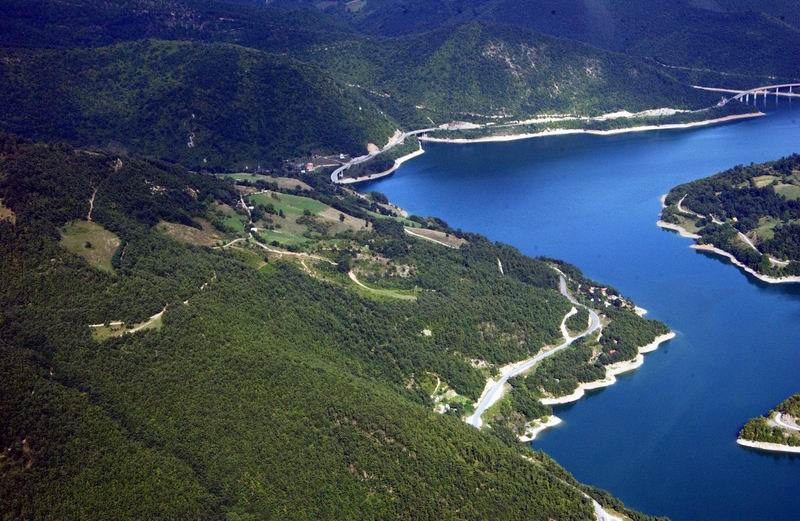
Kosovo authorities, specifically the Inspectorate of the Ministry of Environment, Spatial Planning and Infrastructure, accompanied by the Kosovo Police, demolished 11 villas near Lake Gazivode (Ujman) in the municipality of Zubin Potok. The action was carried out on 21 July, at the request of the public hydro-economic enterprise “Ibër-Lepenci” (Ibar-Lepenac).
The European Union Office in Pristina stated that it regrets the demolition, which has taken place while affected residents had initiated court proceedings within the 15-day deadline stipulated on the notices of public enterprise Ibër-Lepenc/Ibar-Lepenac to vacate and clear the land.
“The EU is concerned about the lack of due process in this and several other recent cases in northern Kosovo since February this year. It calls for an immediate halt to any further demolitions, forced removals or takeovers until concerns relating to due process, proportionality, property rights, human rights and effective remedies are adequately addressed”, the press release notes.
According to the EU Office, “the authorities should engage without delay with the affected residents and municipalities and consider lawful arrangements”.
These unilateral actions were also condemned by the OSCE mission in Kosovo, as well as by the German and British embassies in Pristina.
Despite the warnings by the international missions, on 30 July, “Jezero” hotel was demolished. It was done one day before the expiration of the deadline given by the company “Ibar-Lepenac” to the owners to vacate the property. The owners claim that their property was usurped, but before the demolition, they removed all the belongings from the building, “Vreme” reported.
Commenting on these developments, Ramadan Ilazi notes that the continuation of irreversible measures while court proceedings were pending, and after the EU had publicly called for a halt, created the impression that EU concerns could be acknowledged but disregarded in practice.
“Kosovo Civic Alternative reacted publicly to the developments in Lake Ujman/Gazivode because state authority must be exercised through predictable and transparent procedures and equal standards for every community. Sovereignty and the rule of law reinforce one another when enforcement respects property rights, judicial review and Kosovo’s constitutional commitment to a multiethnicity. The immediate consequence may remain diplomatic and reputational rather than a formal change in EU policy, but repeated episodes of this kind can gradually reduce Kosovo’s political capital and make it harder to be viewed as a rational partner, also because these actions carry potential security consequences”, Ilazi says.
He underlines that these events come at a particularly difficult moment for Kosovo.
“The conduct of Kosovo’s political parties in the Kosovo Assembly and their prolonged failure to fulfil their responsibility to establish functioning institutions are already damaging the country’s credibility. The European Commission has linked the political gridlock to a lack of political will, while the EU has repeatedly stressed that Kosovo needs functioning institutions and tangible reform progress”, Ramadan Ilazi concludes.
Speaking on the same topic, Donika Emini underlines that the problem is that the north cannot be viewed through a purely legal or environmental lens.
“Every intervention there carries an inter-ethnic and political dimension, and this is precisely where the EU’s concerns come in. I therefore expect the issue to generate tension, but I would not necessarily see it as a major turning point in Kosovo-EU relations on its own. Both sides have been quite careful in choosing their battles and, over the past year, there have also been areas where Kosovo has shown some flexibility towards the EU, including on the implementation of the law on foreigners”, Emini remarks.
In her opinion, for the EU, the more sensitive “red lines” are likely to remain issues such as the Association of Serb-majority Municipalities, particularly if Kosovo moves forward on the integration of the health and education sectors, which are closely linked to the Association.
“At the same time, Kosovo is currently going through a serious political crisis and does not have a fully legitimate government, which makes the EU’s room for engagement more complicated. So, I would describe the current situation as a delicate balancing act rather than an outright new confrontation. There will certainly be reactions from the EU, but whether the demolitions become a significant point of contention will depend largely on how incrementally the Kosovo authorities proceed and how much flexibility the EU is willing to show”, Emini concludes.
Aleksandar Šljuka underlines that, when it comes to Kosovo’s European integration, certain consequences (of the recent demolitions) are possible, but they should not be viewed in isolation.
“Kosovo submitted an application for the EU membership as early as in December 2022, but the Council has not considered this application to date, which is why Kosovo remains the only entity in the Western Balkans with the status of a potential candidate. However, this is not only influenced by the attitude towards the Serbian community, but also by broader issues of the rule of law, implementation of reforms, as well as certain external factors”, Šljuka clarifies.
“Kurti may be viewed as a non-cooperative partner by the EU”
Albin Kurti visited the dam at Lake Gazivode/Ujman on August 4, 2026, describing it as an “exceptional asset for the Republic of Kosovo and all its citizens”. He toured the site alongside acting Economy Minister Artane Rizvanoli and Faruk Mujka, Director of the public enterprise Ibër-Lepenc (Ibar-Lepenac). During the tour, Kosovo officials highlighted that this enterprise has been making a profit for the first time since the end of the 1999 war.
“It is interesting that Albin Kurti did not make many public comments on the recent demolitions, nor was he in the foreground of communication. This is not surprising, since the prime minister is not formally directly responsible for such activities, so the director of the public company Ibar-Lepenac and the minister of environment were in the spotlight, presenting the entire procedure as regular work of the competent institutions. However, it is difficult to see these moves separately from the broader approach Kosovo institutions have taken towards the Serb community since Kurti came to power”, Aleksandar Šljuka notes.
According to him, “as a result, in some EU institutions and among some international partners, these developments are likely to be seen as a continuation of previous unilateral moves, which further strengthens the perception of Kurti as a non-cooperative partner”.
“Whether this will lead to a more concrete answer is another question. Experience so far shows that the restrictive measures introduced by the EU to Kosovo in 2023 did not produce the expected results”, Šljuka concludes.
On 10 August, Serbian President Aleksandar Vučić said the official Belgrade is considering changing the course of the Ibar River inside Serbia before it flows into Kosovo, prompting fierce reactions from Pristina.