The European Commission is expected on October 6 to propose significant changes to the way the EU takes decisions – without reopening the treaties – alongside an entirely new set of safeguards against democratic and rule-of-law backsliding in future member states.
For the first time in almost a decade, the Commission could also put forward indicative timelines for completing accession negotiations with the most advanced candidates – Montenegro, Albania, Ukraine and Moldova -as part of new “roadmaps” to be unveiled later in the month.
For Serbia and other candidates further behind in the process, Brussels is proposing different forms of “gradual integration”.
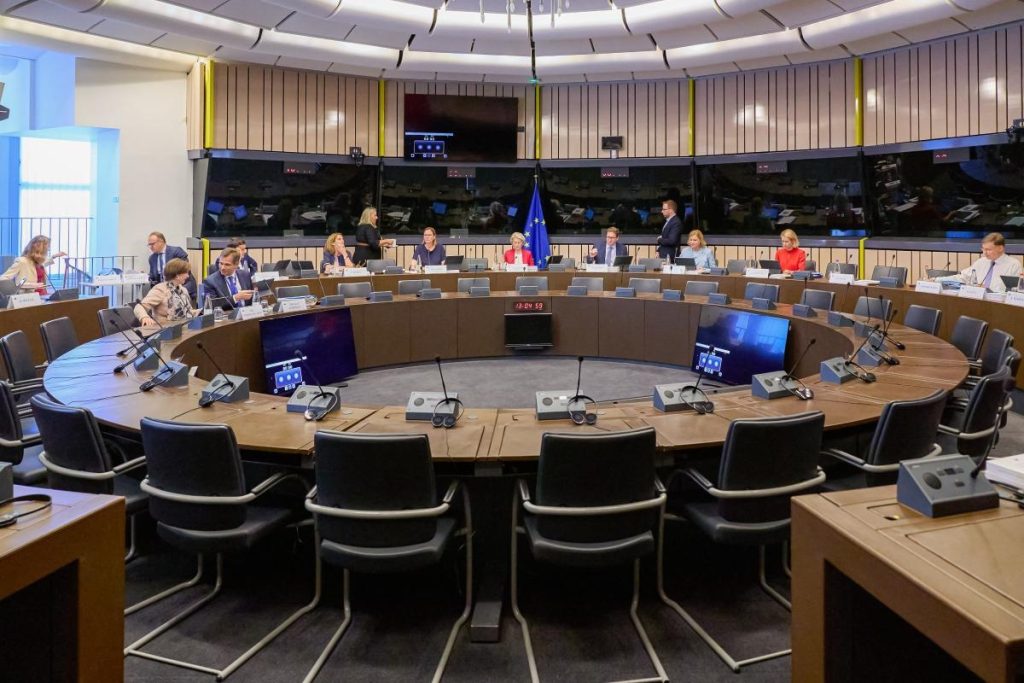
October could become enlargement month in Brussels. After almost a year and a half of delays, Ursula von der Leyen is due next week to present the Commission’s proposals for reforming the EU ahead of its next expansion.
The central question is straightforward: how can the EU take in new members without making decision-making more cumbersome or weakening its democratic safeguards?
A draft of the Commission proposal argues that the EU needs to change both the way it takes decisions and the composition of its institutions if it is to remain effective with a significantly larger membership. The next enlargement would also be accompanied by stronger safeguards and a more developed system of gradual integration.
Those safeguards could prove crucial to securing support for enlargement among existing member states. According to several sources familiar with the proposal, the current draft envisages financial and institutional safeguards – as well as temporary restrictions on the ability of new members to use their veto.
New members: temporarily without a veto?
The Commission believes new member states could be required, for a limited period after accession, to accept restrictions on their ability to block decisions in areas where unanimity is required.
Such an arrangement could be set out in a declaration accompanying the accession treaty. The aim, according to people familiar with the proposal, would not be to create permanently different rights for new members, but to allow them to be gradually integrated into the EU’s decision-making system.
Financial penalties for rule-of-law backsliding
A new financial safeguard would allow the Commission, for a limited period, to propose measures including the suspension of EU funding where there are clear indications that rule-of-law deficiencies in a new member state could put the sound management of the EU budget or its financial interests at risk.
In effect, Brussels wants to make it easier to protect EU funds if a newly admitted country begins to backslide after joining.
Suspending voting rights over breaches of EU values
The proposal also envisages giving the EU greater scope to suspend a new member state’s voting rights in cases of particularly serious breaches of the Union’s fundamental values.
Under the proposed system, the Council could act on a Commission recommendation and take such a decision by qualified majority for a limited period.
The crucial difference would be the removal of the unanimity requirement – the hurdle that has made comparable action under the EU’s existing Article 7 procedure extraordinarily difficult.
New member states would also be required to join the European Public Prosecutor’s Office before entering the EU.
Moving away from unanimity
The Commission will also propose making greater use of qualified-majority voting wherever the existing treaties allow it, reducing the EU’s reliance on unanimity.
This would apply above all to foreign policy, defence and sanctions – but also to enlargement.
The most straightforward route would be through the EU’s so-called passerelle clauses, which already allow member states to change decision-making procedures in certain areas without formally amending the treaties.
Countries worried about being outvoted would retain safeguards. An “emergency brake” would allow particularly sensitive issues to be referred to EU leaders, while another mechanism would require efforts to find an acceptable compromise where a significant group of member states risks being overruled.
Preparing the institutions for a bigger EU
The proposal also envisages reducing the number of European Commissioners to two-thirds of the number of member states.
The Council would establish a rotation system designed to reflect the EU’s demographic and geographical diversity. The Commission proposal also points to the need to adjust the composition of the European Parliament as the number of member states grows.
Roadmaps to membership for Montenegro, Albania, Ukraine and Moldova
Internal EU reform is only one side of the equation.
Under the current timetable, the European Commission is due on October 28 to present new accession “roadmaps” as part of its enlargement package.
Brussels wants to give the frontrunners greater predictability and a clear step-by-step path towards membership – potentially including indicative timelines for closing all negotiating clusters.
“These roadmaps will identify reforms and upcoming milestones, and indicate the sequencing needed to successfully conclude accession negotiations,” the draft Commission document says.
The Commission believes this would give candidate countries, member states and EU institutions a clearer framework for planning the next stages of accession, while preserving the principle that progress towards membership remains merit-based.
Gradual integration for candidates further from membership
At the same time, the Commission wants to make much greater use of gradual integration – while making clear that this is not intended as an alternative track for Montenegro and Albania.
“For Montenegro and Albania, which are already well advanced in the accession process, the priority remains the successful conclusion of accession negotiations,” the draft says.
For other candidates, however, gradual integration is presented as a more immediate way of moving closer to the EU – accelerating economic convergence, deepening political cooperation and delivering tangible benefits while reforms continue.
The approach would also vary by country and sector rather than follow a single template. Serbia, Ukraine and Moldova, for example, have a particular interest in agreements that would facilitate access to the EU single market for industrial products. Other candidates have different immediate priorities.
The Commission therefore argues that gradual integration should remain flexible enough to reflect different starting points, reform trajectories and policy priorities.
If the plans are confirmed, this would be the first time in almost a decade that the European Commission has offered indicative timelines for completing negotiations with the most advanced candidate countries.
The last time it did so was in February 2018, when the Commission set out a list of steps and reforms intended to put Serbia and Montenegro in a position to join the EU by 2025.
Member states largely ignored both the Commission’s enlargement strategy and its indicative timeline.
Much has changed since then. Serbia has fallen towards the back of the group of negotiating candidates, while the political climate inside the EU has shifted dramatically in favour of enlargement. The Commission now considers Montenegro and Albania to have a realistic prospect of membership by the end of this decade.
The debate among EU leaders at their October 15 summit – and again in December – will provide the first indication of how far member states are prepared to go: both in reforming the Union itself and in taking the decisive steps towards admitting new members.