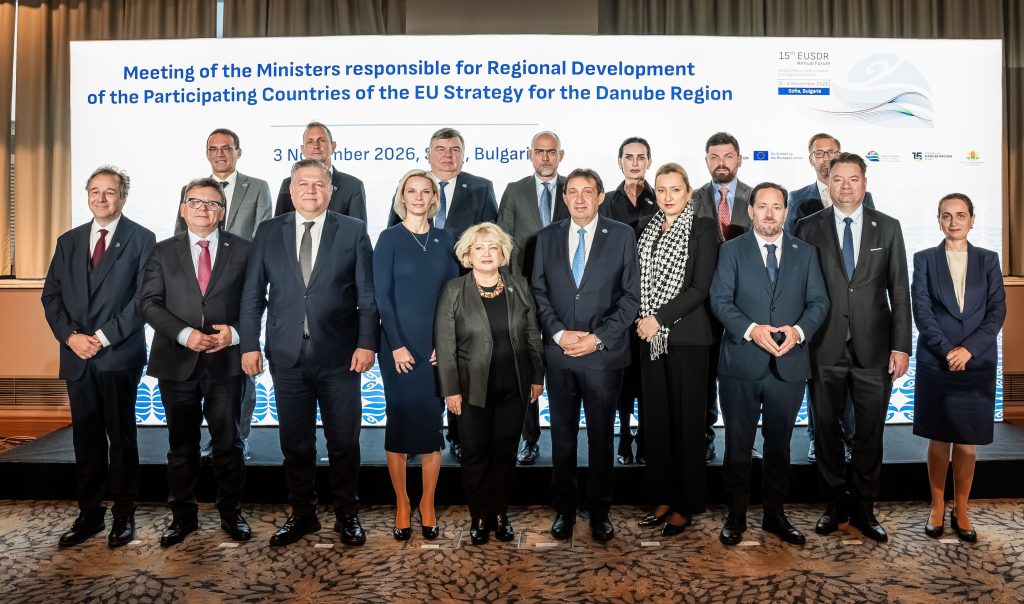
SOFIA – “Cohesion policy should retain its strong role in the European Union’s next long-term budget after 2027, since it is of key importance for the development of infrastructure, the competitiveness of regions and support for local economies”, stated Bulgarian Minister of Regional Development and Public Works Ivan Shishkov at the official opening of the 15th Annual Forum of the EU Strategy for the Danube Region, which is held in Sofia on 3-4 November.
According to him, “the Danube River can be much more than a geographical link. It can be a driver of development for entire regions”.
“There is still significant potential for the development of transport and economic infrastructure, while better connectivity is particularly important for peripheral and border areas, small towns and territories that have lost population, economic activity and development opportunities over the past decades”, Shishov noted.
He underlined that the “success of the Danube Strategy must be felt in our cities and regions – through better connections, new investments, jobs and opportunities for young people”.
Similarly, Deputy Prime Minister Atanas Pekanov remarked that “the future European budget must respond to the need for greater flexibility so that it can take into account the differences and needs of the regions”.
“For the Danube region, this means “investments in connectivity, the development of local economies and social activities that will push us closer to the top. It also means creating conditions for people to see a future where they live, to have access to quality jobs, education and social services, and to have a real choice to stay”, Pekanov said.
In his video message to the participants of the Danube Strategy Annual Forum, European Commission Executive Vice-President for Cohesion and Reforms Raffaele Fitto emphasized that working together is more vital than ever. To this end, he stated three core messages.
First, the EU Strategy for the Danube Region has delivered tangible outcomes through the steadfast alignment of participating states toward shared objectives. Second, the long-term prosperity of the region hinges on enhanced resilience, heightened competitiveness, and robust connectivity, necessitating deeper synergies across these domains.
Third, cooperation represents a profound political responsibility; the Danube region serves as a prime testament that Europe functions at its strongest when EU member states and candidate countries act in unison.
Furthermore, Fitto highlighted the strategic role of the Danube initiative in advancing the EU enlargement process, noting that macro-regional cooperation effectively bridges countries at varying stages of European integration.
The EU Strategy for the Danube Region (EUSDR) is a macro-regional strategy adopted by the European Commission in December 2010 and endorsed by the European Council in 2011.
The Strategy was jointly developed by the EC, together with the Danube Region countries and stakeholders, in order to address common challenges. It seeks to create synergies and coordination between existing policies and initiatives taking place across the Danube Region.
The participant countries are Austria, BiH, Bulgaria, the Czech Republic, Croatia, Germany, Hungary, Montenegro, the Republic of Moldova, Romania, Serbia, Slovakia, Slovenia, and Ukraine.
The Declaration, adopted today at the EUSDR Annual Forum, reaffirms the participating countries’ commitment to strengthening cohesion, competitiveness, connectivity and resilience across the Danube Region, while highlighting the continued importance of transnational cooperation in addressing shared challenges and opportunities.
Marking fifteen years of the EUSDR, Ministers underlined the added value of macro-regional cooperation in advancing economic development, territorial cohesion, environmental sustainability, connectivity and European integration. They stressed that place-based approaches and territorial cooperation remain essential instruments for achieving balanced and sustainable development across Europe.
The Declaration also calls for a strong territorial dimension in future European policies and programmes beyond 2027 and in the upcoming EU Budget 2028-2034 and highlights the strategic contribution of macro-regional strategies to strengthening resilience, competitiveness and prosperity in Europe.
The participating countries further called for stronger recognition and integration of EU macro-regional strategies within future European policies and funding programmes, ensuring that territorial cooperation remains a cornerstone of European development and enlargement efforts.
At the conclusion of the Annual Forum, the Presidency of the EUSDR was formally handed over from Bulgaria to Croatia, which will hold the Presidency of the Strategy in 2027.