Summary of this article was originally published on the BIEPAG Blog.
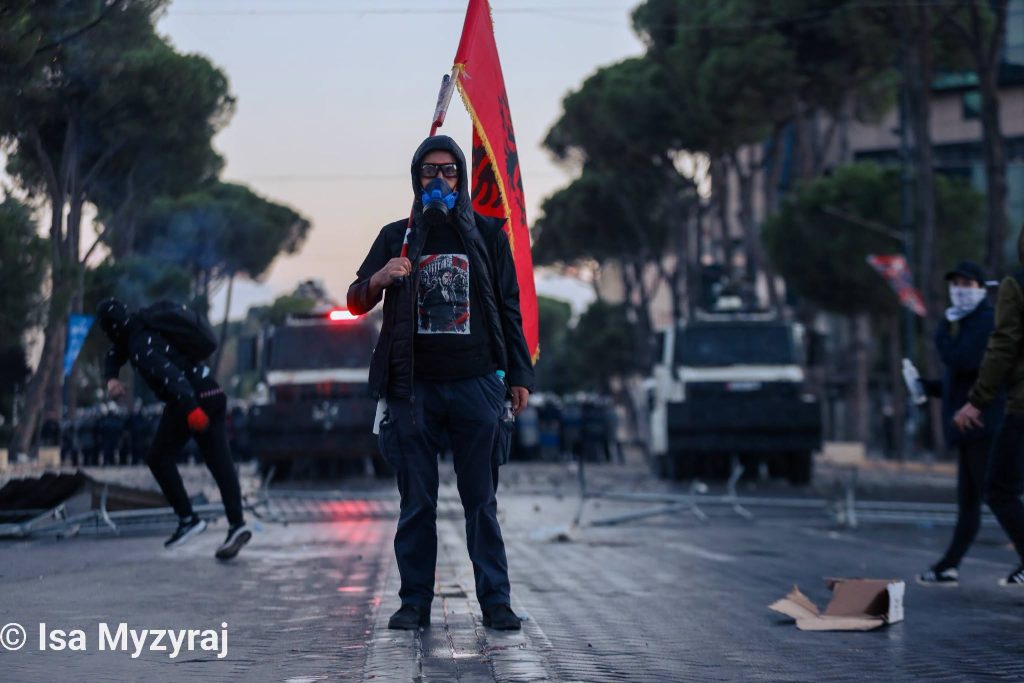
The European Commission’s (EC) annual progress report on Albania lands amid the remnants of Molotov cocktails and spent rubber bullets scattered across the streets of Tirana, still shrouded in a thick haze of teargas. It comes at a particularly auspicious moment, when Edi Rama’s government has made peaceful protest not only increasingly impossible, but effectively illegal through a series of decree-laws targeting not just demonstrators, but anyone within the vicinity of a public space that might, in the government’s eyes, turn into a site of protest.
While recognising the so-called Flamingo Revolution as “the largest civic mobilisation since Albania’s democratic transition” and acknowledging its demands for “transparency, accountability, anti-corruption efforts and good governance”, the Report stops short of confronting the political conditions that have fuelled its escalation.
In particular, it fails to connect the movement’s confrontational resurgence in October, marked by students (re)joining the protests, to the government’s repressive response to peaceful mobilisation and its systematic narrowing of the space for public dissent, a reality that sits uneasily with the Report’s own assessment that civil society continues to “operate in a partly enabling environment.”
By calling on all sides to “make genuine attempts to engage in constructive dialogue” the EC is framing the situation as a failure of communication between ostensibly equivalent parties, glossing over the fundamental asymmetry of power between a government that controls the state apparatus and citizens demanding accountability from it. More importantly, it fails to name the government’s dismissiveness and political arrogance, let alone address the escalating use of coercive and legal instruments to suppress dissent, including the even more brazen criminalisation of protest.
The contradiction is particularly striking given that, shortly afterwards, the Report calls on the authorities to “take all measures to ensure that all allegations made against the police are investigated promptly”, yet offers no comparable scrutiny of the government’s political responsibility for endorsing police brutality, including against journalists, whom the Commission itself recognises as operating in a highly threatening environment.
The Report is considerably more forthright, however, when it comes to the environmental grievances that initially sparked the protests. Under Chapter 27 on Environment and Climate Change, the Commission explicitly links the deterioration of nature protection to the government’s 2024 amendments to the Law on Protected Areas and the extension of the Strategic Investment framework, effectively corroborating the protesters’ longstanding concerns. Its criticism goes beyond technical shortcomings in the transposition of the European Union (EU) acquis, pointing instead to the political choices and legislative interventions that have weakened environmental safeguards and undermined the protection of ecologically sensitive areas.
The Commission’s assessment is particularly important in this regard, as it recognises that the protests are a direct response to concrete government policies that place controversial strategic investment and development interests above environmental protection and rule of law benchmarks.

The picture becomes even more troubling with the EC’s reference to the Special Structure Against Corruption and Organized Crime (SPAK) investigations into the large-scale development within the Pishë Poro–Narta protected landscape, particularly in Zvërnec, where prosecutors are examining property-title transfers connected to the planned development, as well as preventive asset seizures and an arrest warrant for one of the landowners over possible links to an organised criminal group involved in international drug trafficking and large-scale money laundering.
This matters because the Commission’s own findings expose the deeper political stakes behind the protests: not only have government policies weakened environmental safeguards to accommodate controversial development interests, but the developments themselves have become entangled in investigations involving organised crime. The issue, therefore, extends to the capacity of the rule of law to constrain the intersection of political, economic and criminal interests, particularly when the institutions mandated to investigate and hold these interests accountable are themselves exposed to political pressure and interference.
It is precisely this institutional dimension that emerges from Chapters 23 and 24 on the Judiciary and Fundamental Rights. The Commission acknowledges “attempts by public officials and politicians, including at the highest levels, to exert undue influence on justice institutions, as well as personal attacks on magistrates at all levels.”
Such conduct reflects a deeper problem concerning the executive’s relationship with judicial independence and the limits of institutional accountability. For instance, the protracted confrontation between the government and the judicial governing councils over the implementation of the Constitutional Court’s decision on judicial salaries offers a particularly telling illustration of this dynamic as it disrupted the functioning of the judicial system.
A similar pattern is evident in the case of former Minister of Infrastructure and Energy and former Deputy Prime Minister Belinda Balluku, whose suspension was ordered by the Special Court against Corruption and Organised Crime (GJKKO), followed by SPAK’s request to Parliament to lift her parliamentary immunity. The Commission is particularly critical of the response this case triggered from the executive and legislative branches, noting that it included direct attacks against SPAK and judicial institutions.
It also highlights politicians’ repeated attempts to question the Constitutional Court’s authority and verbal attacks against individual judges, contributing to a hostile environment for the judiciary to the point that “eight magistrates have been placed under protection, including two judges and six prosecutors.”
The Commission’s findings thus point to a broader contradiction at the core of Albania’s rule-of-law reform: while judicial institutions are formally strengthened through the EU-driven reform process, their ability to exercise institutional autonomy remains vulnerable to political pressure and executive interference. These weaknesses, moreover, are not confined to the judiciary. The Commission’s assessment of Parliament and electoral reform reveals a similar deficit in the institutional mechanisms meant to ensure political accountability and democratic oversight.
Parliament’s failure to fulfil its constitutional responsibilities in an inclusive and effective manner poses particularly consequential for electoral reform, a necessary step towards breaking the Parliament’s political capture and restoring its capacity to exercise independent oversight, which the Commission considers urgent ahead of the 2027 local elections.
While rightly identifying shortcomings in the electoral legal framework and the need for greater transparency in political party financing and advertising, the EC’s Report also exposes a fundamental inconsistency: the committee tasked with drafting the reform excludes all opposition parties beyond the main opposition, reproducing the very deficit of political inclusiveness the reform is meant to address.

Yet, perhaps the most revealing aspect of the Report lies not in what the Commission acknowledges or recommends, but in the political approach that allows it to often disregard the implications of its own findings. By treating Albania’s accession primarily as a geopolitical imperative, the EU risks prioritising the appearance of reform over its substantive implementation, rewarding formal compliance while overlooking the continued concentration of political power and the erosion of democratic accountability.
The Commission’s continued endorsement of Rama as a reliable partner is emblematic of this contradiction considering that Rama is not simply a partner through whom the accession process must be managed, but a political actor whose governing practices are themselves undermining the democratic transformation that accession is supposed to advance.
In this regard, it is important that the EU move beyond its reliance on a stabilitocratic incumbent and engage meaningfully with the wider democratic landscape, including emerging opposition forces and civil society. At a moment when both Albania’s political future and the credibility of EU enlargement are at stake, Brussels has considerable leverage and a responsibility not to squander it.
Given the broad political and societal consensus in favour of EU membership, as well as the opportunity presented by an accelerated accession process, the main issue is whether the EU is willing to ensure that accession drives genuine democratic transformation rather than legitimising a government that delivers reforms on paper while consolidating authoritarianism in practice.
Views expressed in the Opinion section belong to the authors and do not necessarily reflect the views of European Western Balkans.