Progress in tackling corruption across the Western Balkans remains uneven, with the prosecution of senior officials continuing to be a weakness in much of the region. The European Commission assessed that Albania and Montenegro have made good progress in the fight against corruption, while Serbia and Kosovo made limited progress. Bosnia and Herzegovina and North Macedonia made no progress.
These overall assessments encompass prevention and enforcement and they do not refer solely to results in high-level corruption cases, which deteriorated in Serbia and Kosovo.
The findings in the European Commission’s reports published last week show that adopting legislation and launching investigations do not necessarily translate into successfully concluded proceedings.
Albania and Montenegro make good progress, weaknesses remain
The most successful countries from the Western Balkans are Albania and Montenegro.
The European Commission rates Albania as being between a moderate and good level of preparation in the fight against corruption and as having shown good progress overall.
It singles out the Specialised Structure Against Corruption and Organised Crime (SPAK), which continues to demonstrate independence and deliver results in high-level corruption cases.
In 2025, 34 corruption cases involving 160 defendants were referred to court, including ten high-level corruption cases involving 13 defendants.
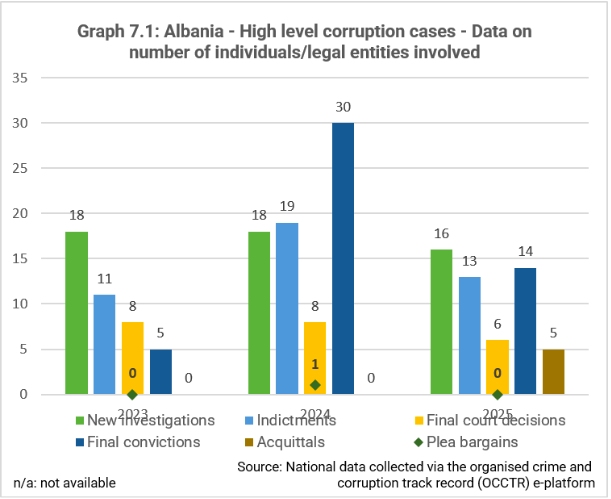
However, the recovery of illicit assets remains a weakness because the value of seized and confiscated assets in corruption cases has remained limited.
“During 2025, SPAK seized and confiscated assets amounted to 45.4 million euros in total, but only 1.2 million referred to high-level corruption proceedings, with the value of confiscated assets limited to approximately 100.000 euros”, the European Commission states.
The ratio between seized and confiscated assets is not yet satisfactory, according to the European Commission, suggesting the need to further implement extended confiscation measures, as well as non-conviction-based confiscations, including third-party and value-based confiscations.
The EC assess that Montenegro also made good progress in this area. It reports an improved track record of final court decisions and convictions in high-level corruption cases, alongside increasingly complex investigations and indictments.
“The complexity of cases continued to increase, requiring a decisive commitment from the prosecution and law-enforcement authorities, as well as improved specialisation and strategic coordination, including internationally. The quality of indictments continued to improve significantly, particularly in the alignment between factual descriptions and legal qualifications”, the European Commission states.
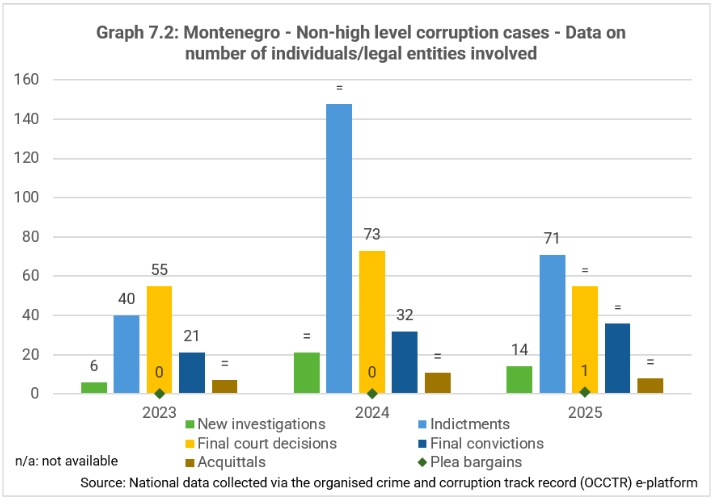
Nevertheless, the capacity of the Special State Prosecutor’s Office needs further strengthening. Despite improvements in its functioning, the Agency for the Prevention of Corruption’s work remains largely confined to administrative checks.
Serbia and Kosovo: Limited progress, weaker results in high-level corruption cases
Serbia made limited progress overall in the fight against corruption, with amendments to legislation on lobbying, corruption prevention and political financing contributing to that assessment.
However, the Commission stresses the need for stronger political will and reports a further increase in operational obstacles and attempts to exert undue influence on the Prosecutor’s Office for Organised Crime.
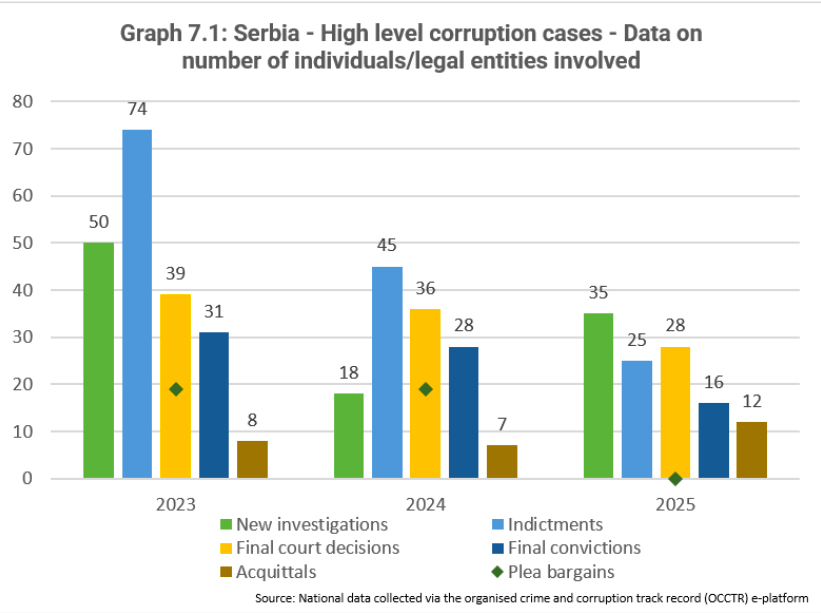
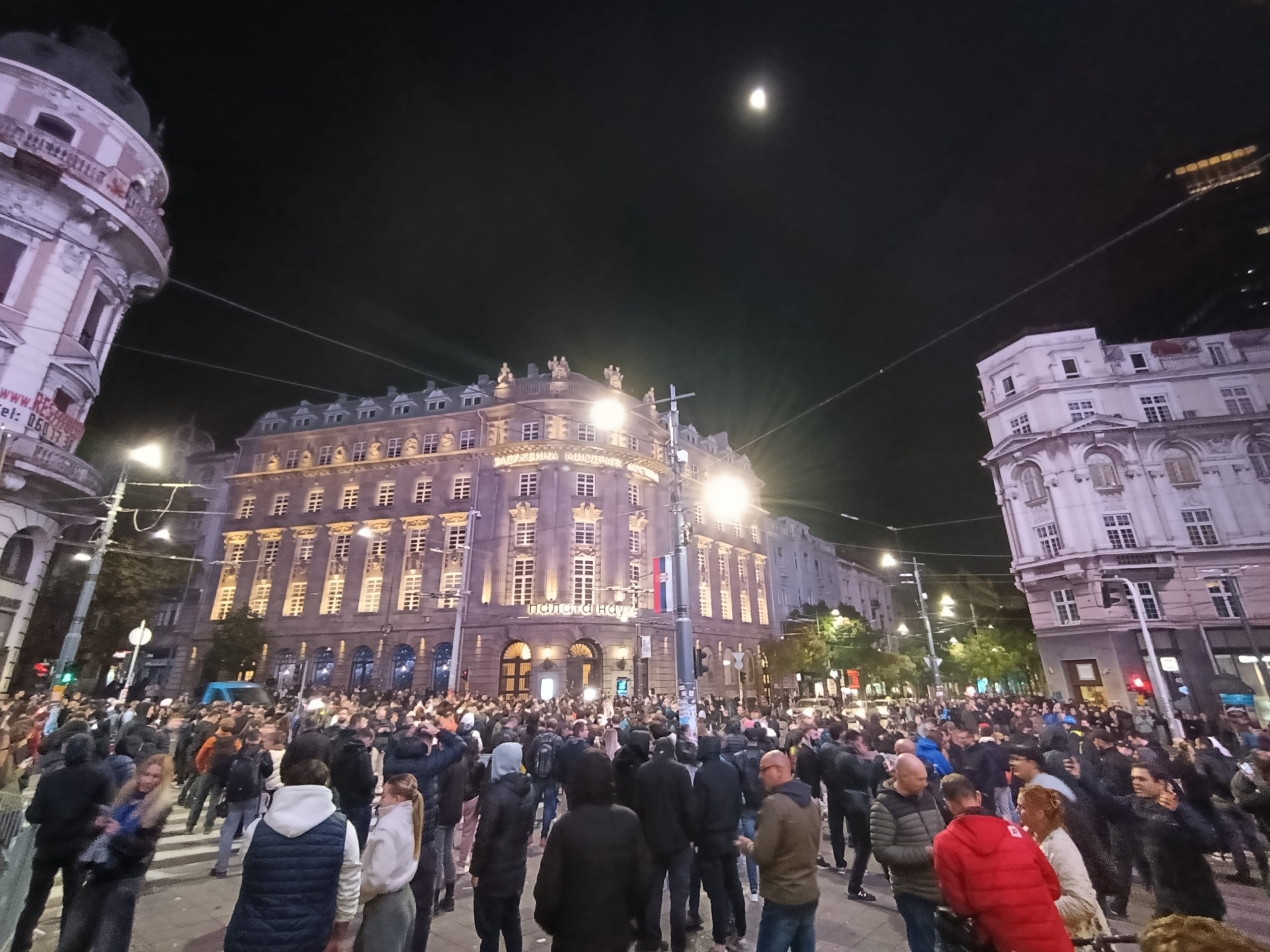
The number of individuals convicted in high-level corruption cases through final judgments fell from 31 in 2023 to 16 in 2025. The European Commission recalls that investigations linked to the collapse of the canopy at Novi Sad railway station have yet to be completed.
The Commission notes that prosecutors reported insufficient police cooperation in providing evidence, while the removal of 17 experienced members of the investigative task force slowed the investigation.
Kosovo also made limited progress in the fight against corruption. According to the European Commission Report, its track record improved in corruption cases outside the high-level category, but high-level cases followed the opposite trend.
The number of individuals convicted through final judgments fell from 38 in 2024 to 17 in 2025, while the number of people indicted dropped from 91 to 34. The Commission highlights lengthy trials and inconsistent and lenient sentencing.
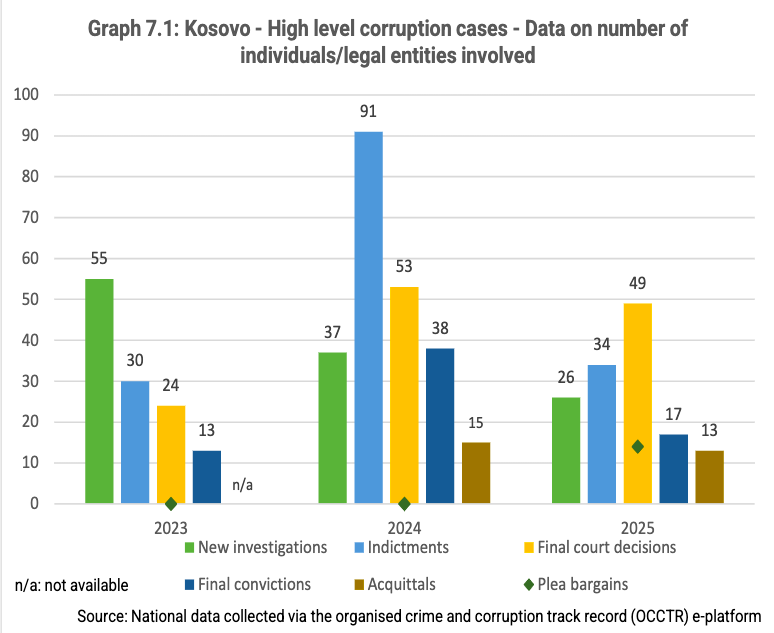
When it comes to legal framework, the European Commission recalls that Kosovo has yet to adopt a national anti-corruption strategy and an accompanying action plan, making it harder to establish clear objectives, responsibilities and deadlines.
No progress in Bosnia and Herzegovina and North Macedonia
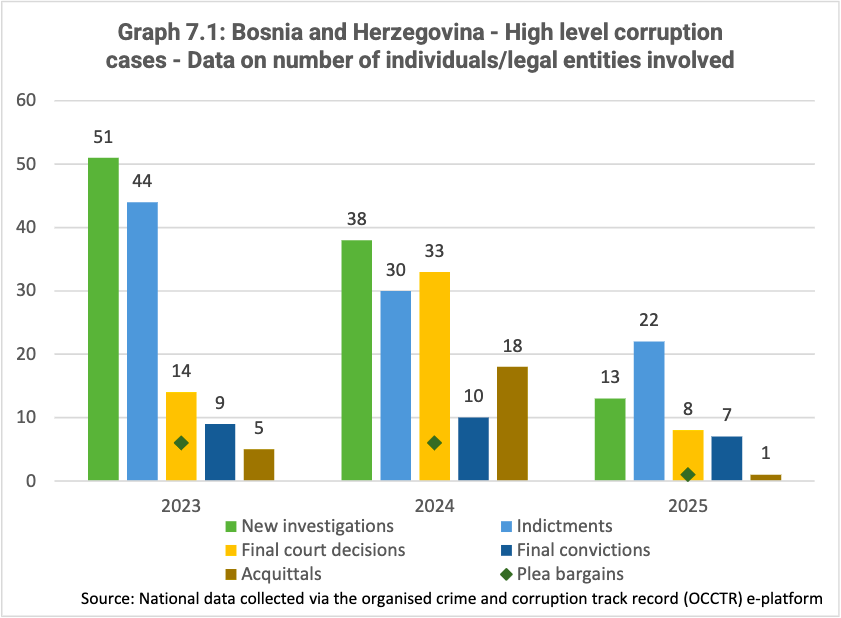
Bosnia and Herzegovina made no progress in the fight against corruption. The Commission finds that political authorities have persistently failed to tackle widespread corruption and have actively obstructed progress, amid prolonged stagnation and signs of state capture.
The number of individuals convicted of high-level corruption through final judgments fell from ten in 2024 to seven in 2025. Particularly concerning is the finding that no law enforcement agency has submitted a report on high-level corruption to the Prosecutor’s Office of Bosnia and Herzegovina since 2022. This finding concerns the state-level prosecutor’s office, rather than all prosecutors’ offices across the country.
The European Commission states that the substantive provisions of the Law on the prevention of conflict of interest are applied inconsistently. The commission in charge found 5 cases of conflicts of interest in 2025, but handed down just 1 sanction, since in the other cases the persons concerned were no longer in office at state level.
According to the European Commission, the number of state-level officials who complied with their obligation to submit financial reports for the verification of asset declarations continued to decrease (261 out of 600, or 24 fewer officials than in 2024).
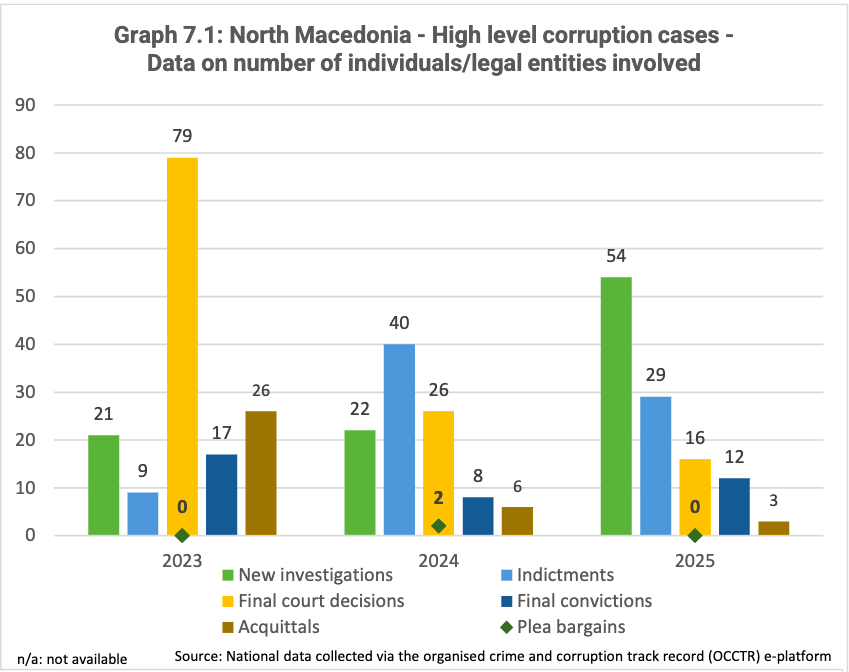
North Macedonia also made no progress in preventing and fighting corruption. The Commission concludes that amendments to the Criminal Code adopted in January 2026 failed to adequately address the adverse effects of the 2023 amendments, including problems relating to the limitation period.
Although new investigations have been launched, systemic obstacles persist in translating them into effective judicial proceedings and asset recovery. The number of individuals convicted of high-level corruption through final judgments rose from eight in 2024 to 12 in 2025, but this increase was insufficient to secure a more favourable overall assessment.
Ukraine and Moldova receive more favourable assessments than much of the region
The experiences of Ukraine and Moldova show that spending longer in the accession process does not, in itself, guarantee greater success in tackling corruption. Although both countries were granted EU candidate status only in 2022, they received more favourable assessments of their progress than Serbia, Kosovo, Bosnia and Herzegovina and North Macedonia.
Moldova made good progress, while Ukraine made some progress in the area of fight against corruption.
In Ukraine, the number of individuals convicted in high-level corruption cases through final judgments increased from 69 in 2024 to 133 in 2025. The Commission highlights the work of specialised institutions on cases involving senior state officials. In contrast to the declining figures in Serbia and Kosovo, Ukraine recorded an improvement in this indicator despite wartime conditions.
Moldova’s results also reveal the limits of its progress. In 2025, first-instance courts delivered 128 guilty verdicts involving 181 individuals in proceedings handled by the Anti-Corruption Prosecutor’s Office. However, 38 high-level corruption proceedings involving 85 individuals were also discontinued because limitation periods had expired.
These first-instance verdicts are not directly comparable with Ukraine’s final convictions. Nevertheless, the findings for both countries point to the same challenge: institutions’ ability to pursue politically sensitive cases must be matched by judicial proceedings that reach final judgments in a timely manner.
Reforms should be measured by their results
For anti-corruption reforms to deliver lasting results, the way their success is assessed must also change. In its report, the regional anti-corruption network SELDI recommends measuring progress towards EU membership through concrete outcomes: how many high-level corruption indictments lead to convictions, how long proceedings take and how much illicit wealth is recovered.
In its report “The Geoeconomics of State Capture: Reconciling Anti-Corruption and Strategic Imperatives in the Western Balkans”, SELDI states that achieving such results requires institutions protected from political influence.
SELDI Network proposes safeguards for anti-corruption bodies’ budgets, non-renewable terms for their leaders and parliamentary oversight that includes opposition representatives. Asset checks should also extend to officials’ relatives, associates and affiliated companies.
Public procurement is another area that SELDI identifies as a priority. The network recommends closing loopholes that allow competitive procurement procedures to be bypassed through special legislation and intergovernmental agreements. It also advocates linking procurement, company ownership and asset registers to enable the early detection of irregularities.
Independent monitoring of reforms also requires multi-year support for civil society, access to data for investigative journalists and protection against political retaliation, SELDI concludes.
This article was published as part of the project “Civil society for good governance and anti-corruption in southeast Europe: Capacity building for monitoring, advocacy and awareness-raising (SELDI)” funded by the European Union.