BELGRADE – Four public prosecutors will leave Serbia’s Public Prosecutor’s Office for Organised Crime (JTOK) following last week’s decision by the High Prosecutorial Council. It is a consequence of the controversial set of laws on the judiciary adopted by the Serbian parliament in January, which were criticised by the European Union as a step backwards in establishing an independent judiciary in Serbia.
Two of the four public prosecutors were responsible, among other things, for the case of the reconstruction of the Serbia-Hungary railway. This case saw the arrests of two former ministers last August, who were charged with abuse of office and suspected of damaging the budget of Serbia by at least 115 million US dollars.
Another public prosecutor among the four who were removed from JTOK was responsible for the case that included the seizure of five tons of marijuana on property owned by a local official of the ruling Serbian Progressive Party (SNS) earlier this year.
The decisions by the High Prosecutorial Council, which led to the removal of the four prosecutors, are widely interpreted as a fulfilment of one of the goals of the revised laws on the judiciary, adopted in January.
One of the most controversial amendments to the laws concerned the status of prosecutors seconded to JTOK from other offices. Under the adopted amendments, these prosecutors would have to return to their original offices.
At the time of the adoption of the laws, 11 out of 20 public prosecutors in JTOK were seconded from other offices. Many of them have been handling sensitive cases concerning high-level corruption and organised crime.
On 6 March, the High Prosecutorial Council of Serbia voted to re-appoint 7 out of 11 seconded public prosecutors to JTOK, but it did not do so in four cases. One of the deciding votes was cast by the Minister of Justice of Serbia, Nenad Vujić, who is a member of the Council alongside elected public prosecutors and legal experts.
Public prosecutor Predrag Milovanović, who abstained from the vote in four cases and thus contributed to the outcome, claimed that he voted to re-appoint public prosecutors with a longer tenure in JTOK, in the absence of “objective criteria”.
Milovanović also said that he might vote for a regular appointment of these prosecutors to JTOK when a public call for filling the vacancies in this Office arrives on the agenda of the High Prosecutorial Council. It is, however, unknown when this might take place.
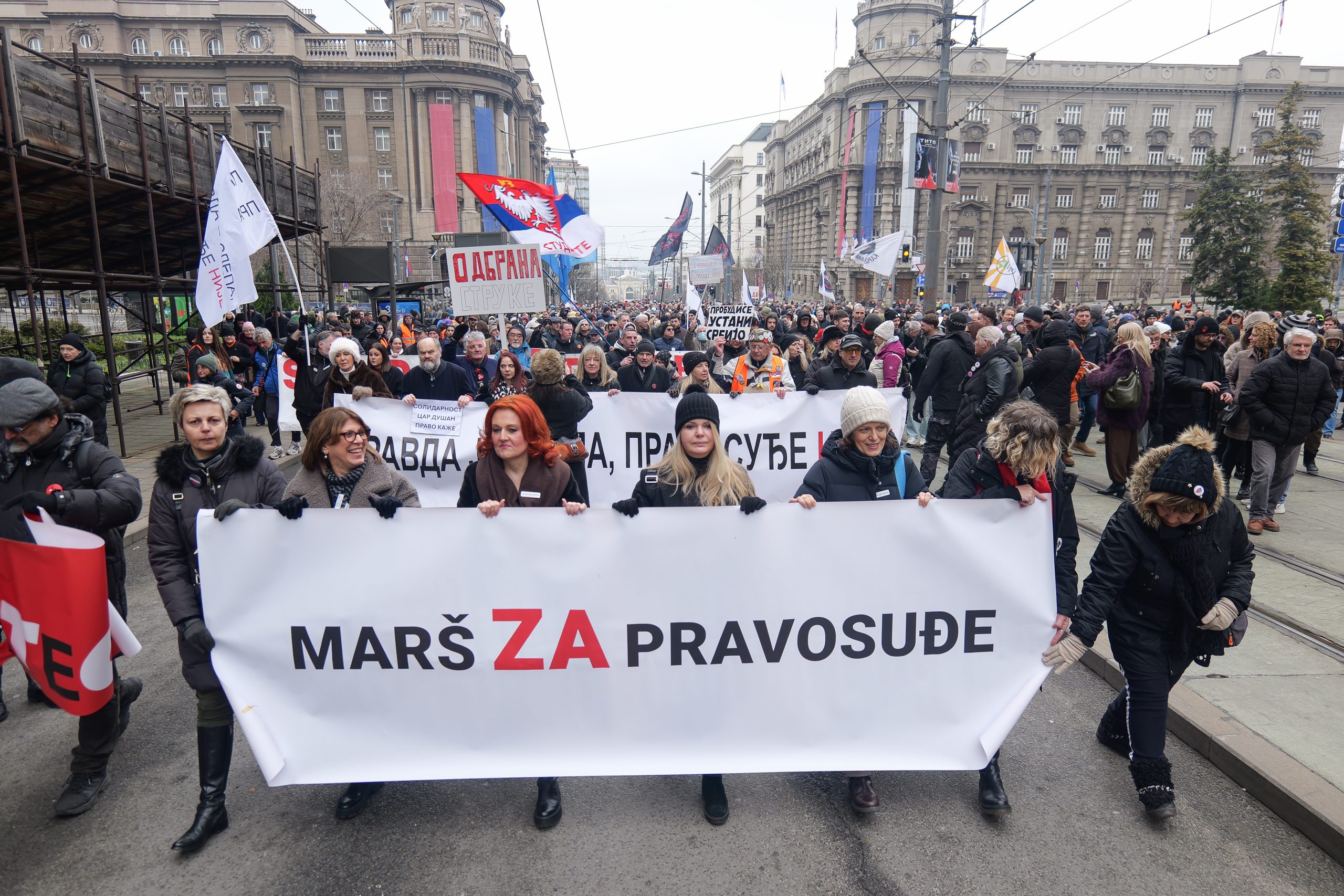
For the critics, these decisions were made in a clear attempt to weaken JTOK and obstruct its work in cases that could be politically damaging for the ruling party.
An MP of the ruling SNS, Uglješa Mrdić, who formally proposed the laws that were adopted in January, later stated that their goal was to restrain the prosecutors who were “planning to arrest several ministers from the Serbian Progressive Party (SNS) and, as he claimed, even Serbian President Aleksandar Vučić”.
After the laws were adopted, despite warnings from Brussels about the problematic nature of the changes, Serbian authorities seemed to back down slightly, formally requesting an assessment from the Council of Europe’s Venice Commission.
Nevertheless, the changes had already entered into force before the opinion was requested and before the Venice Commission could issue its review. As demonstrated by the vote of the High Prosecutorial Council, they are already re-modelling Serbian judiciary.
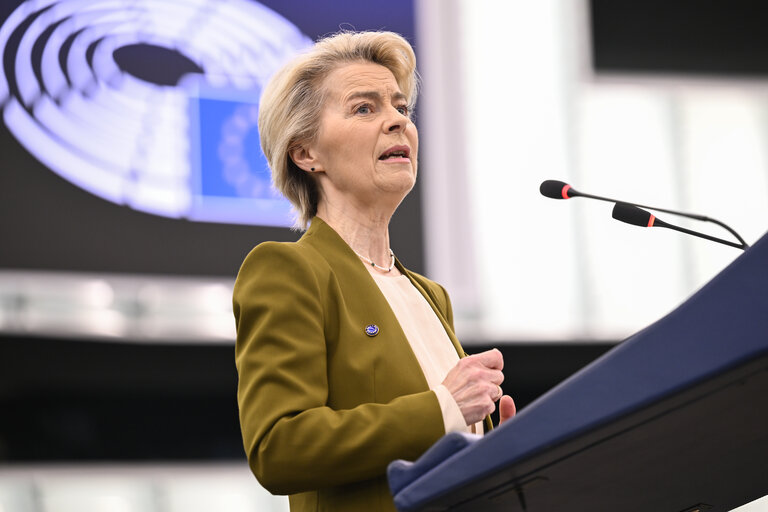
The European Commission has stated that the amendments represent a serious step backwards in terms of the rule of law and judicial independence. It warned that the changes were adopted without broad consultations and could negatively affect Serbia’s EU accession process, particularly in chapters related to the judiciary and fundamental rights.