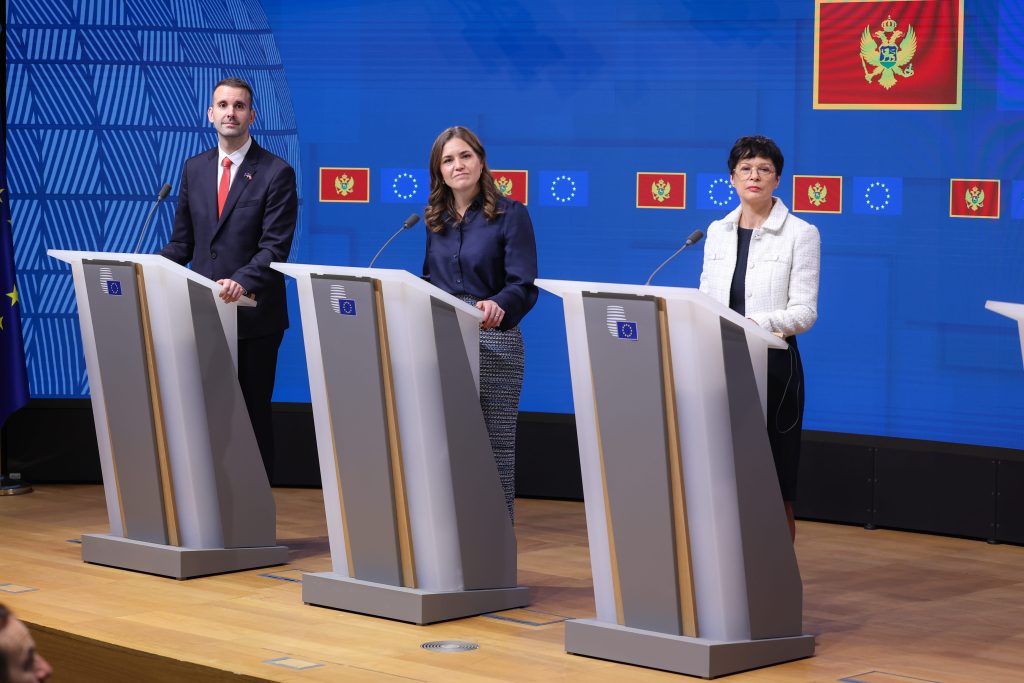
On 22 April, ambassadors of the EU member states approved the establishment of an ad hoc working group to draft the Accession Treaty with Montenegro. According to analysts, the core structure of the treaty will likely mirror the Croatian precedent, signed in December 2011, but “safeguard” clauses are expected to be more robust and stricter.
European Commissioner for Enlargement Marta Kos has recently stated that Montenegro’s accession agreement will be the first to include new safeguard mechanisms.
“Safeguard clauses are nothing new, but this will be new. And this is now linked to pre-enlargement policy reviews. The EU must prepare itself institutionally, politically, and financially”, Kos said.
Reacting to these messages, Pierre Mirel, a former Director of the Directorate-General for Enlargement at the European Commission, remarks for European Western Balkans that the accession treaty “must include strong safeguards to protect the judiciary system, its independence, impartiality and effectiveness, which the European Commission will monitor post-accession”.
Speaking on the same topic, Fjona Merkaj, a Project Officer at European Liberal Forum (ELF), notes for EWB that “Montenegro’s Accession Treaty is likely to go beyond Croatia’s in both scope and philosophy”, as we can see “a transition from a ‘trust-based’ to a ‘resilience-based’ enlargement model”.
Agreements on “transitional periods”
The Accession Treaty between European Union member states and Croatia was signed on 9 December, 2011, in Brussels. It established the legal framework for Croatia to become the 28th EU member state on 1 July, 2013, following the ratification of the document by all member states and a successful national referendum held on 22 January 2012.
During the interim period between the signature of the Accession Treaty and the actual date of accession, the work on Croatia’s preparations for EU membership continued. The Accession Treaty included provisions which allowed for appropriate measures to be taken in case problems are identified during the monitoring process.
Until its accession, Croatia had an active observer status in most of the Council working groups as well as Commission committees. This allowed Croatia to become familiar with the working methods of the EU institutions and to become involved in the decision-making process.
In some areas, the European Union and Croatia had negotiated specific arrangements to enable the country’s smooth integration into the EU (so-called “transitional periods”). The most important transitional periods related to freedom of movement for workers, free movement of capital, competition policy, financial services, transport and internal borders.
Transitional periods were limited in time and scope. The duration of these arrangements was different for different policy areas.
In addition, the Accession Treaty envisioned the establishment of the Schengen instrument as a temporary measure. Croatia officially joined the Schengen Area on 1 January, 2023. On this date, checks at Croatia’s land and sea borders with other Schengen members were abolished.
Fjona Merkaj states that temporary restrictions on the free movement are expected to be incorporated into the Accession Treaty with Montenegro as well.
“However, in Montenegro’s case, these may be more tied to specific economic convergence indicators to manage the risk of brain drain, which has been a major point of concern in recent Commission discussions”, Merkaj clarifies.
Pierre Mirel agrees that such a document may include transitional periods, “whereby full implementation of EU legislation is temporarily suspended to ensure a smooth transition, either at the EU’s request or of Montenegro”.
“Should the treaty include a transitional period on the free movement of workers, considering that Montenegro faces a shortage of labour force during the tourism season? Or to limit the emigration of certain professions, such as nurses and doctors, where public hospitals face a shortage as well? In such cases, it might be welcome to limit Montenegro’s losses and not due to fear in member states, rather the opposite”, Mirel stresses.
“Conditionality will continue even after the signature of the treaty”
There were three “safeguard clauses” in the Accession Treaty with Croatia: a general economic safeguard clause, a specific internal market safeguard clause and a specific justice and home affairs (JHA) safeguard clause. They had been designed to deal with difficulties that might have been faced as Croatia adjusted to its responsibilities and rights as an EU member.
Safeguard measures could include protective measures taken by member states or the suspension of specific rights under the EU acquis directly related to the shortcomings of a new member state.
Among other things, Croatia had committed to continuous monitoring by the European Commission. The monitoring focused on justice, freedom and security policy, including the implementation and enforcement of Union requirements with respect to external border management, police cooperation, the fight against organised crime and judicial cooperation in civil and criminal matters.
In Pierre Mirel’s opinion, “an effective judiciary system is indeed a cornerstone for membership and for ensuring that democratic standards are respected”.
“The EU rule of law budgetary conditionality mechanism, through a regulation in force since 2021 to face Poland and Hungary breaches, allows the Commission to freeze post-accession budgetary funding. It protects the EU budget by ensuring that funds are not misused or affected by rule of law breaches, as with Hungary where 18 billion euros have been frozen during Viktor Orbán’s tenure”, Pierre Mirel remarks.
Mirel stresses that this regulation “is the most effective tool to face such problems as a direct application of a treaty safeguard”.
“It is, however, currently too limited. In my view, its scope should be extended to ensure that EU values and principles enshrined in the EU Treaty. It should also include the respect of any commitments of Montenegro regarding good neighbourly relations. This is essential to avoid that it would refuse after accession a bilateral pre-accession commitment, such as Croatia refusing to implement the arbitration clause on the Piran Bay with Slovenia”, Pierre Mirel concludes.
Similarly, Fjona Merkaj stresses that “while Croatia’s treaty focused on specific transitional periods, Montenegro’s treaty is expected to be the first to fully put in place the 2020 Revised Enlargement Methodology”.
“Unlike Croatia’s post-accession monitoring, Montenegro’s treaty will likely establish a more permanent link to the EU’s Rule of Law Report cycle. A key difference will be the inclusion of explicit reversibility mechanisms. This would allow the EU to pause or roll back certain benefits of membership if democratic standards slip, representing a safeguard that was not as robustly structured in the Croatian or other previous accession cases”, she remarks.
Merkaj notes that it is likely that Montenegro “will not just commit to monitoring, but to a Conditionality Mechanism, like the one used for current member states and linked to the EU budget”, which would make rule-of-law adherence a continuous requirement for accession to Union funds.
She stresses that although elements such as worker restrictions and judicial monitoring will look similar to the Accession Treaty with Croatia, “their legal enforcement will be much more structured” in the case of Montenegro.
“Montenegro’s treaty is expected to reflect a shift toward managed risk, where conditionality will continue even after the signature of the treaty”, Fjona Merkaj concludes.