Is the regime of Aleksandar Vučić nationalist? For those who would make that argument, there are plenty of examples to cite.
For instance, the vast majority of media outlets controlled by the regime have been spreading nationalist and anti-Western propaganda for over a decade, appealing to the nationalist voter base. Many of the warmongers from the 1990s have been welcomed into the ranks of the ruling party.
Vučić is now in a formal alliance with his political mentor, Vojislav Šešelj, and his extreme-right Serbian Radical Party, having formed coalitions with the party during last year’s local elections. It would come as no surprise if this coalition is formalised at the national level as well, as the regime has been shifting further to the right in recent years to compensate for a steady, though not dramatic, decline in the polls.
In addition, the main narrative promoted by Vučić and his allies regarding the ongoing student protest movement is that it represents a Western-backed colour revolution, aimed at installing a puppet government that would, among other things, recognise Kosovo’s independence.
Despite all these factors, one should still stop short of simply labeling Vučić’s regime as nationalist. Simultaneously with this kind of rhetoric, Vučić has continued to pursue a largely cautious and pragmatic foreign policy, carefully avoiding direct confrontation with the geopolitical interests of the EU and the U.S. in the Balkans. The position of national minorities in Serbia, though far from ideal, has not been significantly downgraded during Vučić’s rule.
This does not mean that the government is liberal or pro-European either. EU accession has long ago stopped being its priority, evidenced by the pace of reforms. The rhetoric of the state officials towards the EU has long been cold and sometimes outright hostile.
The point is – the situation is complex. Vučić’s regime is not purely nationalist, and even less purely pro-European. It is, above all, purely kleptocratic and increasingly authoritarian. Throughout most of its rule, it has relied on a broad, big-tent coalition to maintain power.
Just as one must appreciate the complexity of assigning an ideological label to Vučić’s regime, the same applies when discussing the student movement.
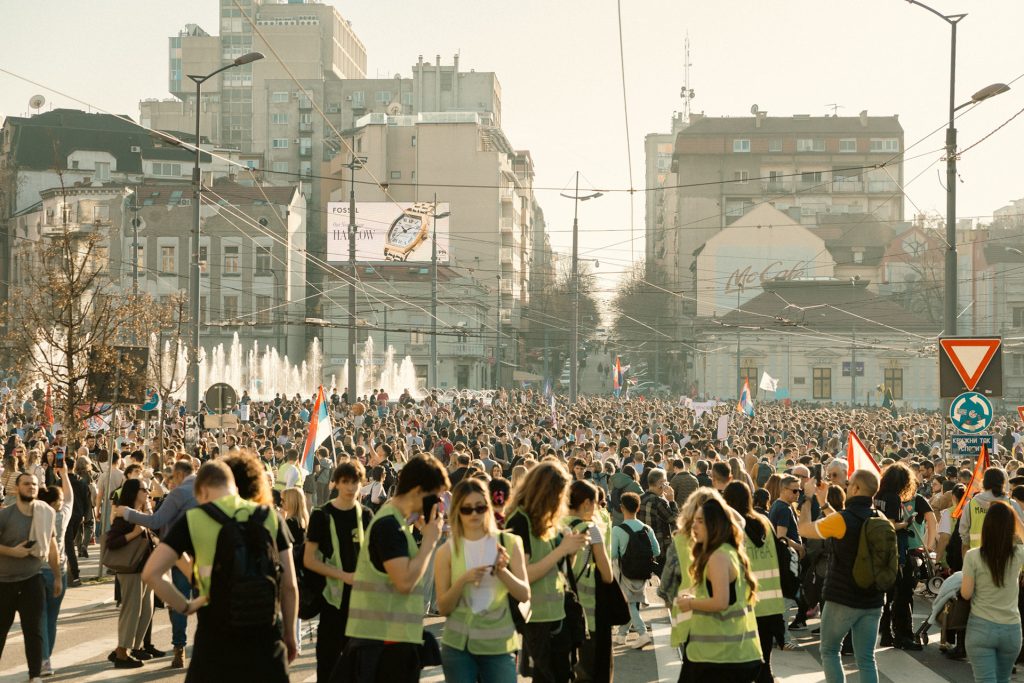
The large student protest held on 28 June, St. Vitus Day in Serbia, featured several speakers who used nationalist rhetoric and invoked the Kosovo myth (linked to the 1389 Battle of Kosovo, fought on that day). Some of the speakers were known supporters of nationalist causes.
Many liberal and pro-EU supporters of the student movement were dismayed by these speeches and criticised them afterwards. However, in the days that followed, the focus in Serbia shifted to street blockades, which the students initiated to pressure Vučić into calling snap elections.
Meanwhile, some commentators, mostly outside Serbia, continued to focus on the 28 June speeches, concluding that “Greater Serbian nationalism seems to have won the upper hand” among the students (journalist Michael Martens) and that it is now “the main driving force behind the protests” (economist Branko Milanović). Notably, these portrayals have not appeared in the regime’s official narrative, which continues to claim the protests are a Western-backed “colour revolution.”
Despite the criticisms, no liberal or pro-EU party, organisation, or influential public figure has withdrawn support for the student movement. This cannot be understood without recognising the complexity of both the movement itself and its base of supporters.
Protest heterogeneous from the beginning
From the beginning of the movement, in November 2024, both liberal and nationalist elements have been involved. The nationalist segment took centre stage on 28 June, due to the symbolic significance of this date. But this alone is not enough to conclude that nationalism has become the dominant agenda of the movement, especially since those themes have not reappeared in student messaging since that day.
Careful observers of Serbian public opinion should not be surprised that the student movement is ideologically heterogeneous. Only a minority of the Serbian population is currently enthusiastic about the EU. According to the latest Eurobarometer survey, only 37% of citizens trust the EU, while a CeSID poll shows that just 27% have a very positive or positive view of it.
There are several reasons for this, but a major one is the regime’s propaganda. Anti-EU narratives dominate Serbian public discourse and are primarily driven by the highly influential regime-controlled media. Any political actor promoting liberal, pro-Western policies has been smeared and vilified by these outlets, allowing Vučić to maintain his nationalist credentials by contrast.
Vučić has succeeded in making it nearly impossible for an ideologically coherent political alternative to remove him. There simply aren’t enough opposition voters on either end of the ideological spectrum. This is one of Vučić’s most significant strategic victories.
The remaining pro-EU opposition-minded citizens of Serbia are largely aware of this reality. That’s why the necessity of a broad coalition of anti-regime voters, including nationalist opposition, is rarely denied. Just like the regime itself, its opposition is neither purely pro-European nor purely nationalist. It is, above all, purely anti-authoritarian.
Such a broad coalition has already taken shape in recent months: it is the student movement and its supporters. The regime’s authoritarian response to the protests has further polarised society, making the divide between pro- and anti-Vučić forces the central political fault line. This polarisation has helped keep the ideologically diverse coalition of student supporters united, at least for now. The general consensus is that ideological divisions should reemerge only after the regime is defeated.
A new kind of nationalism?
Beyond these strategic considerations, there is a more substantive complexity to address. It is too early to claim that students adhere to the same kind of nationalism that dominated the 1990s, or the kind currently promoted by the regime. Some students have occasionally made vague references to national identity and symbols, peaking on 28 June. However, they have not called for aggressive policies toward neighboring countries or minorities within Serbia.
In fact, there have been encouraging developments in inter-ethnic relations since the start of the protests. The integration of Bosniak students from Novi Pazar into the movement has been widely seen as a major step forward in Serb-Bosniak relations. Student protest held in the Bosniak-majority city of Novi Pazar in April was filled with unprecedented symbolism, including students with hijabs carrying Serbian flags.
The truth is that the nationalist sentiments among these protesting students, most of whom were born after 2000 and grew up in the political atmosphere shaped by the Vučić regime, have not crystallised into a clear political program. A hopeful view, supported by some evidence, is that the majority of students, though not liberal cosmopolitans, also reject the aggressive, toxic nationalism that led to the breakup of Yugoslavia. They may be somewhere in between and could succeed in shaping a more constructive and benign sense of national identity.
We will have to wait and see how things unfold, but for now, it is certainly too early to assign exclusive ideological labels. If nationalism were to become the core of the students’ agenda, it would undoubtedly fracture the movement. At this stage, however, it appears that there is a broad awareness among the regime’s opponents that such a development must be avoided.