Following the brutal police crackdown on protests across Serbia last month, the ruling regime in Belgrade has not only launched an offensive in foreign media to polish its tarnished reputation, but has also sent a series of letters to European institutions and foreign embassies in Serbia with the same objective.
As European Western Balkans has learned from diplomatic sources, in recent weeks, letters from Serbian authorities have been regularly arriving at the different addresses across European countries and institutions, seeking to discredit the students and citizens participating in the protests.
These letters justify the police actions as a response to violence allegedly perpetrated by the protesters.
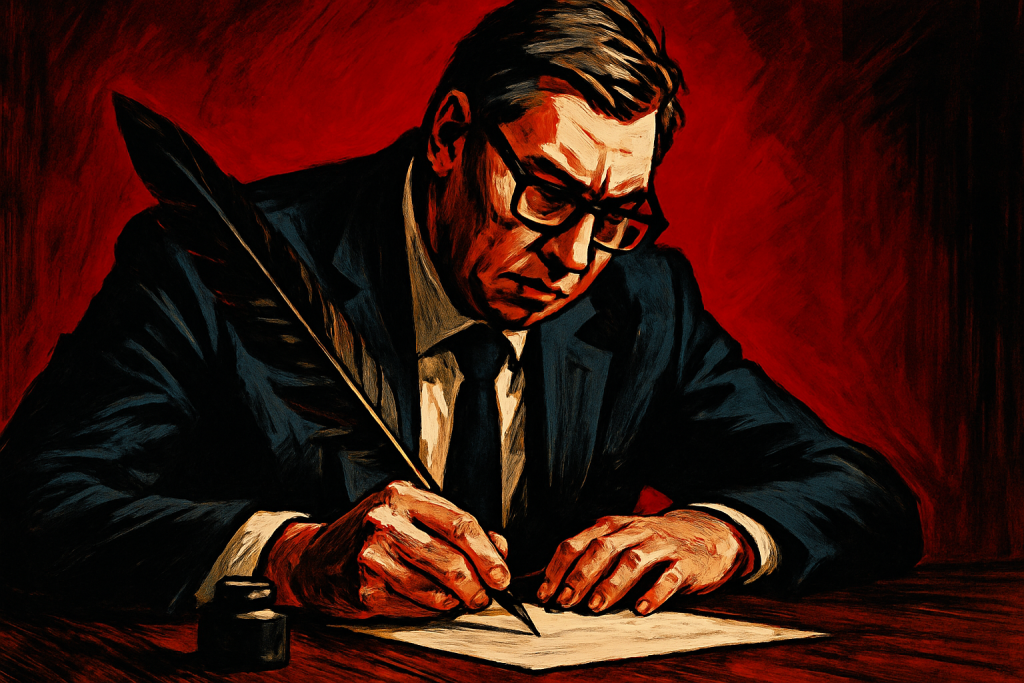
One such letter, which leaked on Wednesday, was sent by Serbian President Aleksandar Vučić to European Commission President Ursula von der Leyen on 21 August.
In addition to discrediting students and citizens, Vučić claims in the letter that the civic protests “pose risks not only to Serbia, but also to the stability of the wider Western Balkans”.
What does the letter say?
In the letter to the EC President, Vučić accused protest participants of “organized violence”, noting that mass demonstrations have disrupted daily life, restricted freedom of movement, and created economic hardship for many Serbian citizens.
He adds that the Serbian police have acted with maximum restraint, ensuring public peace while avoiding the systematic use of force.
“Nonetheless, as protest participation has diminished, certain opposition elements have escalated their tactics into organized violence, including attacks on police officers, public facilities, and private property. More than 170 police officers have been injured while fulfilling their duty to protect citizens – a responsibility that lies at the heart of every democratic state”, Vučić writes in the letter to which EWB had access.
He further notes that the state is concerned by the spread of manipulated narratives and disinformation, which attempt to present violent incidents as peaceful demonstrations and legitimate enforcement actions as repression.
“Some organizations, including certain media and NGOs, are unfortunately being drawn into political conflicts, often amplifying unverified allegations that serve to undermine institutions and erode public trust. This risks creating distorted image of events in Serbia, both domestically and internationally”, Vučić writes.
In the letter, he explains to the European Commission President that Nikolina Sinđelić, a student who was held in the Serbian government building during the protests and claimed she was beaten and threatened with sexual assault by Marko Kričak, commander of the Unit for the Security of Certain Persons and Facilities (JZO), is in fact not a student but a member of an opposition party.
The letter concludes that Serbia is fully committed to its European path, to democratic values, and to the rule of law.
“However, attempts to destabilize our country through violence and disinformation pose risks not only to Serbia, but also to the stability of the wider Western Balkans. These are fragile societies where such tactics could easily be replicated undermining regional peace and the shared European project”, Vučić concludes.
Many experts in Serbia interpreted this Vučić’s message as a threat to the EU, suggesting he is ready to provoke destabilization in the region if the European administration provides more open support to citizens on the streets.
To support his claims that the protesters were the ones being violent, Vučić included at the end of the letter a link to a YouTube channel (Violence Library), which had been created just one day before he sent the letter. It contains video footage, which also circulated in pro-government media, showing clashes between citizens and police.
Vučić also attached photographs form the protests depicting scenes of the ruling Serbian Progressive Party (SNS) offices being vandalized.
What happened in August?
While it is true that protests across Serbia in mid-August saw instances of violence, President Vučić conveniently omitted that many demonstrators resorted to stronger measures in response to attacks by supporters of the ruling party.
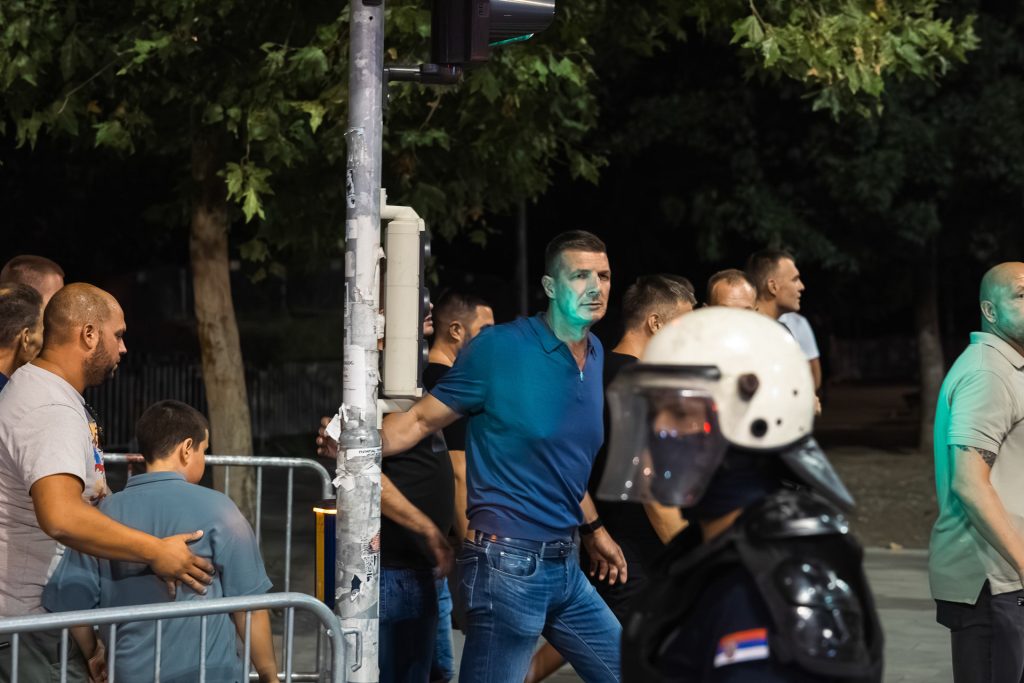
The violence began in mid-August when mostly masked supporters of the Serbian Progressive Party (SNS) attacked citizens during peaceful protests in Vrbas and Bačka Palanka.
While SNS loyalists used fireworks and other pyrotechnics against demonstrators, the police protected the party supporters and targeted the citizens, arresting and beating them.
The following night, in Novi Sad, similar clashes occurred, with SNS members again using pyrotechnics against protesters while the party office was vandalized.
The inadequate response of the police, coupled with the presence of Serbian army personnel during the protests in Novi Sad, has sparked even larger demonstrations across Serbia.
In Valjevo, a city in western Serbia, serious incidents of police violence against citizens were reported, while supporters of the ruling SNS party, who attacked protesters, were reportedly left unchallenged.
During the protests in Belgrade, the Secretary General of a pro-European opposition Freedom and Justice Party (SSP), Peđa Mitrović, was also attacked. Mitrović claims that he was assaulted by masked supporters of the SNS, while the police, who were stationed in a cordon nearby, did not react.
Additionally, SNS loyalists in Belgrade were reportedly led by the president’s brother, Andrej Vučić. Vučić’s son was also seen among them.
Although President Vučić condemned attacks on private property, apparently referring to SNS party offices, he did not mention numerous instances of damage to the property of citizens participating in or supporting the protests, which have been occurring for months.
One such case involves Milomir Jaćimović, a transport entrepreneur from Novi Sad. On multiple occasions, masked individuals vandalized his buses, reportedly because they are used to transport students.
In a letter to the President of the European Commission, Vučić claims that student protests are obstructing freedom of movement. However, he failed to mention that his supporters have been blocking one of the busiest streets in Belgrade for six months, the area between Pionirski Park and the National Assembly, now pejoratively known as “Ćacilend”.
The police have been guarding this area for six months, and numerous media reports have shown that it is frequented by individuals with criminal backgrounds. Among them, during one protest, was seen Đorđe Prelić, a convicted murderer of French football fan Brice Taton.
What is the purpose of these letters?
Vladimir Međak, Vice President of the European Movement in Serbia, told EWB that this letter is an attempt to salvage the government’s reputation in Europe, since no one can any longer claim that Serbia is a democratic country or that Vučić is anything other than an autocrat.
“This is an extraordinary moment when the president of a country sues his own citizens before the President of the European Commission. He is asking for her help, just as he seeks help from Moscow and Beijing. He looks abroad for support because it is clear that he has lost his citizens and legitimacy at home,” Međak said.
He assessed that the letter is full of falsehoods and that it seeks to portray the President of Serbia as a victim and the citizens as aggressors.
The sentence in which Vučić warns that instability could spill over into the region, Međak interprets as a direct and open threat.
“This is a threat. Until now, his government has been involved in instability in North Macedonia, Montenegro, Kosovo, and Bosnia and Herzegovina. That is his track record. Everyone in the EU is well aware that he is capable of causing instability. With this sentence, he is directly and openly threatening regional stability,” Međak said.
He added that, with this letter, the President of Serbia is also trying to prevent clearer EU support for students and demonstrators, since they are the ones advocating for European values in Serbia.