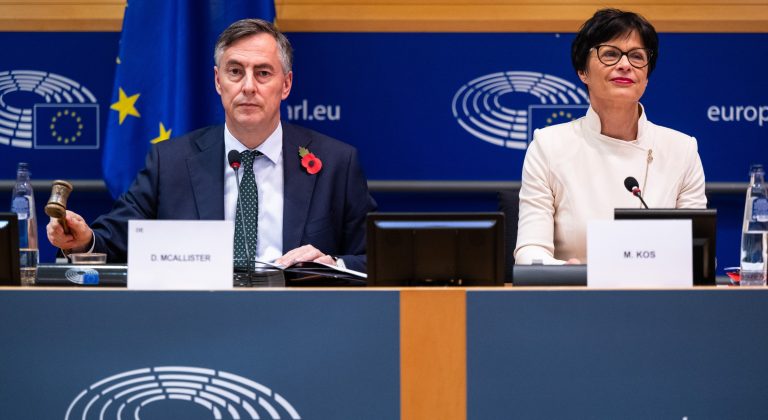
BRUSSELS – Presenting the European Commission’s annual reports on EU candidate countries, Enlargement Commissioner Marta Kos told the European Parliament’s Committee on Foreign Affairs (AFET) today that there is strong support for the enlargement of the European Union and that 2025 has been a good year for some candidate countries.
“We have made significant progress with Montenegro, Albania, Moldova, and Ukraine. Reforms pay off, and that should serve as additional motivation for other candidate countries,” Kos said.
She announced that the EU will soon begin preparations for the accession treaty with Montenegro. Kos explained that over the past year, the European Union had strengthened gradual integration through various instruments for Ukraine and the Western Balkans.
“The new instruments we have reflect the geopolitical reality. We need different mechanisms before candidate countries become full members. A good example is the integration of the energy market with Moldova and Ukraine. Some candidates have joined SEPA, and we are also advancing in the area of roaming,’’ Kos noted.
She added that next week, the EU will adopt the “European Democracy Shield”, part of which will be the Civil Society Strategy, also extended to candidate countries.
“We must protect democracy. We also plan to strengthen independent media, as they are the foundation of all democratic systems, especially in the fight against disinformation,” Kos said.
Speaking about Serbia, she assessed that the pace of reforms has significantly slowed, stressing that the country needs to implement reforms in numerous areas, particularly in fundamental rights and alignment with the EU’s foreign and security policy.
“Serbia must reverse the negative trend in freedom of expression and academic freedoms, and ensure further progress on electoral legislation,” Kos underlined.
Regarding Bosnia and Herzegovina, Kos said the country had experienced tensions within the ruling majority but ultimately adopted a Reform Agenda following recent institutional changes in Republika Srpska.
Kos noted that North Macedonia has aligned its foreign policy with the EU but has not yet advanced at the expected pace, adding that constitutional changes are necessary to move forward.
As for Kosovo, Kos said it remains committed to its European path, but progress has been hindered by domestic political developments.
The European Parliament’s rapporteur for Serbia, Tonino Picula, said the European Commission’s report confirms what MEPs have been warning about for some time.
“Serbia must decisively move forward on its EU path. Promises must be fulfilled, particularly in the areas of media freedom, judiciary reform, and electoral reform in line with OSCE/ODIHR recommendations,” Picula stated.
He also pointed to the negative campaign against the EU led by Serbia’s top officials and pro-government media, which, he said, undermines public trust in the Union.
The rapporteur for Albania, Andreas Schieder, said there is hope that the negotiations could be completed by the end of 2027. He described this as a positive goal that would keep pressure on the political and bureaucratic system and on society as a whole to adopt the necessary laws.
The rapporteur for Kosovo, Riho Terras, described the past year as turbulent for Kosovo and urged EU institutions to lift the restrictive measures imposed on the country.
“Kosovo has shown resilience and commitment, maintaining public order, peace, and democratic continuity, and is ready to cooperate with EU institutions. We must respond with the same political courage and consistency,” Terras said.
The rapporteur for Montenegro, Marjan Šarec, said the Commission’s report reflects good progress across all areas and added that Montenegro’s authorities are aware of the importance of this moment.
He stressed that EU enlargement must take place during this mandate, with or without internal EU reform.
“If the candidates are ready to meet their obligations, there must be no blockage from the European side,” Šarec stated, adding that it is time to start preparing the accession treaty with Montenegro.
The Commission’s reports were also discussed at a joint press conference with Commissioner Kos and the EU High Representative for Foreign Affairs and Security Policy, Kaja Kallas.
Kallas emphasised that enlargement is both a priority and an investment, noting that Russia’s invasion of Ukraine has demonstrated just how crucial enlargement is.
However, she stressed that the EU will not offer shortcuts to membership, as accession is a fair and demanding process.
“Opportunities for enlargement do not come often, but right now, we have one and we must seize it. We will not offer shortcuts. EU accession is a fair and demanding process based on results. A realistic goal is to have new members by 2030,” Kaja Kallas concluded.