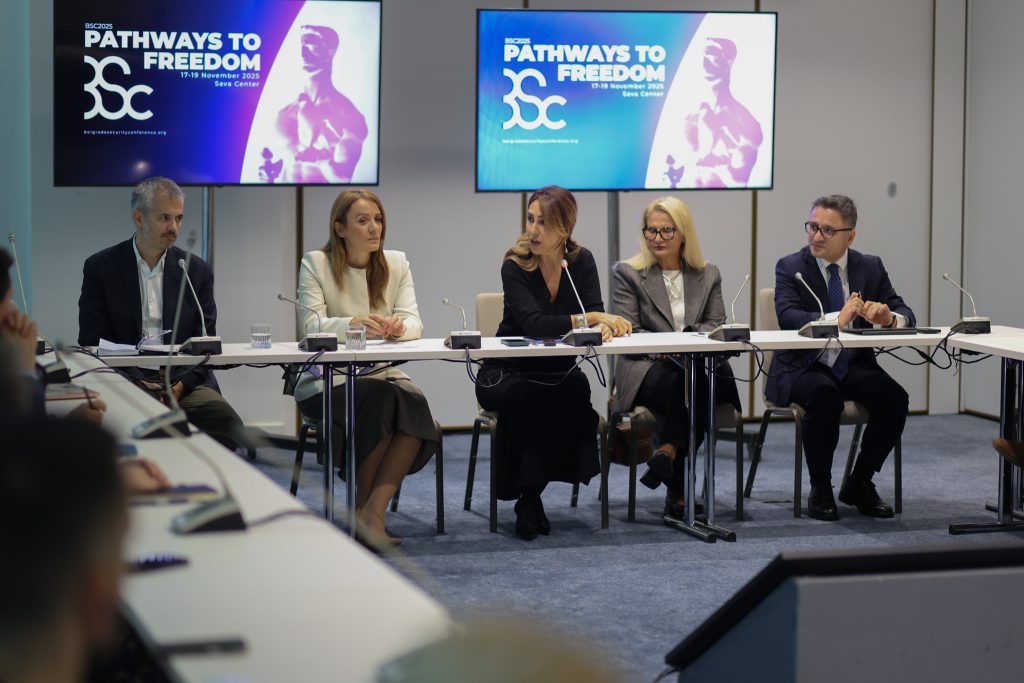
BELGRADE – The future of the region depends on accelerated reforms, economic convergence with the EU, tangible results, and decisive support from the EU to ensure stability and progress, concluded the participants of the panel on enlargement at the Belgrade Security Conference (BSC).
Tanja Miščević, Professor at the Faculty of Political Science, University of Belgrade, and former Minister for European Integration of Serbia, emphasised that the geopolitical shifts following the war in Ukraine have highlighted the longstanding need for progress in the Western Balkans.
According to her, the combination of these factors led to the concept of gradual or accelerated EU integration, resulting in documents such as the Growth Plan for the Western Balkans and Moldova, as well as a special plan for Ukraine.
Miščević explained that the introduction of interim steps before full EU membership is a response to a process that has taken a quarter of a century to reach serious discussions about the Western Balkans.
“Geopolitical momentum and the need to respond to urgent challenges required adjustments in enlargement policy, but without changes to the EU’s primary law, fundamental reform of the process is impossible”, Miščević said.
She highlighted that the EU is currently exploring options to deliver tangible, short-term results, drawing on ideas from think tanks, NGOs, and regional platforms.
She added that the aim is to demonstrate concrete progress and counter “enlargement fatigue,” which has contributed to reform fatigue in the region.
However, Miščević pointed out the main issue with the Growth Plan: there is no clear link between its four pillars and the actual accession process.
She also stressed the need for economic convergence with the EU before accession, which requires funding currently available only to EU members.
“Without unanimous agreement among member states to revise existing pre-accession funding rules, including the Resilience and Recovery Mechanism, meaningful change is not possible”, Miščević said.
Fatmir Besimi, founder and CEO of Strategers and former Minister of Finance of North Macedonia, emphasised that reforms require resources – financial, institutional, and in terms of time.
“Political cycles and short-term priorities often lead to compromises that slow progress in key areas such as the rule of law, the fight against corruption, and infrastructure projects,” Besimi said.
Speaking on the financial aspect, he noted that the figures clearly show an imbalance between the region and the EU.
“IPA funds for the Western Balkans amount to around €150 per capita annually, while new EU member states receive about €3,000 per capita annually through structural and regional funds alone. This gap demonstrates that EU membership significantly accelerates convergence and supports the necessary reforms,” Besimi said.
He added that the Western Balkans’ economies, with a population of around 20 million, do not pose a burden on the EU budget.
“It is important to emphasise that the Western Balkans is part of Europe’s future, and both sides must act accordingly. While reforms are being implemented, the pace remains the core challenge. Civil society and intermediary organisations between politicians and citizens play a crucial role in this process, providing a voice that can help accelerate reforms and strengthen the case for enlargement,” Besimi concluded.
Biljana Papović, State Secretary at Montenegro’s Ministry of European Affairs, stated that Montenegro has undergone a kind of reset in its approach to EU enlargement and the implementation of reforms.
She explained that the new government, formed under complex political circumstances, managed to identify a common denominator among diverse political actors by relying on the fact that EU integration remains the broadest point of social consensus.
Papović recalled that support for EU membership in Montenegro stands between 70% and 80%, making European integration the strongest “ideology” in the country and a key driver of reforms.
She emphasised that Montenegro cannot complete the process of closing negotiation chapters on its own, given its limited financial and administrative capacities.
“This is why the support of EU member states, as well as regional cooperation, is of great importance. This government has no Plan B – our only goal is to complete our obligations by the end of next year,” Papović said, adding that progress by other countries in the region would contribute to overall stability and the success of the Western Balkans.
Agon Maliqi, Nonresident Senior Fellow with the Atlantic Council’s Europe Center, emphasised that, after a decade of scepticism toward the EU, a new dynamic is emerging in the region, led by two countries that are actively taking advantage of the current momentum and whose progress can encourage others.
He stressed that the EU must make it even clearer that its doors are open, and that progress on the European path must bring tangible benefits.
“The EU must also provide stronger support to actors in the region who advocate for change, including those in Serbia, where there is significant social potential but insufficient direction. In addition, the EU needs to take a more active role in resolving security issues and bilateral disputes that hinder enlargement, because otherwise that space will be filled by other powers, primarily the United States,” Maliqi said.
He concluded that the EU can regain its credibility only if it combines principled policies, support for reforms, and decisive action in addressing security obstacles.