At this week’s Intergovernmental conference, Montenegro succeeded in closing five more negotiating chapters in its EU accession process. This means the country enters the new year with a third of the chapters closed, while 2026 is widely seen as a key year for achieving the Government’s ambition of Montenegro becoming the 28th member state of the European Union by 2028.
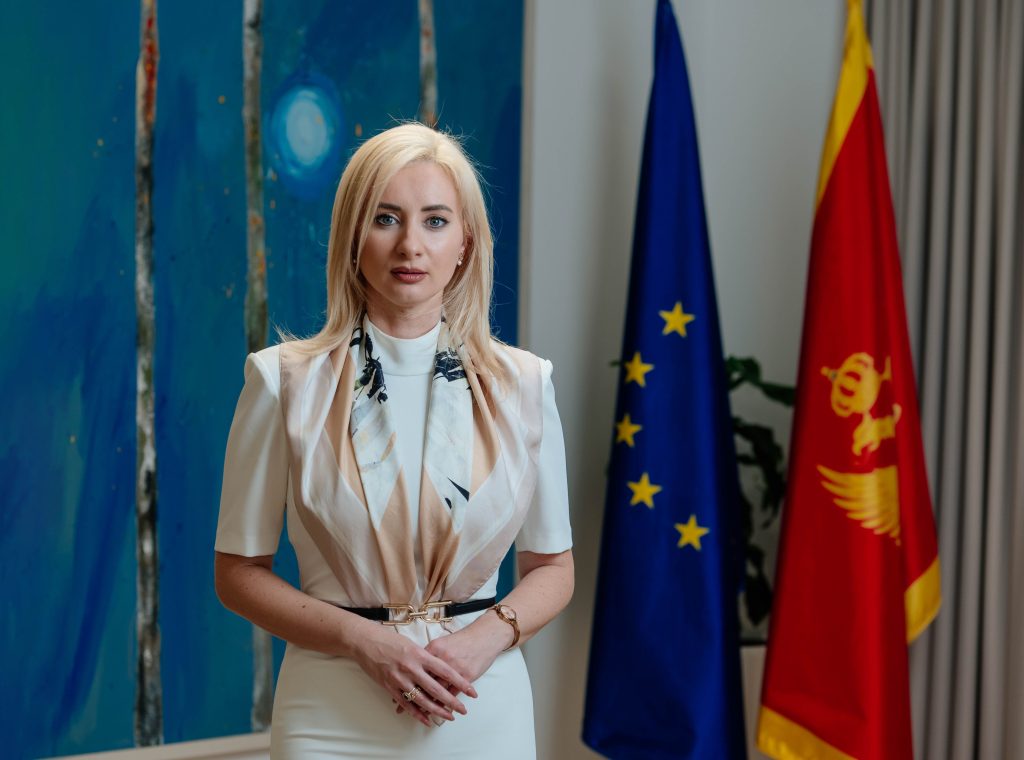
About the process during 2025, future plans, and the challenges on the path to the European Union, we spoke with Maida Gorčević, Minister for European Integration in the Government of Montenegro.
European Western Balkans: Following the Government’s diplomatic offensive, an agreement was eventually reached with France on closing the chapters related to fisheries and agriculture. As EWB has learned, part of the agreement includes special monitoring of these areas after the chapters are closed. What would that mean in practice?
Maida Gorčević: The EU accession negotiations are both a technical and a political process, based on trust, dialogue, and an assessment of a candidate country’s ability to sustainably implement reforms. For this reason, diplomatic dialogue with EU member states is an integral and entirely normal part of the negotiating dynamic. After the closure of each negotiating chapter, including fisheries and agriculture, there is regular monitoring of the implementation of undertaken obligations.
This applies to all candidate countries and is carried out through the European Commission’s annual reports, as well as through continuous institutional dialogue with the EU. In that sense, this is not a new or “special” mechanism, but rather a well-established element of the accession process.
It is therefore important to clarify precisely that Montenegro has not been subjected to any additional or special requirements related to Chapters 11 and 13; this is standard European Union practice.
The agreement with France was reached through institutional and diplomatic dialogue, during which concrete reform steps and results achieved by Montenegro in these areas were presented.
The closure of the chapters confirms that the benchmarks have been met and that there is confidence in Montenegro’s capacity to consistently implement its obligations even after the provisional closure of the chapters.
EWB: Despite the fact that Montenegro has met the technical criteria for closing Chapter 31, it has not yet been closed due to bilateral issues with Croatia. The Government has been working with the authorities in Zagreb to resolve these issues. How far has this process advanced, and do you expect Croatia to unblock this chapter in the near future?
MG: The EU accession process always combines technical criteria with political dynamics, and Chapter 31 – Foreign, Security and Defence Policy – is a clear example of how bilateral issues, although formally outside the EU acquis, can affect the pace of negotiations.
Montenegro has fully met the technical criteria and benchmarks in this chapter and has fully aligned its foreign policy with the EU’s Common Foreign and Security Policy (CFSP). At this stage of the process, assessments should be based on a merit-based approach, that is, on clearly defined benchmarks and concrete results, rather than on other factors.
In the previous period, tangible progress has been made in dialogue with Zagreb through intensive political contacts and open discussions on issues of mutual interest, with a clear commitment to resolving them in a European spirit.
While it would be ungrateful to speculate about the political decisions of other member states, we expect that continued constructive engagement and goodwill on both sides will create the conditions for unblocking the chapter in the near future.
Croatia has repeatedly confirmed its support for Montenegro’s European path, and resolving outstanding bilateral issues through dialogue is the best confirmation of that support. Montenegro’s EU membership remains a shared interest of both countries.
EWB: How do you assess the past year in terms of Montenegro’s European integration? Is the Government satisfied with what has been achieved, and do you believe more could have been done?
In Montenegro, we considered 2024 to be the most successful year in the history of our European integration, but 2025 has been even more successful. Since June of last year alone, this Government has unblocked the negotiation process and closed as many as nine chapters, clearly demonstrating that this is not merely about promises, but about concrete results.
With six chapters closed this year and the realistic prospect of starting the drafting of the Accession Treaty, I would give 2025 a top grade. This success is the result of the continuous commitment and efforts of the Government, Parliament, all relevant institutions, and the public administration, which has closely followed the dynamics of the plan and set a clear goal – EU membership by 2028.
Beyond chapter closures, this year we have also demonstrated success in implementing the reform agenda under the EU Growth Plan for the Western Balkans. We became the first country to join the Single Euro Payments Area (SEPA), further strengthening our integration into European financial and institutional mechanisms.
In addition, Montenegro received a 150 million euros EU grant for the construction of the second section of the motorway – a tangible result that citizens can see and feel. All these steps show that we are not only meeting technical criteria, but are also proactively building the capacity to implement reforms consistently.
Our ambitions do not end here. We plan to close all negotiating chapters by the end of 2026, while continuing to strengthen institutions and reforms that deliver concrete benefits to citizens, confirming that Montenegro knows how, and is able, to pursue the European path in a stable and constructive manner.
EWB: The German Chancellor supported last week the idea of launching the drafting of Montenegro’s Accession Treaty. What would the start of this process mean for Montenegro, and do you see consensus among all member states to move in this direction?
MG: The launch of drafting Montenegro’s Accession Treaty is a logical and expected step after the closure of more than one third of the negotiating chapters. With continued and consistent reform efforts, we expect that all negotiating chapters could be closed by the end of 2026.
The drafting of the Accession Treaty would send a strong political message, further reinforcing our reform efforts and strengthening citizens’ sense that EU membership is not just a strategic goal, but a tangible reality. Germany’s support for this process is particularly significant, as it confirms that key partners recognise our results and commitment.
As for consensus among member states, there is currently a realistic expectation of agreement, with the understanding that some countries will closely monitor the final phase of fulfilling our obligations, which is standard practice in the accession process. What remains essential for us is respect for the merit-based approach: membership must be grounded in results and achievements.
Overall, the start of drafting the treaty would be an important signal that Montenegro is building credibility and trust within the European context, confirming its ability to implement reforms and meet all obligations on the path to full membership.
EWB: Next year has been described as crucial for completing the negotiations. What are the Government’s ambitions for the first half of the year?
Since its formation in late November 2023, the Government’s work has been exceptionally dynamic and continuous, at no point have we paused or postponed strategic tasks. This is a Government that does not waste time, but focuses on concrete results and fulfilling key obligations towards the EU.
The plan for the first half of the year includes intensifying dialogue with EU institutions and member states, as well as implementing concrete measures that directly improve citizens’ lives, reaffirming that Montenegro knows how and is able, to pursue the European course in a stable and constructive manner.
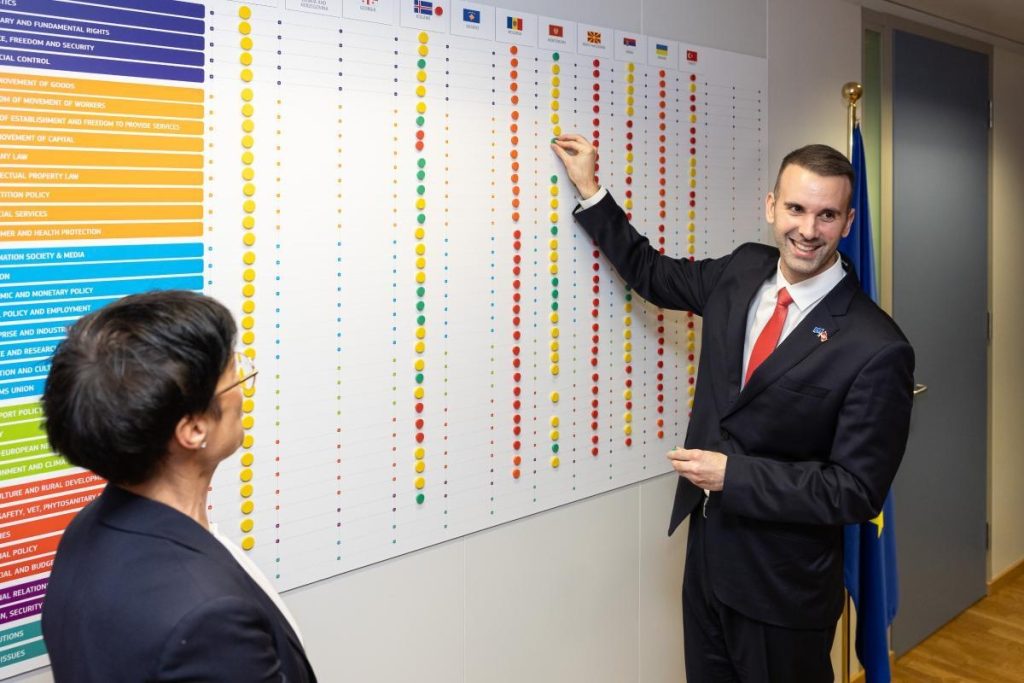
In the first half of next year, we expect the closure of a large number of negotiating chapters, as well as an announcement on the start of drafting the Accession Treaty. Clearly, our objective, and what we consider achievable, is the completion of the negotiation process by the end of 2026. This ambition is grounded in the continuous efforts and results already achieved in reforms, institutional strengthening, and the improvement of the legislative framework.
EWB: Several countries, such as France, are considered sceptical about enlargement in general. In France, citizens are likely to vote in a referendum on Montenegro’s accession. What activities is the Government undertaking to convince these member states that enlargement is in the EU’s interest?
MG: We are continuously conducting diplomatic activities, building partnerships with EU member states and representatives of EU institutions. The recent situation with France served as a kind of wake-up call and further reminded us that, alongside reform results, we must intensify political communication and improve our communication strategy towards all member states, with a particular focus on those that are currently more reserved about enlargement.
Our goal is to familiarise member states with the benefits that Montenegro’s membership would bring to the European Union, as well as to all candidate countries, by demonstrating that the enlargement policy is alive and that the EU values concrete results and a merit-based approach. We want to present Montenegro as a success story for the whole of Europe.
That is why our focus is on consistently presenting Montenegro’s achievements on its European path – reforms, institutional strengthening, and concrete results that demonstrate that Montenegro’s membership is in the interest of the entire European Union.
Through open dialogue and transparent communication, we are building additional trust and credibility, particularly with member states that take a more cautious stance on enlargement.
EWB: What do you see as the biggest challenge for Montenegro in the upcoming period of the accession process?
MG: The process of European integration entails a profound societal transformation shaped by reforms. Among all reform efforts, those related to the rule of law, judicial independence, and the fight against corruption and organised crime are the most complex for any society. It is no coincidence that the new methodology placed these chapters in the fundamental cluster that is closed last, clearly underlining that progress in these areas is key to a candidate’s political compatibility with mature democracies.
The greatest challenge is not merely implementing technical reforms, but delivering concrete results – investigations, verdicts, and strengthened societal resilience to anomalies such as corruption and organised crime. This requires joint and coordinated action by all decision-makers, as well as the active involvement of civil society.
I believe we are on the right track in this regard. Overall, the greatest challenge in the coming period will be maintaining the continuity of reforms in the final phase of negotiations and building lasting public trust in institutions, because this is precisely what makes the European integration process sustainable and credible.
EWB: Despite the country’s political dynamics, there appears to be consensus in the Montenegrin Parliament on European integration. Do you expect the Parliament to remain a constructive actor next year?
MG: I do not believe that the political situation in Montenegro can be described as turbulent, on the contrary, it is quite calm and stable, even when compared to developed European democracies.
Parliament is a key partner in fulfilling obligations under the European agenda, and the Government has a high-quality and substantive cooperation with it. I expect all institutions whose contribution is crucial in this pivotal year of our European path to remain committed to the strategic goal of Montenegro’s EU membership.
I have no doubt that Parliament will continue to be a constructive actor in the coming year and will make a significant contribution to the continuation of the European integration process.