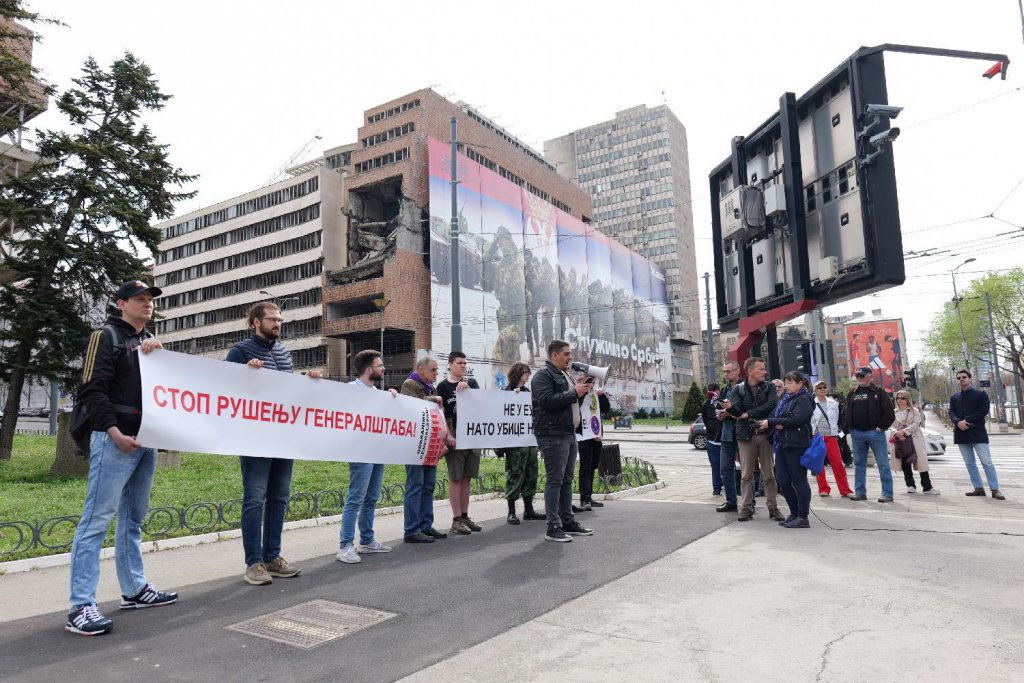
A majority of citizens of Serbia were opposed to the project to build a hotel-apartment complex on the site of the General Staff building in Belgrade, according to a public opinion survey conducted shortly before Jared Kushner’s company decided to withdraw from the project.
The survey was commissioned by the Belgrade-based Centre for Contemporary Politics and originally published on its Serbian-language Savremena politika portal. Centre for Contemporary Politics is also the founder of the European Western Balkans portal.
As many as 64.3 per cent of respondents said they fully or mostly did not support the Serbian government’s plan to build a complex at this location that would be majority-owned by a company belonging to Jared Kushner, the son-in-law of U.S. President Donald Trump.
When asked whether they supported the project, 44.5 per cent of respondents said they “do not support it at all,” while 19.9 per cent said they “mostly do not support it.” On the other hand, 28.1 per cent of citizens said they “mostly support” the project, and 7.6 per cent said they “fully support” it. Overall, 35.7 per cent of respondents supported the project.
The survey was conducted by telephone between December 3 and December 11, 2025, on a representative sample of 1,000 respondents.
Citizens were also asked about the possible presence of corruption in the project. Nearly half of respondents (47.3 per cent) believe that the project contains elements of corruption “to a large extent,” while an additional 17 per cent said corruption exists “to a lesser extent.” Meanwhile, 16.6 per cent of respondents believe there is no corruption in the project, and 19 per cent said they did not know.
The withdrawal of Kushner’s company from the project was officially announced on 15 December. A spokesperson for the private investment firm Affinity Partners stated that the company was withdrawing “out of respect for the people of Serbia and the city of Belgrade,” explaining that “major projects should unite, not divide.”
The authorities signed the contract with Kushner’s company in May 2024. It provided for the removal of the General Staff complex’s status as a cultural monument, the demolition of existing buildings, and the granting of the land on a 99-year rent-free lease, with the possibility of later converting it into ownership rights at no cost.
At the same time, the Public Prosecutor’s Office for Organised Crime filed an indictment proposal last week against Minister of Culture Nikola Selaković and three other individuals, in connection with illegalities related to the removal of cultural heritage protection from the General Staff buildings.
The General Staff and Ministry of Defence buildings in Belgrade were constructed between 1955 and 1965, based on a design by a renowned architect Nikola Dobrović, as a unified two-part complex on both sides of the street. During the NATO bombing in 1999, the complex was heavily damaged and has since stood as a symbol of wartime destruction, as well as of the unresolved relationship of the state toward its own cultural and historical heritage.