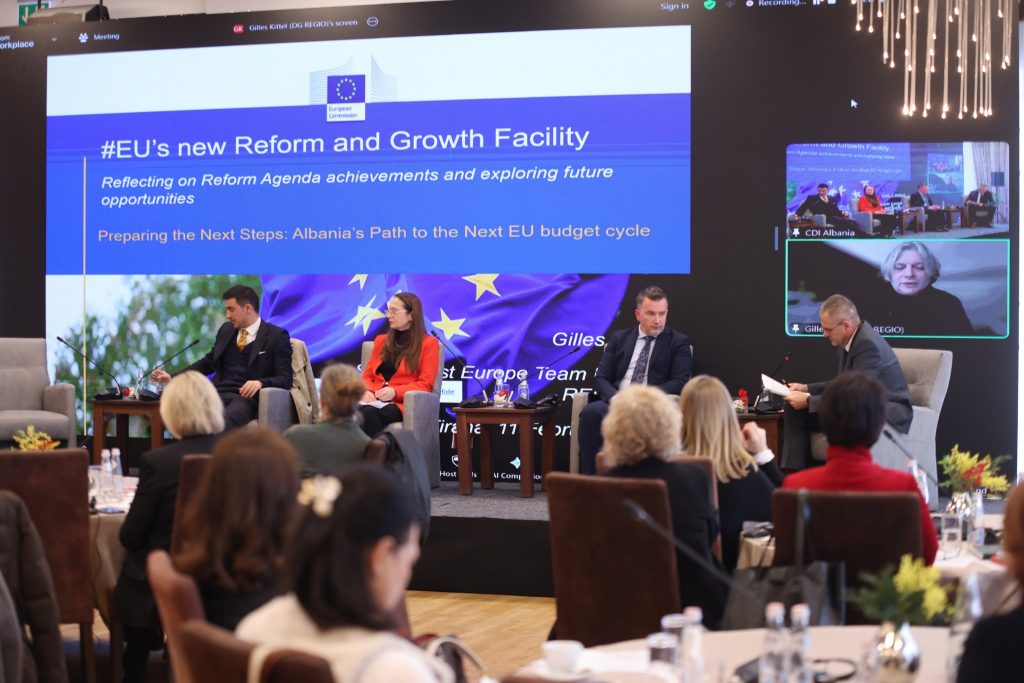
TIRANA – Performance and measurable results will determine not only the credibility of EU related reforms in Albania, but also the country’s readiness for the next stage EU budget cycle, it was concluded at the conference “Reflecting on Reform Agenda Achievements and Exploring Future Opportunities”, organized by Cooperation and Development Institute (CDI).
In her opening remarks, CDI Executive Director Krisela Hackaj framed the Growth Plan not merely as a funding tool but as a structural shift in governance.
She described it as “not simply a financing instrument, but a governance framework centred on performance, oversight, and stakeholder participation,” highlighting CDI’s Reform Tracker as a tool designed to support “data-driven oversight and wider participation.”
Ritva Heikkinen from the EU Delegation to Alabnia, acknowledged Albania’s “tangible results and strong political commitment,” but cautioned that sustained momentum, stronger planning, and broader stakeholder involvement, especially at local level, will be crucial as the country prepares for future EU funding frameworks.
It was added that the performance logic is most visible in the implementation phase.
With eight out of 31 reforms under its responsibility, the Ministry of Economy and Innovation carries the largest share of measures.Deputy Minister of Economy and Innovation of Albania, Blerta Rama, described the RGF as “a turning point in Albania’s reform process.”
According to Rama, as negotiations advance and timelines tighten, reforms are increasingly assessed through outcomes rather than legislative alignment alone. She added that accountability, transparency and implementation quality have become central, while inter-institutional coordination and local impact remain persistent challenges.
Lorela Simoni from State Agency for Strategic Programming and Aid Coordination (SASPAC) outlined the coordination architecture underpinning this approach: weekly reporting cycles, inter-ministerial working groups and monitoring protocols directly linked to financial disbursements.
“This system has allowed Albania to advance under performance pressure and stand out at regional level, although verification indicators, administrative constraints and capacity gaps remain structural limitations”, Simoni said.
Beyond institutions, the conference examined whether reforms enjoy real societal backing.
From the business community, Diana Leka of the Albanian Investment Council pointed to a paradox: optimism about EU integration coexists with concerns about weak consultation structures.
Reform ownership, she argued, depends on genuine engagement. “Businesses must organize and participate, but institutions must consult meaningfully and respond visibly”, she said.
Juliana Hoxha, Co-Chair of the EU-Albania Joint Consultative Committee, argued that participation often remains procedural rather than influential.
She called for RGF implementation to become publicly traceable, for the Monitoring Committee to function as a genuine governance body, and for dedicated funding to support civic engagement.
Adding a European civil society perspective, Oleg Roibu from the European Economic and Social Committee (EESC) stressed that participation is “a structural condition for credible enlargement, not an optional add-on.”
Limited capacity and insufficient stakeholder inclusion, he warned, risk creating governance deficits that could undermine both fund absorption and public trust.
According to him, consultation mechanisms must move from ad hoc practices to permanent institutional structures, ensuring genuine representation of employers, workers and civic organisations.
Preparing for the next EU Budget
During the conference, Albanian Government officials framed the RGF as a rehearsal for the next EU budget cycle.
Adrian Kamenica from the Prime Minister’s Office outlined Albania’s ambition to close negotiation chapters by 2027 and be technically ready to engage with the next EU budget from day one.
The RGF, he said, serves as a “performance-based rehearsal” for future EU governance requirements, preparing institutions for a significantly larger financial and administrative burden.
According to Kamenica, institutional capacity remains the core challenge, as civil servants juggle accession negotiations, reform reporting and daily responsibilities.
Kamenica highlighted efforts to develop a new monitoring system with reward-based incentives, noting that CDI’s Reform Tracker offers a useful model for independent oversight.
From a fiscal perspective, Deputy Minister of Finance Endrit Yzeiraj stressed that planning frameworks must evolve toward impact measurement.
“Future EU funding will demand justification not only of spending but of results. The challenge now is moving from planning ahead to planning well”, he assessed.
Gilles Kittel from the European Commission’s Directorate-General for Regional and Urban Policy presented discussions on the future Cohesion Policy, pointing toward stronger multi-level governance and performance monitoring systems capable of linking outputs to funding decisions.
“The partnership principle and requires engaging civil society, social partners and the private sector from the outset”, he concluded.