The article was originally published at Savremena politika in Serbian.
Arben Kingji, Chief of General Staff of the Albanian Armed Forces, announced last week that his country, Croatia and Kosovo would hold joint military exercises this year – two in Zagreb, and one in Tirana. According to Kingji, the cooperation plan “implies not only joint exercises, but also exchange of experiences and deeper operational coordination”.
This step is based on the agreement (Memorandum) on defense cooperation, which the three sides signed in March 2025, causing harsh reactions from the Serbian authorities.
Official Belgrade claims that the memorandum violated the 1996 subregional arms control agreement, as well as UN Security Council Resolution 1244, according to which KFOR is the only armed force in Kosovo and Metohija.
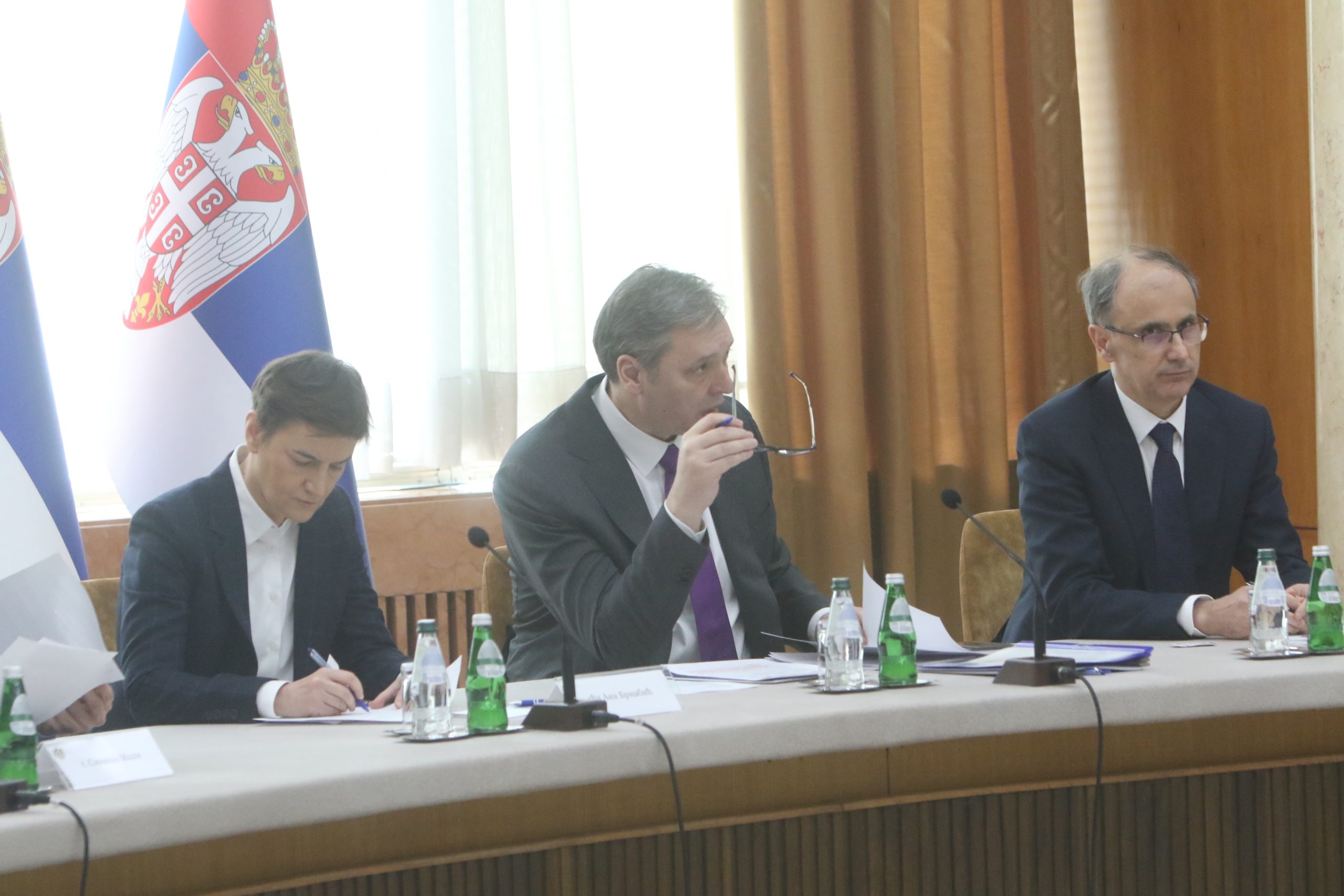
Last weekend, Serbian President Aleksandar Vučić reacted to the announcement from Tirana regarding joint military exercises, while commenting on the US armed action against Iran and the escalation of tensions in the Middle East for Informer TV.
Asked by a journalist how he saw the plans of the Albania-Pristina-Croatia alliance, Vučić repeated the claims that “it is directed against Serbia”.
“I noticed in the Croatian press that they write that I will go mad because they will have military exercises in Zagreb and Tirana. As if it was directed against me. No, it is directed against Serbia, I am completely rational, absolutely calm… Speaking about Croatia – it is a country that does not deliver to us those responsible for the most serious violent acts, such as terrorism… Croats demonstrate in the most brutal way that they are hostile towards us”, Vučić remarked.
Elaborating on Vučić’s claims, Ramadan Ilazi, Head of Research at Kosovar Centre for Security Studies (KCSS) in Pristina, states for Savremena politika, that he understands that this cooperation agreement is viewed with concern in Belgrade, “but I do not see objective grounds for such concern when one considers that, in terms of military and hard security, the primary actor in Kosovo remains NATO through its KFOR mission”.
“The sensationalization of this defence cooperation agreement appears largely driven by domestic political calculations, particularly at a time when President Vučić is facing a crisis of credibility”, Ilazi notes.
“Cooperation agreements are a typical defense strategy of small states”
In late January 2026, the officials overseeing defence policy and armaments of Croatia, Albania and Kosovo met in Zagreb. The Ministry of Defence of Croatia announced that they discussed the possibilities for improving cooperation in the domain of defence capacities, interaction between defence industries signatories of the memorandum and the steps for further implementation of the Memorandum, signed on 18 March 2025 in Tirana.
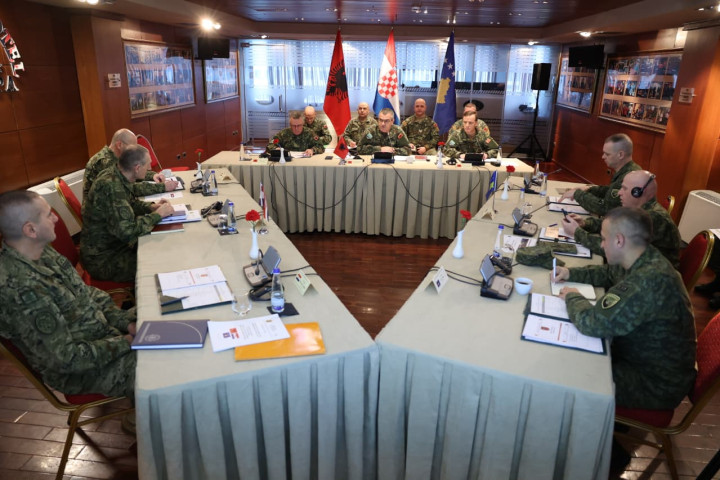
Also, in early February 2026, a meeting of the Chiefs of General Staff of the Albanian and Croatian armed forces, and the Commander of the Kosovo Security Force, was held in Shkodra. The focus of the talks was on deepening military cooperation through concrete plans.
A few days later, Defence Ministers of Croatia and Albania, as well as the Prime Ministers of Kosovo and Croatia, Albin Kurti and Andrej Plenković, met on the sidelines of the Munich Security Conference.
“We share common values with Croatia, and it is a supporter of our membership in NATO and the European Union”, Kurti said on this occasion.
Plenković stated on X that he discussed with Kurti the situation in the region, security challenges and the status of the Croatian minority in Janjevo, stressing that “Croatia continues to strengthen cooperation with Kosovo and supports its European path”.
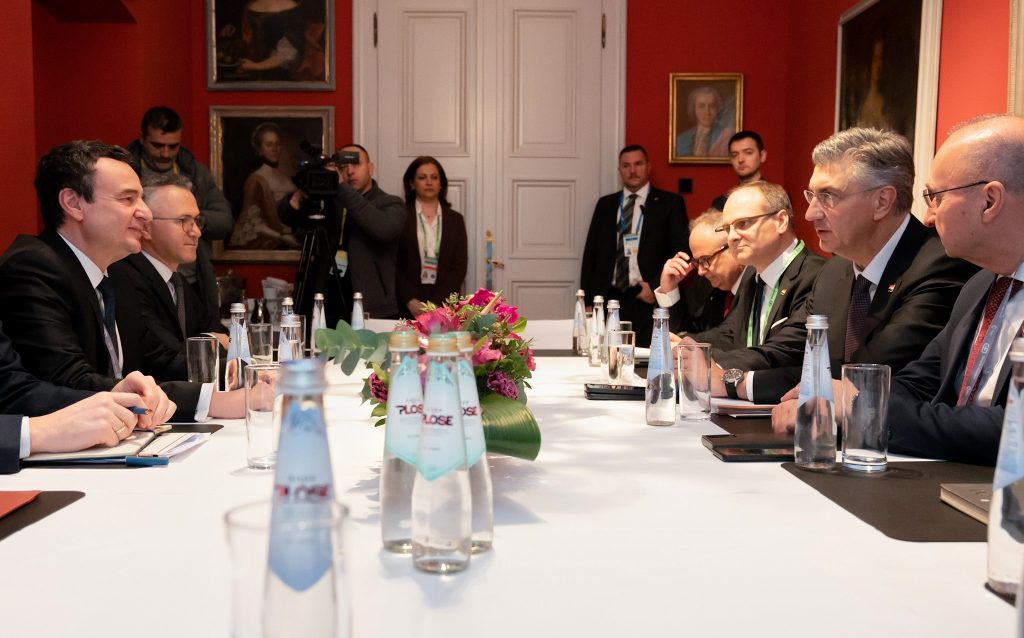
In reaction to these meetings, Vučić, who also attended Munich Security Conference, said: “I see that Plenković and Kurti met here, as well as the Defence Ministers of Croatia and Albania… very nicely”.
“If their goal was to worry us, they worried us, and, accordingly, we will take steps”, he stated.
However, a few days later, Vučić remarked during the international forum in New Delhi that he had “lengthy talks with Plenković.
“For the first time we talked about the military alliance of Pristina, Tirana and Zagreb. I can say that Prime Minister Plenković stressed that it was not directed against Serbia”, he noted.
According to Ramadan Ilazi, “the military cooperation between Kosovo, Albania, and Croatia should primarily be understood as a normal and legitimate form of defence cooperation between Kosovo and NATO member states, both of which also contribute troops to NATO’s KFOR mission in Kosovo”.
“This agreement can help the Kosovo Security Forces (KSF) further develop and strengthen their alignment with NATO standards. Such agreements are not unusual in Europe or in our region (think of the cooperation), and are typically focused on strengthening interoperability, training, and crisis-response capabilities”, Ilazi underlines.
He recalls that, before joining NATO in 2023, Finland spent decades deepening bilateral defence cooperation with the United States, Sweden, and the United Kingdom.
“The Baltic states followed the same path in the 1990s, long before their NATO membership in 2004. They signed bilateral defence agreements, hosted NATO exercises, etc. Albania, Bulgaria, Italy and North Macedonia have military mobility agreements in place. It is also important to recall that both Albania and Croatia are NATO members and are bound by NATO’s collective defence principles. As such, they cannot enter into defence arrangements that would undermine or pose new challenges to the security of the Alliance or its members. To date, neither NATO nor KFOR has expressed any concern regarding this cooperation, that I heard of”, Ilazi remarks.
Similarly, Senada Šelo Šabić, a Scientific Advisor at the Institute for Development and International Relations (IRMO) in Zagreb, states for Savremena politika that she does not see the trilateral military agreement as a threat either to Serbia, “or to the peace in the region”.
“It is about defence cooperation, within the framework of defined international obligations -Croatia and Albania are NATO members, Croatia recognizes Kosovo, and cooperation is developing within the Euro-Atlantic security context. Such forms of cooperation are common among partners and they do not represent a destabilizing factor”, Šelo Šabić clarifies.
She notes that “whether something is to be interpreted as a threat, depends on the political message one wants to send”.
“This initiative can be presented as a threat, but it can also be seen as a step towards strengthening regional resilience and interoperability, which in the long term can open space for wider regional security cooperation, once the political conditions are met”, Šelo Šabić explains.
In addition, Ramadan Ilazi stresses that this agreement also cannot be seen in isolation from two major developments in the recent years – Kosovo’s inability to advance its integration into NATO, and Banjska attack in September 2023.
Ilazi also remarks that “President Vučić’s suggestion that Serbia should draw lessons from Azerbaijan’s strategy in Nagorno-Karabakh has understandably created anxiety in Kosovo”.
“EU and NATO membership would significantly reduce security dilemmas in the WB”
Elaborating on the possible scenarios regarding the strengthening of security in the Western Balkans, Ramadan Ilazi states that“what would ultimately benefit the region most is for all countries, including Serbia, to focus on integration into NATO and to work toward achieving this goal collectively”.
“EU and NATO membership would significantly reduce security dilemmas and address many of the anxieties surrounding defence and security cooperation between the countries of the region, and with others. At the same time, it is important to recognize that concerns exist in Kosovo as well, when it comes defense posture of Sebria. These include Serbia’s potential adoption of the so-called ‘total defence’ concept, the Project 5000 (aimed at increasing the number of Serbian Special Forces to 5,000), the way Kosovo is treated in Serbia’s security doctrine in general, Serbia’s openness to Russian military presence, and its acquisition of Russian and Chinese military equipment”, he concludes.
For her part, Senada Šelo Šabić notes that “Serbia, like any sovereign state, has the right to decide on its own security arrangements, including cooperation with NATO, which it already has”.
“But, at the same time, other states have the right to develop their own forms of cooperation. It is crucial that security issues in the region are conducted transparently and without rhetoric that unnecessarily raises tensions”, Šelo Šabić stresses.