The current conflict in the Middle East, particularly around the Strait of Hormuz, have triggered significant global oil market volatility this week, with Brent crude surging above 100-119 USD per barrel. In spite of the fact that on 20 March oil prices declined by 0.4%, reaching approximately 108 USD a barrel, experts state that the economic consequences of this geopolitical turmoil cannot be mitigated in the short term.
For instance, it is stressed that the closure of the Strait of Hormuz has removed an estimated 7 million to 10 million barrels per day from the global market, roughly 7% to 10% of total global demand.
On 19 March, US Treasury Secretary Scott Bessent indicated potential measures aimed at controlling rising oil prices. These included lifting sanctions on Iranian oil tankers and considering further releases from the US Strategic Petroleum Reserve, Reuters reported.
For the Western Balkans Six, the “energy shock”, caused by the war in the Middle East, has necessitated urgent state interventions to prevent economic paralysis, since these countries remain highly dependent on imported fossil fuels for transport and industrial production.
Albania and BiH announce cuts in the excise tax on diesel
Albania is the country with the most expensive fuel in Europe when the price of oil is compared to the income of citizens. It is estimated that an Albanian citizen currently needs 7.2% of their daily income to buy a liter of diesel. The high prices are heavily influenced by tax policies.
As of March 20, 2026, diesel prices in Albania have reached approximately 214 Lek per liter (2.58 USD). This increase, following the outbreak of the war in Iran, with prices jumping from around 170-175 Lek per liter previously, marks one of the highest levels in recent times.
According to Albanian Prime Minister Edi Rama oil prices in Albania “have increased moderately compared to the rise in international markets”.
At the same time, Rama said the government is working on a new initiative, which implies that authorities plan to enter the market as a guaranteed distributor and wholesaler. He noted that the state role will secure supply volumes, support operators, and ease relations with third parties.
In addition, Economy and Innovation Minister of Albania Delina Ibrahimaj announced that the Government will reactivate the Transparency Board to monitor fuel prices. She also confirmed a 20 percent cut in the excise tax on diesel, reducing it from 39.6 LEK per liter. Ibrahimaj said the government took the decision after recent market developments, it was reported by the Albanian media outlets.
Similarly, in Bosnia and Herzegovina, the Federation government has initiated a proposal to temporarily abolish or significantly reduce excise duties on fuel. Prime Minister Nermin Nikšić indicated that the state is willing to forgo revenue to assist distributors and protect the most vulnerable citizens from the inflationary pressure on food and transport.
In early March 2026, diesel prices in Bosnia and Herzegovina were roughly 2.55 BAM per liter (approximately 1.52 USD), but they rose sharply and currently exceed 3 BAM (1.78 USD) at some petrol stations. Officials said the stepped-up controls are aimed at preventing unjustified price hikes and protecting consumers.
Kosovo’s businesses call for government intervention, Montenegro will take “concrete steps” soon
In Kosovo, businesses have been calling for government intervention for several weeks to curb the rise in fuel prices, Koha ditore reports. Due to the escalation of tensions in the Middle East, these prices increased over 20 cents, reaching more than 1.50 euros per liter of diesel.
The Ministry of Industry, Entrepreneurship, Trade and Innovation, at the beginning of the price increase, set the profit margin for oil producers at 2 cents for wholesale sales and 12 cents for retail sales.
Minister Mimoza Kusari-Lila said that a stabilization of prices is expected in the coming months, especially during the summer.
The current diesel price in Montenegro is approximately 1.50 USD per liter, whereas on 1 March it was approximately 1.38 USD per liter.
Minister of Energy and Mining Admir Šahmanović told Dan that the Government is closely monitoring developments in the oil products market and that it is already considering measures that will mitigate the sharp rise in prices, adding that the public will soon be informed about the concrete steps.
According to Dan, the most likely scenario is that excise taxes will be reduced by a quarter, which would cause the price of fuel to be reduced by 13 cents. In that case, the diesel price would not raise 30 cents, but 17, i.e. it would cost 1.67 euros per liter.
North Macedonia considers the reduction of VAT, Serbian President announces three additional measures
North Macedonia generally maintains lower fuel prices compared to its neighbors, particularly Serbia, due to lower taxes. The current retail price for a liter of diesel in the country is approximately 85.5 MKD (1.6 USD). This reflects a significant increase in early March 2026, with prices rising 14.5 MKD at that time.
The Government of North Macedonia told Telegrafi.com that it is “actively monitoring the situation with fuel prices and in the coming period, among the alternatives under consideration is the reduction of VAT from 18% to 10%, with the aim of protecting the standard of living of citizens.
In Serbia, the current retail price for a liter of diesel is 208 RSD (2.04 USD). In early March 2026, the price of diesel was approximately 203 to 208 RSD per liter, supported by government-regulated pricing.
Serbia has prolonged its ban on crude oil and fuel product exports until 2 April, to protect its domestic market from potential shortages and price increases. The suspension covers exports of diesel, gasoline and crude oil across all transportation methods.
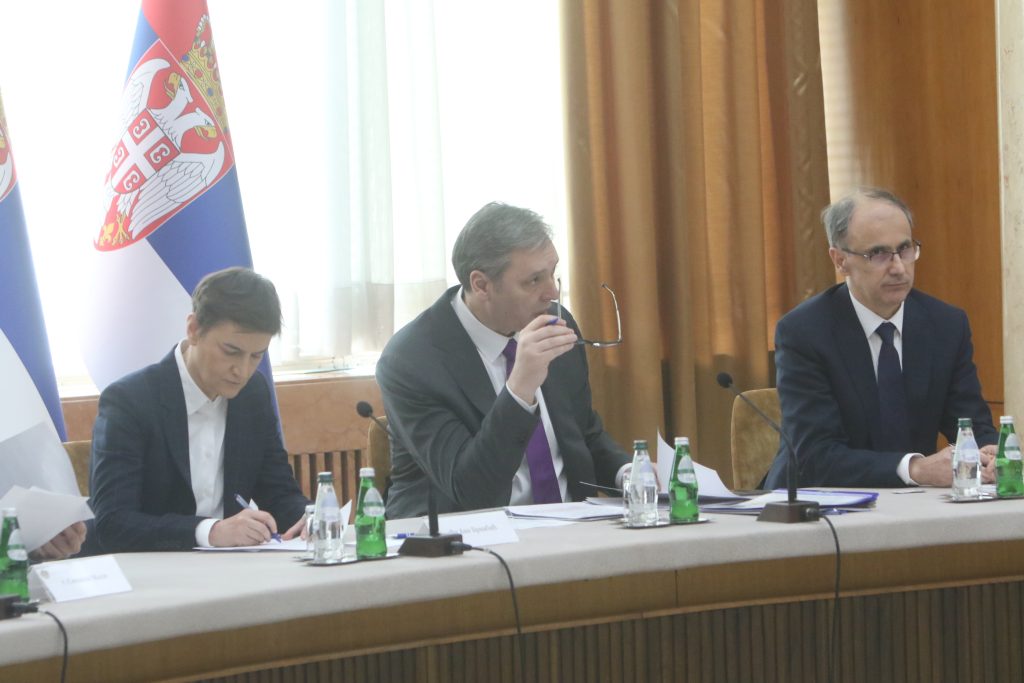
Serbian President Aleksandar Vučić addressed the nation on 20 March, following a session of the Council for National Security focused on the energy security. On this occasion, he announced three key measures.
“The first measure is the reduction of excise duties”, Vučić explaining that the government found a legal mechanism within the Law on Trade to slash excise taxes by more than 20 percent. According to him, “the realistic retail price of diesel today is 257 dinars.
“However, the price at the gas stations until today was 208 dinars. We have decided to allow an increase of only four dinars – taking it to 212 dinars… The second measure involves releasing 40,000 tons of oil from strategic reserves… The third measure targets the agricultural sector during the spring sowing season. For the next seven days, the price of diesel for farmers will be capped at 181 dinars per liter”, he clarified.