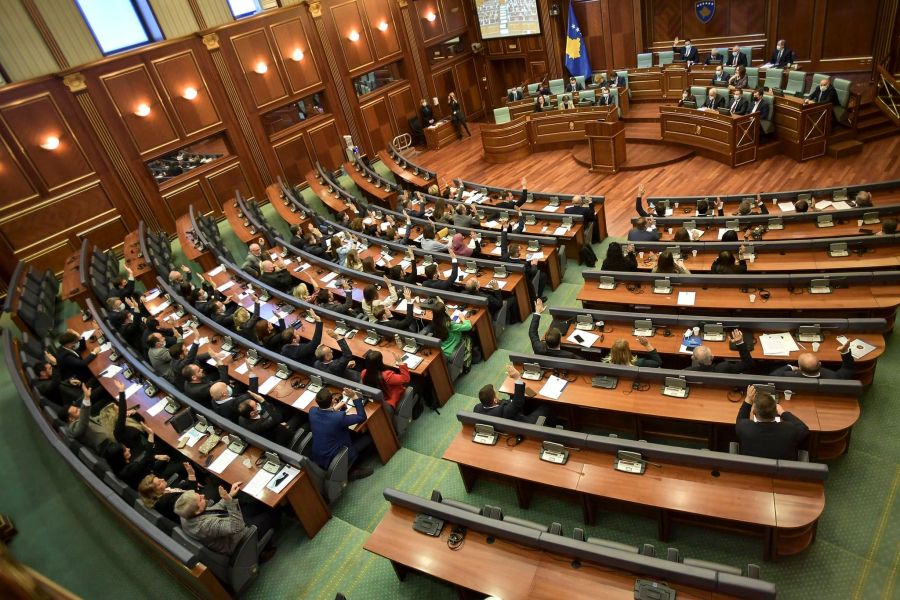
PRISTINA – The Kosovo Constitutional Court ruled on 25 March that President Vjosa Osmani’s decree on the dissolution of the Assembly does not produce legal effect, and specified that the deputies have a deadline of 34 days to elect a president.
The decision of the Constitutional Court came after a dispute between the executive and the president regarding the dissolution of the Assembly, which followed the failure of the parliament to elect a president in early March.
Prime Minister Albin Kurti submitted a request for an assessment of the constitutionality of the president’s decree on 7 March, and two days later, on 9 March, a similar request was submitted by the deputies of Self-Determination.
The dispute followed the failure of the Assembly to elect a president at an extraordinary session on 5 March, which was convened at the request of 42 Self-Determination deputies. Although the candidates Glauk Konjufca and Fatmire Kolcak were proposed, the session was interrupted because the presence of a two-thirds majority in the hall was required for the election of the head of state.
The very next day, the President of Kosovo issued a decree on the dissolution of the tenth convocation of the Assembly, which caused political and legal reactions. This move was assessed as unconstitutional by Kurti, as well as by some legal experts.
Vjosa Osmani welcomed the verdict of the Constitutional Court, emphasising that “the Court has not found any violation of the Constitution by the President”, Reporteri.net reported.
In the Presidency’s statement, Osmani explains that the court has confirmed that “the 60-day deadline must be consumed before the 30-day deadline, provided for by the Constitution, and that this 30-day deadline before the end of the current President’s term is final and binding, and cannot be relativised”.
She emphasised that “it is not the decree that is leading the country to new elections, but rather the failure of the Assembly to elect a new President”.