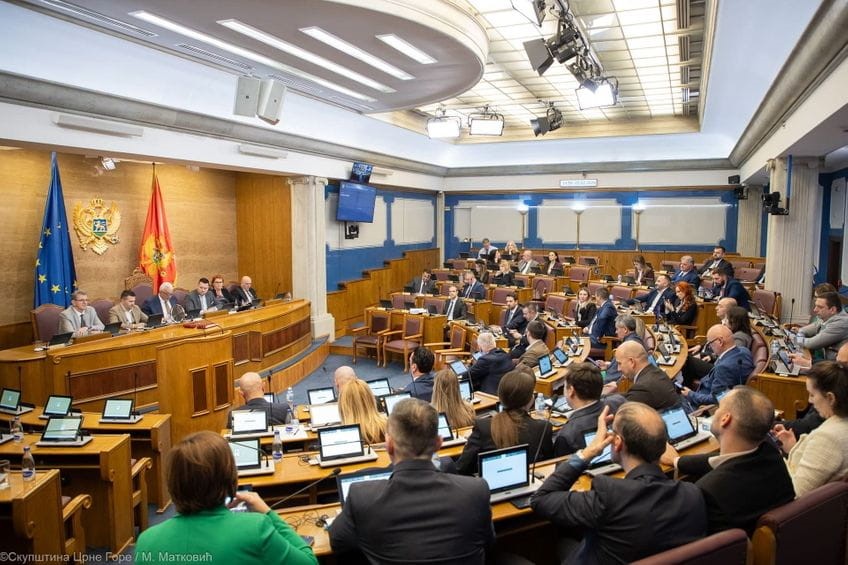
PODGORICA – The Parliament of Montenegro adopted constitutional amendments on Monday that change the composition and appointment procedures of the Judicial and Prosecutorial Councils, reduce the direct influence of the executive branch over the judiciary, and provide additional guarantees for the independence of the Central Bank of Montenegro.
The amendments were supported by 68 MPs, with no votes against or abstentions, following an agreement between the parliamentary majority and most of the opposition.
Among other changes, the amendments alter the composition of the Judicial Council by removing the Minister of Justice from the body and increasing the number of judges among its members. The Judicial Council will consist of nine members – the President of the Supreme Court, five judges elected by the Conference of Judges, and four eminent lawyers elected by Parliament.
The changes also concern the composition and appointment of the Prosecutorial Council and define its constitutional position more precisely.
The four eminent lawyers on the Judicial Council will be elected by Parliament by a qualified majority, a two-thirds majority in the first round and a three-fifths majority if the required support is not secured in the first round.
According to the rationale behind the reform, the changes are aimed at reducing political influence over the judiciary and strengthening the institutional independence of the courts and the State Prosecutor’s Office, which has been one of the European Commission’s longstanding demands in Montenegro’s EU accession negotiations.
The amendment concerning the Central Bank of Montenegro explicitly stipulates that the CBCG is an autonomous and independent institution accountable to Parliament, while its status and functioning will be regulated by a separate law.
The change is intended to bring Montenegro’s constitutional framework into line with EU rules on central bank independence and the Statute of the European System of Central Banks and of the European Central Bank. It is also important for the closure of negotiating Chapter 17, which covers economic and monetary policy.
Civil society in Montenegro raised concerns about certain provisions, particularly regarding the distribution of powers within
Kos: Another major step on Montenegro’s European path
European Commissioner for Enlargement Marta Kos said that Montenegro had taken another major step on its European path.
“This is another major step on Montenegro’s European path. It demonstrates broad consensus and represents significant progress towards closing extremely important chapters related to fundamental reforms,” Kos wrote on X.
Head of the EU Delegation to Montenegro Johann Sattler said that, by adopting the amendments, the parliamentary majority and the opposition had once again demonstrated political maturity and a willingness to cooperate on reforms related to EU membership.
According to Sattler, the constitutional changes represent a significant step towards strengthening the independence of institutions and bring Montenegro closer to closing negotiating Chapters 17 and 23, which cover economic and monetary policy, and the judiciary and fundamental rights, respectively.
Montenegrin Prime Minister Milojko Spajić said that the adoption of the constitutional amendments would contribute to strengthening the rule of law, judicial independence and the stability of state institutions.
“Congratulations to the Parliament of Montenegro on adopting the constitutional amendments – a key condition for closing negotiating Chapters 23 and 24,” Spajić wrote on X.
He added that the adoption of the amendments would strengthen the rule of law.
“The adoption of the amendments to Montenegro’s Constitution, with 68 votes in favour, will contribute to strengthening the rule of law, judicial independence and the stability of state institutions,” Spajić said.