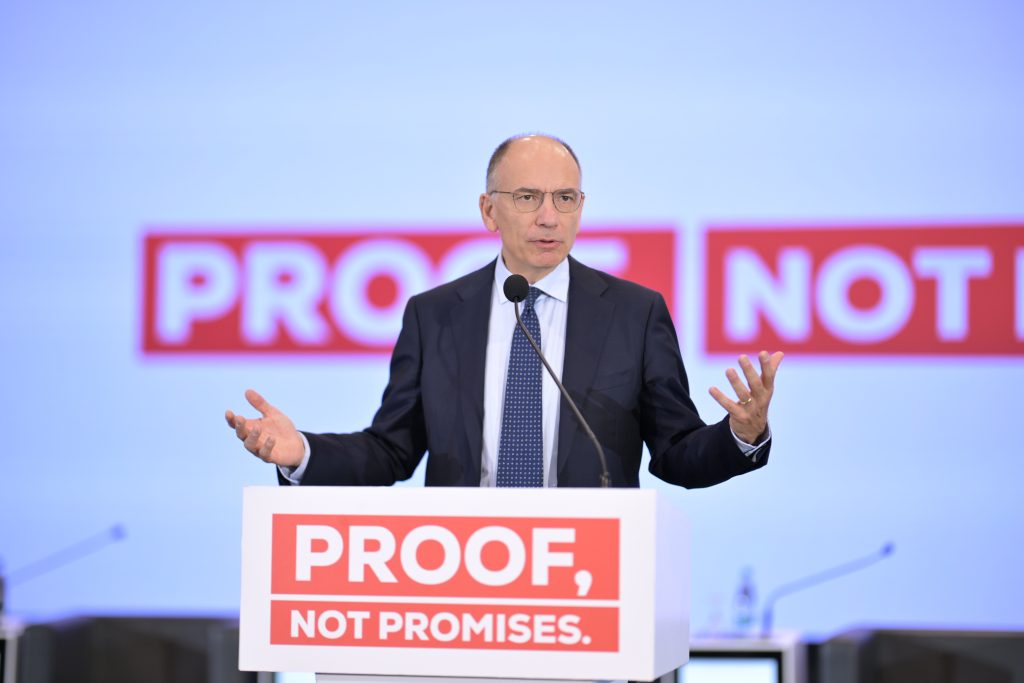
In 2024, Enrico Letta, former prime minister of Italy, authored a high-level report “Much More than a Market”, which called for a stronger and more integrated Single Market capable of enhancing the EU’s competitiveness, resilience and global influence. In 2026, EU institutions shaped the “One Europe, One Market” agenda and roadmap based on this report, with agreements on all initiatives to be reached by the end of 2027.
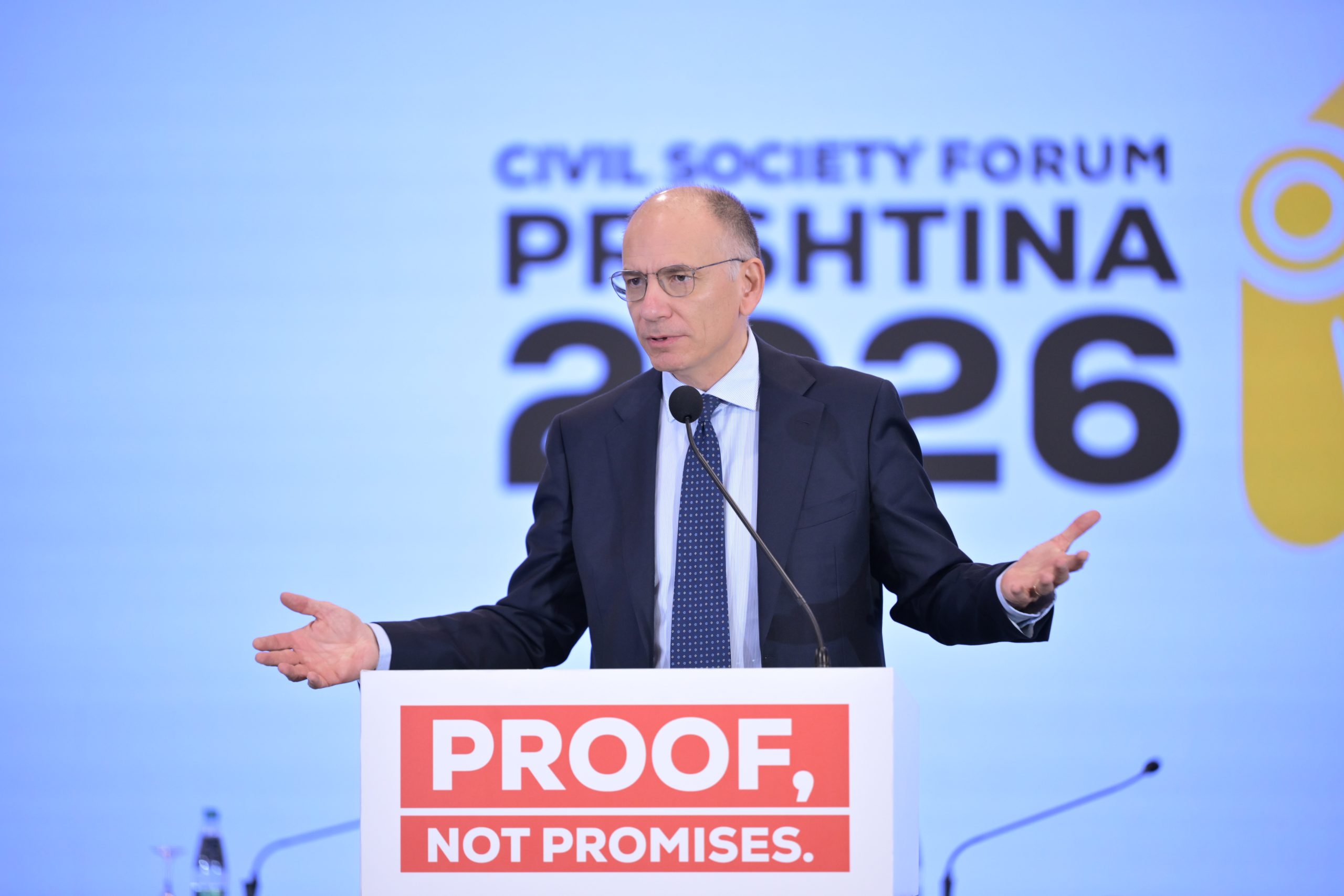
EWB spoke with Enrico Letta at the Civil Society & Think Tank Forum 2026 on 7 October in Pristina. Just the day before, the European Commission published its communication “Preparing for a Wider Union”, which proposed earlier participation of candidate countries in selected EU policies before membership. We spoke to Letta about this new document, as well as the “One Europe, One Market” agenda and EU enlargement in the Western Balkans.
European Western Balkans: Let me begin by asking you about the “One Europe, One Market”, plan, inspired by your own report. How do you assess its implementation so far? Are you optimistic, and do you see sufficient political will among the EU member states and the Commission to push the process forward?
Enrico Letta: We lost an entire year – 2025 – and completely missed the momentum at that point. In 2026, however, there has been an acceleration. I see greater focus, greater momentum and a real possibility of achieving results.
The plan is backed jointly by the three institutions: Parliament, Council and Commission. That makes it more than just a set of measures. All three institutions contributed to it, and there is agreement on accelerating the process and fast-tracking approvals. The Irish Presidency is working very hard to move quickly. The European Parliament is also making a serious effort to speed up implementation.
I am therefore more optimistic than I was six months ago, because I can see this acceleration taking place. The result is not guaranteed, however. Inertia is the enemy. We need to change some fundamental systems rather than simply preserving them.
In today’s world, in which populist forces are threatening European integration, we may be tempted to think that remaining on the defensive is enough. That is not the case with the Single Market. If we merely defend the present situation, we are defending a market that is only half integrated. This is the most important point to understand.
The Single Market is incomplete because, 25 years ago, three fields were left outside its perimeter: energy, telecommunications and financial services. Their continued fragmentation is creating a major problem for European competitiveness.
So, returning to your question, I am more optimistic today because I see momentum and a genuine possibility of progress. But we must continue fighting for it. It will not be easy.
EWB: Is it perhaps too ambitious to strengthen and deepen the Single Market while simultaneously enlarging the European Union – and therefore the Single Market as well?
EL: No. I think the two processes can overlap without any problem. The reason we are trying to complete the Single Market – to move from a single market to “one market” – is exactly the same reason we are enlarging. Today, both are primarily questions of strategic autonomy, security and collective security.
We are enlarging in order to become bigger and to bring the Western Balkans, Ukraine, Georgia and Moldova into the European Union. This would make Europe larger, more autonomous, more independent and more secure. That is the main objective of the entire process, and the two agendas overlap.
Completing the Single Market serves the same objective. If we do not complete its integration, we will remain insecure. Consider connectivity, energy and finance. We were dependent on Russia for energy, and we are dependent on the United States for connectivity and finance, particularly on US technology. Given today’s American foreign policy, such dependence is very complicated. The overlap between the two processes therefore does not work against enlargement.
EWB: Do you consider enlargement itself a strategic interest of the EU? How high does it rank among the Union’s priorities?
EL: In my own compass, it is at the highest level, also because previous enlargement was so successful. We have a fantastic track record. I consider the 2004 enlargement one of the European Union’s greatest achievements.
The next enlargement – beginning with those Western Balkan countries that are closest to joining – is, for me, one of the most important missions for the future of Europe. It is the way for Europe to become stronger, larger and more influential.
The instability of the Balkans is a European issue. We cannot continue to pretend that it is a problem for others to solve. Europe must help resolve and overcome this instability because its consequences are negative for everyone. We must move in that direction and integrate the Western Balkans. The region is part of Europe’s future and part of the European family.
EWB: How do you assess the European Commission’s new communication “Preparing for a wider Union”, published on 6 October? It envisages gradual accession, including bringing candidate countries into the Single Market before membership.
EL: I am very pleased, because it is moving in the right direction. I am a great admirer of Marta Kos. I think we have an excellent Commissioner for Enlargement, and personal leadership matters in politics. She knows the issues, she is accountable, she has experience and she is doing a very good job.
The communication is moving in the right direction. In the final pages of my report, I referred to the need to build a larger community, extending beyond the 27, and to the Single Market as a tool for achieving this. I also proposed building a common market for defence involving non-EU European countries. Gradual Single Market integration can be another fundamental step, so my assessment is positive.
I would go further in the direction I mentioned at the end of my speech (at the CSF): we should help candidate countries coexist and integrate with one another. One of the mistakes of previous enlargements was that we did not invest enough in integration among the candidates themselves.
Enlargement is not only a matter of each capital’s relationship with Brussels. It is also about the ability of candidate countries to coexist with each other. That is fundamental because this is how countries learn the habits and behaviours of coexistence that have underpinned the European Union from the beginning.
EWB: In that sense, are the Berlin Process and the Common Regional Market in the Western Balkans steps in the right direction, by encouraging countries to cooperate and establish strong links long before membership?
EL: Of course, but we must strengthen them and invest more in the process. The leaders of EU member states need to give this greater attention. Once again, there is a lesson from the past.
These countries will become part of the European Union. One day or another, they will be members. What we do today is shaping how their societies will feel about the Union once they have joined.
During the previous enlargement, we promised too much at the beginning, in the 1990s, but the process concluded much later – in 2004, in 2007 for some countries, and in 2013 for Croatia. Frustration became part of the experience. Some of the attitudes we now see in member states that were candidates at that time are also consequences of that frustration and of how the process was mismanaged during the 1990s. We must not repeat that mistake.
We must provide a credible sense of direction along what is inevitably a complicated path, and we must manage promises responsibly. Above all, we need to understand that what we do today will shape how these societies feel when they become members. We want them to be constructive participants in the European Union, not frustrated, anti-Brussels or anti-EU members.
What happened in Budapest is instructive. Poland and Hungary, in my view, illustrate what I am describing. This is partly a legacy of the promises made in the 1990s: expectations were set very high, while implementation of the process subsequently became much more complicated.
EWB: Returning to gradual accession, your report links access to the Single Market to the political Copenhagen criteria. This sets a high bar – almost the same as full EU membership – and the new Commission communication uses similar language. For some governments, democratic and rule-of-law reforms may be the most difficult step. How can Single Market access remain an attractive incentive if meeting the conditions is politically costly? Is there a trade-off whereby the higher the bar, the weaker the incentive for governments to deliver?
EL: Keeping the bar high is the only way to convince the current member states not to place obstacles in the way of enlargement. This is evident. We must be aware that next year could present a major obstacle to the entire enlargement process: France.
The French presidential election could be a turning point for enlargement. I do not think that Marine Le Pen, as President of the French Republic, would be a great supporter of it. The result of the French election will therefore be crucial. A Le Pen victory risks being the coffin of enlargement.
We must therefore avoid frightening public opinion in the current member states. The French presidential election is the only forthcoming election I can see that could have truly serious consequences for enlargement. Keeping the bar high is fundamental to reassuring national public opinion in Europe.
At the same time, the Single Market is an extraordinary accomplishment. It gives citizens a remarkable set of liberties, freedoms and opportunities, and it is a powerful way to modernise an economy. This is the story of all the countries that joined between 2004 and 2013. Their results have been remarkable, largely because of accession to the Single Market.
The Single Market accelerates wealth, growth and opportunity. We must explain this to the public. You have already experienced one example in the Western Balkans through roaming, but there are many others: education, industrial opportunities, consumer benefits and easier travel. The Single Market is a dream, and we have to make that dream real.
EWB: How can the EU ensure that Single Market participation remains a step toward full membership rather than becoming a permanent arrangement for some candidates? Given opposition to formal enlargement in countries such as France, could candidate countries be left economically integrated but without the political rights of member states?
EL: I do not see this as a major problem. There are already three countries that participate in the Single Market without being members of the European Union. The door to EU membership is open to them, it is their choice not to join.
Once a country is accepted into the Single Market, the next step becomes easier, because the Single Market represents around 80 per cent of the European Union. I therefore do not see this as a significant obstacle.
EWB: Finally, enlargement sceptics in the EU often ask about its economic consequences and the benefits for existing member states. What economic benefits would the Western Balkans bring to the European Union, and what comparative advantages could the region contribute after joining?
EL: I have no doubt that the Western Balkan countries can contribute to the European Union in many areas. First, their accession would help eliminate one major problem: instability in the Balkans. This has long weakened the European Union in its relations with the rest of the world. Demonstrating that the EU has brought the Balkans’ traditional, almost volcanic instability to an end would send a very powerful message.
The second benefit is the enlargement of the market. The Western Balkans are important societies and important markets, and their inclusion would represent another step forward.
The third benefit is the message enlargement would send to the rest of the world: the European Union is a successful process. The accession of additional countries demonstrates that success.
Consider the international reaction to Iceland’s recent ‘no’ in the referendum on resuming EU accession negotiations. The global attention was greater than Iceland’s material importance to the Union. Whether Iceland joined would not have changed Europe dramatically, but the referendum changed the image of the European project.
Bringing the Western Balkans into the Union would change that image positively. It would show the rest of the world that Europe brings wealth, democracy and the rule of law, and that the EU remains an open and successful project capable of convincing countries to join it. I am a strong supporter of enlargement for all these reasons.