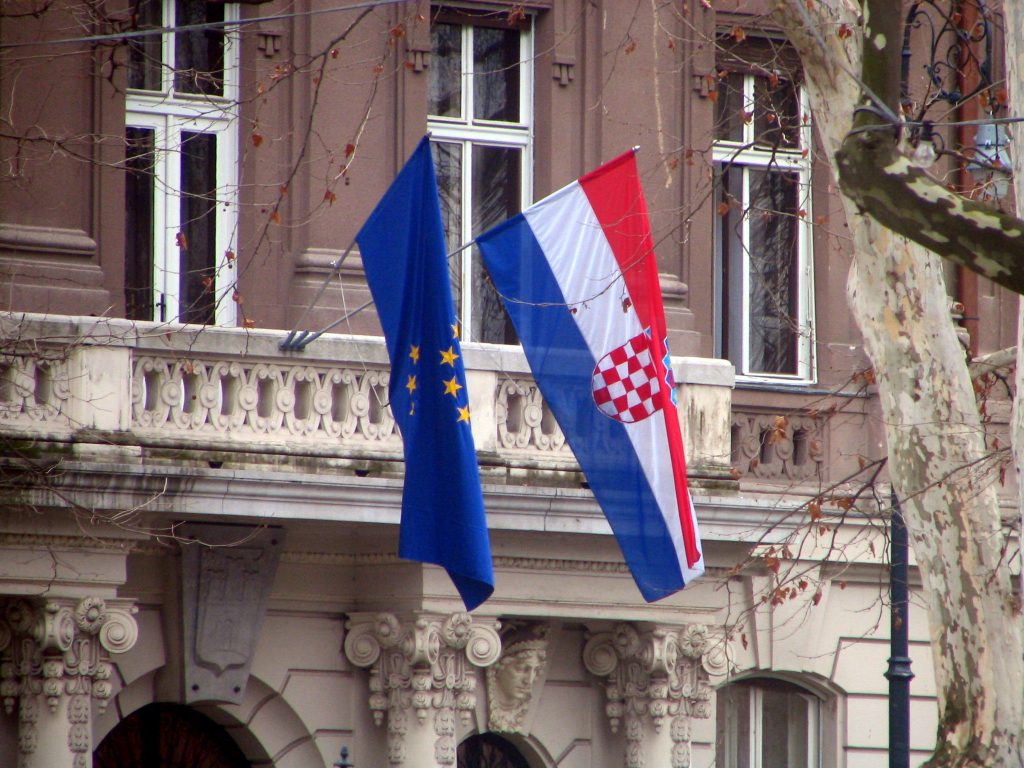
ZAGREB – Croatia has circulated a document to EU member states outlining its position on outstanding issues with Montenegro and setting out the conditions Podgorica must meet before joining the bloc, Radio Free Europe (RFE) reports.
According to RFE, some of Croatia’s demands are directly linked to the closure of negotiating Chapter 23, on judiciary and fundamental rights, and Chapter 31 on foreign, security and defence policy.
Zagreb says that tangible progress is essential to securing broad public, political and parliamentary support in Croatia, including for the ratification of Montenegro’s accession treaty.
The document, seen by RFE, states that the key outstanding issues “must be solved before Montenegro joins the EU”.
Most of Croatia’s demands concern the legacy of the wards of the 1990s and fall under Chapter 23, which, alongside Chapter23, is considered central to the rule of law.
They include compensation for Croatian citizens detained at the Morinj camp, preservation of the memorial plaque installed at the site, and renaming the municipal swimming pool in Kotor. The pool is named after water polo player Zoran Gopčević, who, according to Croatia, served as a guard at Morinj in 1991-1992.
Croatia also seeks clarification of the fate of 14 missing Croatian citizens, with full cooperation from the Montenegrin authorities, including information sharing and access to archives.
Other demands include the prosecution of war crimes, including under the principle of command responsibility, and the resolution of property rights issues affecting Croatian families in Montenegro.
The remaining two demands concern Chapter 31, which, according to RFE, Montenegro has been unable to close since 2024 because of Croatia’s opposition following the Montenegrin parliament’s adoption of a resolution on Jasenovac.
Zagreb is seeking the return of the training ship Jadran. Croatia says the vessel was undergoing an overhaul in Montenegro when war broke out in 1991 and belongs to Croatia under the 2001 Agreement on Succession Issues.
The second demand concerns the border between the two countries. Croatia wants Montenegro to confirm its respect for the former inter-republic boundary, in accordance with the principle of uti possidetis juris, and to sign a land border treaty based on three existing maps.
According to the document, once the land border issue is resolved, Croatia would be ready to convene regular meetings of the commissions responsible for maritime delimitation, without setting deadlines for that process.
In the document, Croatia emphasises that it has consistently supported Montenegro’s Euro-Atlantic integration, including its accession to NATO, and provided Podgorica with a Croatian translation of the EU acquis valued at €8 million.
At the same time, Zagreb argues that “unexpected unilateral moves” by the Montenegrin authorities have reignited historical tensions and called into question broad support in Croatia for Montenegro’s EU membership.
According to the document, Croatia presented Montenegro with a non-paper listing the outstanding issues in December 2023 and also shared it with EU member states and the European Commission.
Bilateral consultations were held in January and May 2025, while the two countries’ foreign ministers have met around ten times this year, each time at Zagreb’s initiative.
“None of the outstanding issues has yet been resolved,” the document states.
Croatia says it wants to facilitate Montenegro’s accession and that its demands are limited, clearly defined and achievable.