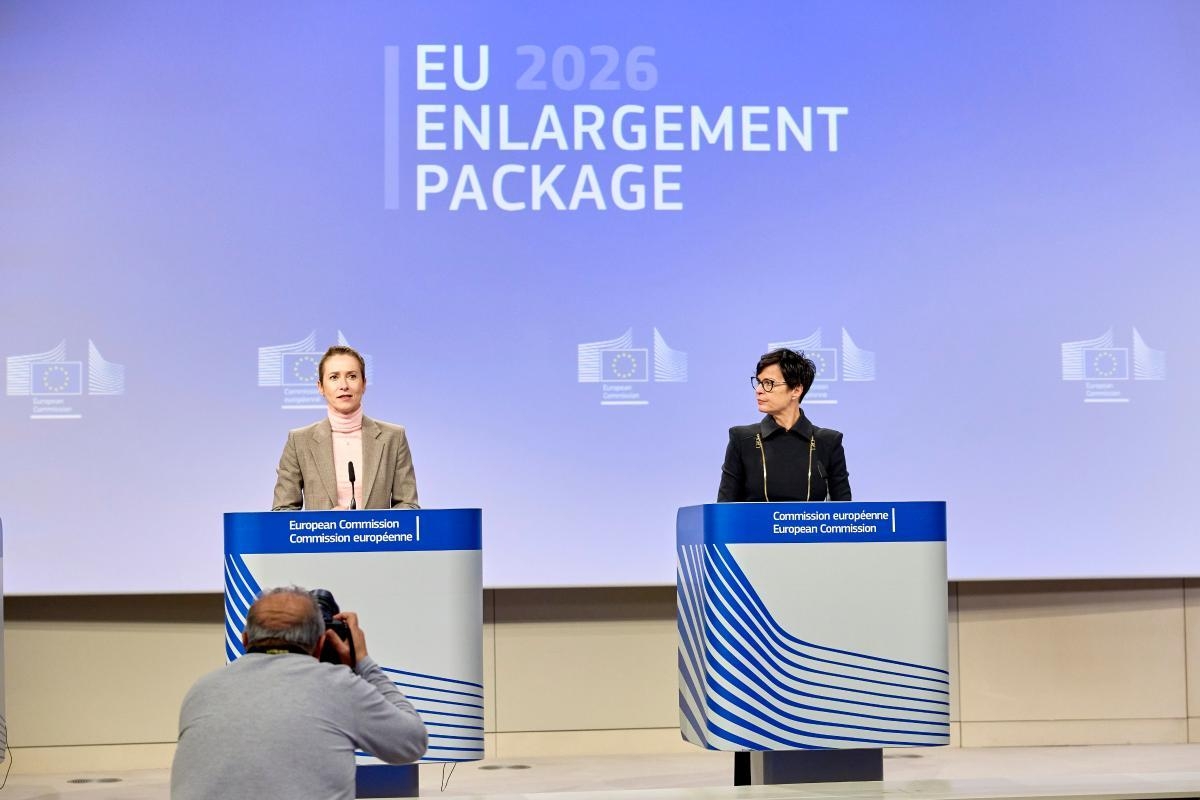
European Commission published its annual enlargement reports yesterday. We report the key findings of the Report on Montenegro in the areas of democracy, rule of law and economic criteria:
The legal and institutional framework provides a basis for the democratic conduct of elections. Following the adoption of amendments to the Law on the election of the President, to the Law on the Election of Councillors and Members of Parliament and to the Law on the Financing of Political Entities and Election Campaigns, Montenegro’s legal framework is broadly aligned with European and international democratic standards, as well as the EU acquis. Some efforts are still needed to address key outstanding recommendations by the Organisation for Security and Co-operation in Europe / Office for Democratic Institutions and Human Rights (OSCE/ODIHR) and GRECO. The procedure for appointing the President and the members of the Central Electoral Commission is ongoing.
Parliament can exercise its powers, including control of the executive and involvement in the legislative process, in an overall effective way. In the first part of the reporting period, crossparty cooperation facilitated a steady adoption of EU-related legislation. Following a crossparty agreement brokered in July 2026, Parliament adopted by a large majority a first set of constitutional amendements strenghtening the independence of the Judicial and Prosecutorial Council as well as that of the Central Bank. It also successfully delivered on a number of key commitments aimed at advancing the EU accession process. It notably completed the electoral reform, adopted amendments to the Law on Internal Affairs and the Law on the National Security Agency, established cross-party oversight bodies, appointed the pending two Constitutional Court judges and adopted numerous EU accession-related laws in several extra-ordinary sessions. Opposition parties suspended their cooperation with the government and ruling majority in September after Parliament Speaker sent condolences to the son of convicted war criminal Ratko Mladić following his death. A debate and vote for his dismissal were held in October, and the attempt to remove him failed.
The institutions in charge of the EU integration process are in place and coordinate the country’s EU accession negotiations satisfactorily. Montenegro demonstrated its focus on the EU integration agenda. Despite one party’s withdrawal from the coalition in early 2026, the government delivered its policies in a broadly stable environment, and has prioritised EU accession as its central objective. It took steps to strengthen the legislative framework regulating the executive’s role, including by adopting a Law on Government, which has yet to be approved by Parliament.
Civil society, including human rights defenders, overall operate in an enabling environment. The main legal and institutional framework for civil society is in place. The involvement of civil society in policymaking is formally institutionalised but is sometimes limited to a procedural formality. In December 2025, the Council for cooperation between the government and non-governmental organisations resumed its work for the first time since October 2021. The practice of issuing calls for proposals to finance civil society-led projects is not implemented consistently across ministries.
Montenegro has a good level of preparation in the area of public administration reform and has made good progress notably by adopting the Law on free access to information, the Law on Local Self Government the Law on Local Civil Servants, the Law on budget and fiscal responsibility as well as related secondary legislation on the Law on civil servants and state employees for the central civil service. Montenegro needs to continue efforts in further strengthening the management and planning of human resources for regular filling of vacancies and the application of a new competency framework.
Montenegro’s judicial system has a good level of preparation and has made good progress. Montenegro adopted constitutional amendments, strengthening the independence of the Judicial and Prosecutorial Councils, fully in line with EU and Venice Commission recommendations. In addition, Montenegro adopted amendments to the Law on the Judicial Council and Judges, the Law on the State Prosecution Service, and the Law on the Special State Prosecutor’s Office, addressing recommendations from the European Commission, the Venice Commission and GRECO. Montenegro appointed judges to the Constitutional Court, restoring its full composition and strengthening its effective functioning. Furthermore, two lay members to the Judicial Council and three lay members to the Prosecutorial Council were appointed, improving effective functioning. The institutional stability and leadership of the Supreme Court, Supreme State Prosecution Office, and Special Prosecution Office was further improved through targeted reforms.
Montenegro has a good level of preparation in the fight against corruption. Good progress was made on the implementation of reforms. The process to adopt two sets of amendments to the Constitution is ongoing. Two out of three votes have taken place in Parliament to adopt a constitutional amendment removing immunity for the Prime Minister and ministers covering all corruption-related offences. In addition, Parliament held a first of three required votes on a constitutional amendment responding to a key recommendation of the Venice Commission, by introducing prior integrity checks for prime ministerial and ministerial nominees. Both amendments have yet to be finally adopted by Parliament. This will be a major achievement, addressing longstanding GRECO and Venice Commission recommendations. Parliament adopted amendments to the legal framework regulating the funding of political parties and electoral campaigns to address key GRECO and OSCE/ODIHR recommendations regarding its scope, clarity and implementation. In addition, Montenegro adopted amendments to the Law on prevention of corruption and the Criminal Procedure Code, as well as a new Law on Whistleblower Protection and a new Law on Confiscation, in line with European standards and best practice, and addressing Venice Commission and GRECO recommendations.
A new full-term Director of the Anti-corruption Agency was appointed, ensuring its improved functioning. The institutional framework for preventing and fighting corruption is in place. Human resources and capacities in the fight against corruption have increased but further resources are needed for the Special State Prosecution Office. The fight against corruption track record improved with regard to final rulings and convictions in high-level corruption cases, and the complexity of investigations and indictments demonstrates the commitment of the prosecution and law enforcement to tackle the most serious cases. The effectiveness and coordination of prosecutorial and lawenforcement institutions in the area of corruption continued to improve. However, the number of final convictions remains low and needs to increase. Additional efforts are needed to accelerate the implementation of the strategic framework.
The legislative and institutional framework on fundamental rights is largely in place and Montenegro continues to largely meet its international obligations on human rights. However, more effort is needed to fully implement this framework and to ensure access to justice and enforcement of rights in administrative and judicial proceedings, in particular for groups in vulnerable situation. Montenegro needs to continue aligning the legal framework with the EU acquis and European standards. The groups in most vulnerable situation in society (including Roma4 and Egyptians, people with minority racial or ethnic background, persons with disabilities, LGBTIQ+ persons) continued to be subjected to discrimination, hate speech and hate crime.
Montenegro has a good level of preparation in the area of freedom of expression. Good progress was achieved on the implementation of reforms. Montenegro continues to uphold a zero-tolerance policy on violence against journalists and media workers, while dedicated legislation on lawsuits against public participation (SLAPPs) must be adopted. Media ownership transparency improved through the public registry, with gaps for online media. Parliament appointed new members to the Council of the Radio and Television of Montenegro (RTCG) and to the Council of the Agency for Audiovisual Media Services (AMU). A new Law aligning with the EU Digital Services Act Directive was adopted. Access to information must be effectively guaranteed through the full implementation of the improved legal framework. The national media strategy continued to be implemented, and Montenegro continues to enjoy a pluralistic media environment and provides adequate legal guarantees for the freedom of expression and an enabling environment for the media to operate freely, independently and professionally. While media ownership transparency improved, concerns about external strong influence over media in Montenegro have increased.
Montenegro has a good level of preparation in the fight against serious and organised crime. Good progress was made with the appointment with a full mandate of the Director of Police in December 2025 and appointment of four deputy-directors of police in July 2026 as well as with the hiring of additional officers for the Special Police Unit, the Asset Recovery Office, the Financial Intelligence Unit and Assest Managemet Office. Construction was completed in April 2026 of the long-awaited new premises for the Special State Prosecutor’s Office and the Special Police Department.
Montenegro has made good progress and reached a good level of preparation in developing a functioning market economy. The recently announced ‘Euro Model’ reforms may pose significant risks to the sustainability of public finances and the external balance, which remain nonetheless to be assessed further, notably following on-going consultations with the stakeholders. Economic growth slowed down amid a continued weak export performance in 2025, before picking up in the second quarter of 2026. The budget deficit overshot the 2025 target, and fiscal vulnerabilities remain due to ineffective fiscal rules, a high level of mandatory spending and high debt rollover needs. The fiscal governance framework has been strengthened, notably through the establishment of the Fiscal Council. The large current account deficit persisted with only about a third of it covered by FDI inflows. The labour market situation continued to improve, even though structural problems persist, such as high rates of youth and long-term unemployment. The banking sector remained well capitalised and liquid while credit growth picked up. Good progress was made in improving the business environment and advancing the reform of state-owned enterprises (SOEs).
Montenegro has made good progress and is between a moderate and a good level of preparation to cope with competitive pressure and market forces in the EU. The authorities continued to implement reforms in the education system, which faces numerous challenges. Efforts to advance the green and digital transitions have continued. The diversification of Montenegro’s narrow production base remains a challenge. The economy is driven by services, in particular tourism, which together with the small size of local companies and their low level of exports, constrain productivity growth and the competitiveness of local firms.