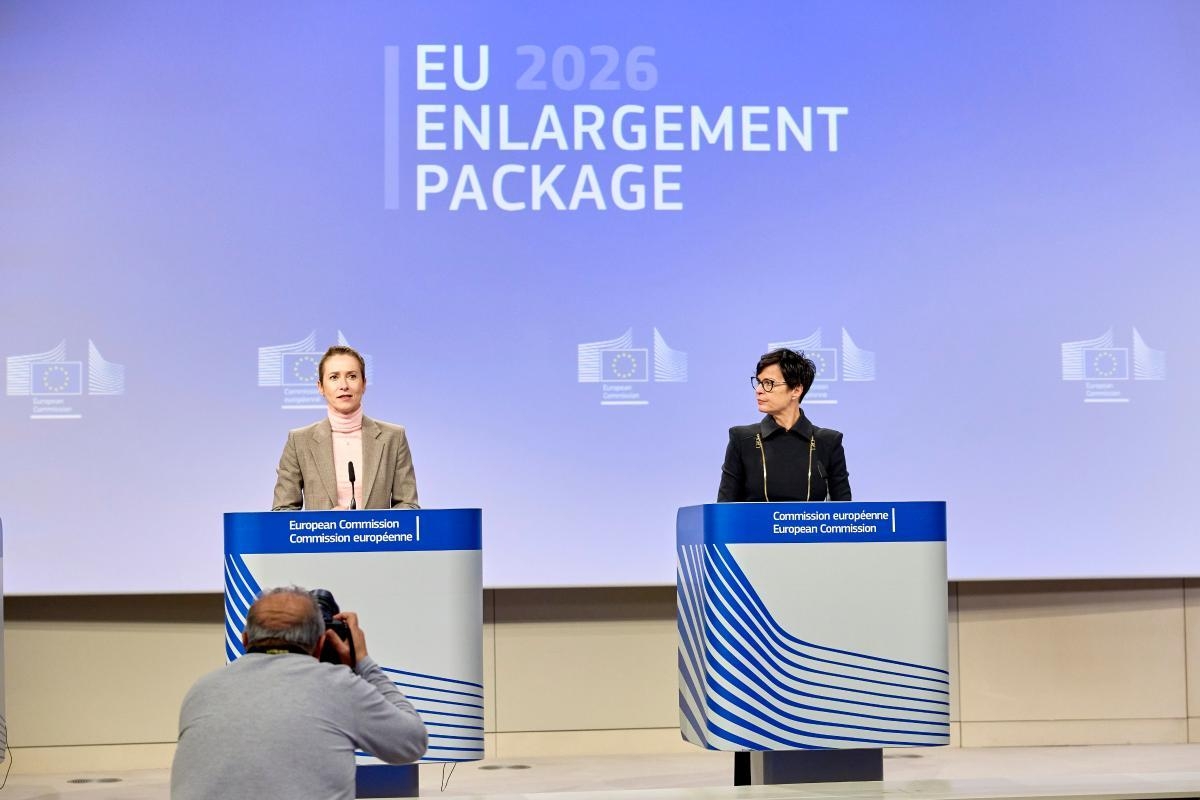
European Commission published its annual enlargement reports yesterday. We report the key findings of the Report on Serbia in the areas of democracy, rule of law and economic criteria:
Tangible improvements are needed in the way elections are conducted. It remains vital that outstanding recommendations by the Organisation for Security and Cooperation in Europe (OSCE) / Office for Democratic Institutions and Human Rights (ODIHR) and the Council of Europe bodies are fully implemented in a transparent and inclusive manner and well ahead of new elections. The adoption of six electoral laws in May, July, and August 2026 marked a step forward in this regard, however not all of ODIHR’s key recommendations were implemented. The full implementation of those laws as well as further reforms are needed, in particular to prevent misuse of office, misuse of state resources, intimidation and pressure on voters, and to ensure the safety of media professionals. Serbia also needs to ensure alignment with all relevant EU acquis in this area, including Regulation (EU) 2024/900 on the transparency and targeting of political advertising, and taking into account European and international standards.
Parliament’s effectiveness and oversight functions remain hampered by the low frequency of parliamentary sessions, the lack of genuine political debate, and the absence of an annual work plan for Parliament. Public scrutiny and involvement in the legislative process are limited while parliamentary debates continue to be marked by tensions between the ruling coalition and the opposition. Parliamentary rules of procedure and the Parliament’s code of conduct for punishing offences by parliamentarians need to be applied consistently.
As regards governance, Serbia’s political debate and decision-making continued to be de facto steered by the President in a manner not intended by the Constitution. Local government reform continues to advance slowly. The institutions in charge of the EU integration process are in place. An operational team for EU accession was established in January 2026, replacing the previous coordination structure. A new chief negotiator was appointed in March 2026. The current deep societal polarisation and persistent anti-EU rhetoric run counter to the authorities’ stated objective of EU accession. The authorities are not yet managing to communicate more proactively and objectively about the EU and Serbia’s accession process.
Civil society, including human rights defenders, continued to operate in a restricted environment and have faced increasing pressure, smear campaigns and attacks, including from high-level officials. A police search of four civil society organisation (CSO) offices in February 2025 has so far resulted in no indictments and was widely perceived as an act of intimidation against civil society. There have been new reports of spyware attacks targeting human rights defenders, student activists and opposition politicians, and little judicial followup so far. Strategic lawsuits against public participation (SLAPPs) increasingly hindered the work of civil society actors. In this context, formal cooperation between CSOs and governmental working groups has not resumed, affecting the inclusiveness of the EU integration process.
Serbia is moderately prepared in the area of public administration reform. However, there was backsliding during the reporting period. While reforms on public investment management are ongoing, this was overshadowed by amendments to the government rules of procedure which lowered the standards for public consultations, while government decrees exempted European integration-related draft regulations and public policy documents from mandatory impact assessments. The excessive number of senior civil servant positions occupied in an acting capacity further increased. In April 2026, the Director of the Public Policy Secretariat was dismissed, without sound justification.
Serbia is between having some and a moderate level of preparation in the area of judiciary. No progress took place during the reporting period. While in August 2026, Serbia adopted amendments to the Law on Judicial Academy, implementing the recommendations of the Venice Commission, undue political pressure on the judiciary and the prosecution increased significantly with little to no follow-up from the relevant institutions. Concerns about prosecutorial autonomy persist. Although a case management system has been finalised for the prosecutors’ offices, Serbia does not have a comprehensive court case management system. Moreover, while new judges have been appointed, overall, a considerable number of vacancies of judges and prosecutors remain to be filled, including the remaining pending appointments to the Constitutional Court. Serbia has yet to show genuine commitment to investigating and adjudicating war crimes cases, including by appointing a Chief Public Prosecutor for War Crimes.
Venice Commission this constituted the removal of some of the safeguards designed to protect prosecutorial autonomy and judicial independence introduced through constitutional amendments in 2023. In May and June 2026, Serbia adopted subsequent legislative amendments and took other non-legislative measures, which the Venice Commission assessed as addressing a considerable part of its recommendations. Additional prosecutors were also seconded to the Prosecutor’s Office for Organised Crime (POOC). Two Venice Commission recommendations remain partially implemented: the need for a structural reform to enhance the operational autonomy of the Special Department for Cybercrime and the need to carry out an analysis about the judicial and prosecutorial re-mapping.
Serbia is between having some and a moderate level of preparation in the fight against corruption. Overall, it has made limited progress. In its Second Compliance Report of 18 August 2026, GRECO reported that Serbia had satisfactorily addressed only three of 24 recommendations under its fifth evaluation round. Implementing some of the GRECO and/or ODIHR recommendations, Serbia amended the laws on lobbying, corruption prevention, and political financing. However, the latter two did not address all ODIHR recommendations.
Implementation of these laws will need to be closely monitored to assess their effectiveness. Overall, corruption is prevalent in many areas and remains an issue of concern. The widespread public protests prompted by the canopy collapse at Novi Sad railway station in 2024 continued, with demonstrators expressing concerns about corruption as well as the perceived lack of accountability and transparency in public infrastructure and construction projects. The corruption investigations launched following the canopy collapse at the Novi Sad railway station have yet to be completed. In June 2026, Serbia adopted a new 2026-2028 action plan for implementing the national anti-corruption strategy.
Nevertheless, there is a need for stronger political will to tackle corruption effectively, establish a robust track record and put in place a strong criminal justice response, including action on high-level corruption. The role and mandate of the Prosecutor’s Office for Organised Crime (POOC) is insufficiently regulated. Operational obstacles as well as attempts to unduly influence the POOC increased further during the reporting period. A majority of the activities of the previous anti-corruption action plan 2024-2026 have not been achieved, with most of them carried over to the new action plan. Also the specific anticorruption measures from the action plan related to the most vulnerable sectors are still to be implemented to tackle corruption more effectively.
Although Serbia’s institutional framework for upholding fundamental rights is broadly in place, the implementation of this framework needs to be improved as a matter of priority. Independent bodies have issued only little, or late, public reaction to human rights violations in the context of protests and other sensitive cases. While protests have been allowed to take place, the safety of participants has not always been guaranteed. Moreover, several violent incidents against demonstrators and journalists have been recorded. To date, only a few perpetrators have been prosecuted. As regards reports of excessive use of force by the police during protests, cases are ongoing although none of the police officers charged have been convicted so far. In relation to the European Court of Human Rights’ interim measure regarding the alleged use of a sonic weapon for crowd control at demonstrations in Belgrade in March 2025, the Belgrade Higher Public Prosecutor’s Office stated in September 2026 that no sound cannon or LRAD device had been used. The announcement that individuals would be prosecuted for engaging in public debate on the alleged use of sonic weapons has had a chilling effect on freedom of expression and open debate in a democratic society.
Serbia is between an early stage of preparation and having some level of preparation in the area of freedom of expression. There was further backsliding during the reporting period, with the environment for journalists, media professionals and outlets continuing to deteriorate, media legislation remaining inconsistently implemented, and the media market becoming more concentrated. Concerns also grew about political and economic influence over media’s editorial policy. Personnel changes in a media group following the announced change of ownership, and at the time of the electoral campaign, raise questions about pressure on the editorial independence of its media outlets. Cases of strategic lawsuits against public participation (SLAPP) persist, increasingly hindering the work of investigative media and CSOs. Since November 2024, there had been no Council of the Regulatory body for electronic media (REM). However, in July 2026, the process of electing a new REM Council was unblocked and the Council was established. The Council’s chair and vice-chair were elected in September 2026. The new Council was unable to reach a decision on expanding the list of media outlets to be subject to more comprehensive and systematic monitoring of the electoral campaign, nor to rule on complaints regarding violations of media regulation during the campaign. In its statement of preliminary findings, the international election observation mission (IEOM) found that “overall, the REM failed to provide effective oversight and timely remedies for election-related violations, which contributed to the advantage of incumbency and was at odds with international standards and good practice.” IEOM also found that “all monitored broadcasters failed to provide voters with the balanced and substantive information necessary to make an informed choice. The systematic imbalance in exposure and treatment undermined legally prescribed equal campaign opportunities.”
Serbia has some level of preparation and has made limited progress in the fight against serious and organised crime. Serbia notably adopted a new Law on preventing and combating trafficking in human beings and on protecting victims, in April 2026, as well as a Law on weapons and ammunition and amendments to the Criminal Code to effectively criminalise the trafficking of weapons, in July 2026. The authorities also continued to cooperate actively with the European Union Agency for Law Enforcement Training, Eurojust, Europol and Interpol, notably on drugs trafficking and the fight against organised crime groups. However, no steps were taken to phase out the role of the security services in investigations of serious and organised crime cases. Deterioration of cooperation between the Prosecutor’s Office for Organised Crime and the police and the large-scale personnel changes within the police hindered investigations. The Law on the organisation and jurisdiction of state authorities in the suppression of organised crime, terrorism and corruption has not yet been amended, and the draft operational plan for financial investigations and for the seizure and confiscation of proceeds of criminal offences, as well as the Law on seizure and confiscation of the proceeds of crime remain to be adopted. Serbia has also not finalised the signature of the Memorandum of Cooperation with the European Public Prosecutor’s Office and cooperation with Eurojust was disrupted by delays in renewing the secondment of a Serbian liaison prosecutor to Eurojust and in signing joint investigation team agreements.
Serbia has a good level of preparation but has made limited progress in developing a functioning market economy. Economic growth slowed considerably in 2025 due to domestic political instability and global uncertainties affecting economic confidence, investment and exports, before rebounding in the first half of 2026. The current account deficit increased slightly in 2025 and was no longer covered by foreign direct investment (FDI) inflows, which halved compared to 2024. The 2025 budget deficit turned out lower than planned and monetary policy remained relatively tight, which helped inflation stay in the target band. The banking sector remained stable amid increased lending. Serbia continued to postpone the full application of certain fiscal rules and the reform of the public sector wage system faced further delays. Limited progress was made in improving budget transparency. State aid rules are not always applied to financial support for state-owned enterprises (SOEs) and large foreign investors. SOEs continue to have a disproportionately large influence on the economy. The business environment is burdened by excessive red tape, rule of law weaknesses, and public administration inefficiency and lack of transparency. The government interfered significantly in the retail market by introducing a margin cap for a wide variety of goods from 1 September 2025 until February 2026. While intended to benefit consumers by lowering inflation, the measure risked causing market distortions and harming the business environment.
Serbia is between having a moderate and a good level of preparation and has made limited progress in coping with competitive pressure and market forces in the EU. The manufacturing and service sectors are well established, bolstered by close economic links with the EU. However, educational outcomes remain below the OECD average as highlighted in the 2025 Programme for International Student Assessment (PISA) and public funding for education and research is insufficient compared to the EU average. Infrastructure gaps are pronounced in certain areas, despite increased public investment. Digital transformation is progressing well. SMEs continue to encounter challenges, including an unfair competitive environment, when compared to large enterprises and foreign investors. Wage growth outperformed productivity growth, and the real exchange rate continued to appreciate, putting pressure on Serbia’s cost competitiveness.