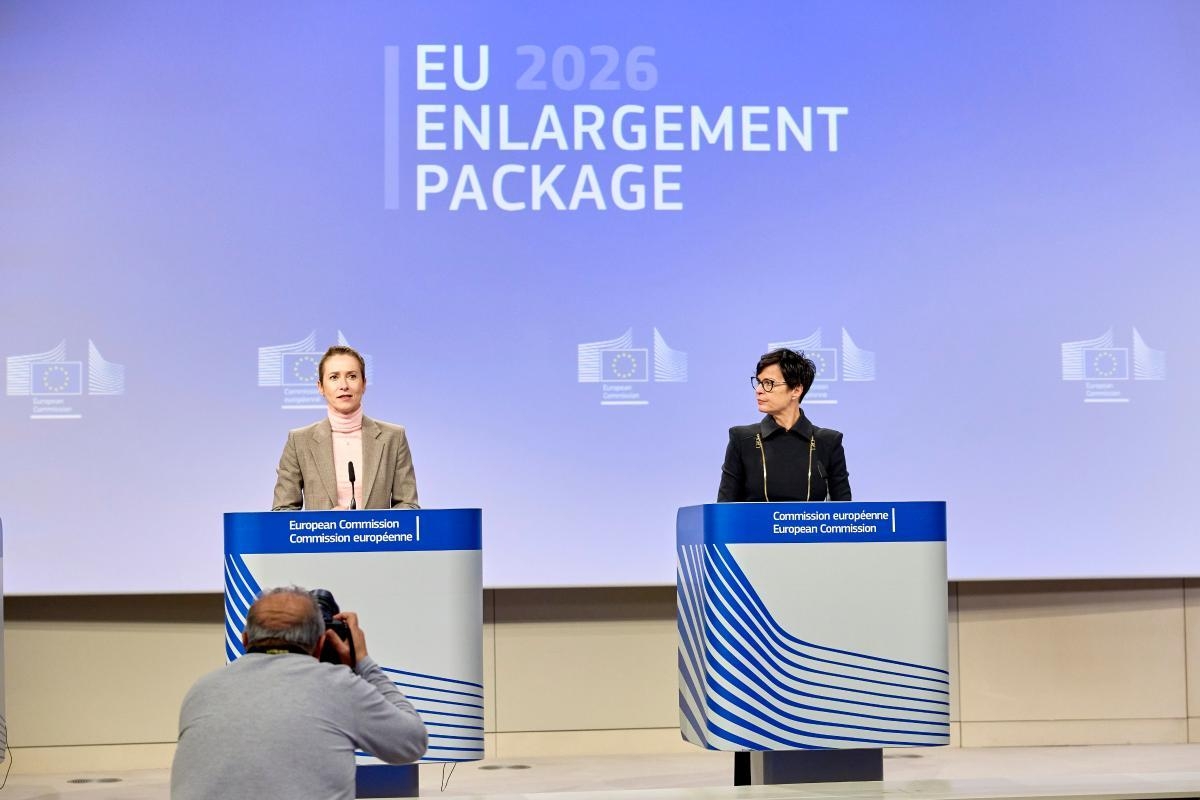
The European Commission’s latest enlargement package divides candidate countries into three broad groups: frontrunners – Montenegro, Albania, Moldova and Ukraine; those making little progress – Bosnia and Herzegovina, North Macedonia and Kosovo; and those moving backwards – Georgia and Turkey.
Serbia has moved closer to the last group after another year of democratic backsliding. But the Student List’s recent election victory has raised hopes in Brussels of a fresh start.
For the first time in well over a decade, the Commission has presented a concrete plan, complete with indicative deadlines, for bringing a group of candidate countries to the end of accession negotiations.
There was a similar attempt in 2018, when Brussels proposed a possible 2025 membership perspective for Montenegro and Serbia. Member states largely ignored that timetable.
Member states will once again have the final say. But the geopolitical landscape has changed dramatically. For the first time in years, the new roadmaps give candidates something they have long lacked: greater clarity about the path ahead and a sense that the finish line may finally be coming into view.
For now, however, that finish line is clearly visible only for Montenegro, and to a lesser extent Albania.
Moldova and Ukraine have yet to enter the final stage of negotiations, when individual chapters can begin to close. The Commission believes both countries could reach that stage within the next 12 months.
EU enlargement commissioner Marta Kos describes the roadmaps as “living documents”, designed to guide and support progress based on merit rather than guarantee a particular outcome.
She has also stressed that the group of frontrunners is not a closed club. Other candidates could qualify for their own roadmaps if they make sufficient progress – a message particularly relevant to Serbia following the Student List’s election victory.
The scope of the plans differs considerably. Montenegro’s roadmap extends all the way to the signing of its accession treaty, while those for Albania, Moldova and Ukraine focus primarily on the next 12 months.
Montenegro: The finish line is in sight
Montenegro is the “frontrunner among frontrunners”, in Kos’s words, and its path towards membership is now the most clearly defined.
According to the Commission’s roadmap, all remaining negotiating chapters could be closed in November and December 2026. Brussels maintains that Montenegro has met all the necessary closing benchmarks and that the next decisions are now in the hands of member states.
The timetable envisages finalising the accession treaty in spring 2027, followed by its signing in June. Commission officials describe the schedule as ambitious but achievable.
Whether EU governments are prepared to follow it remains an open question.
Croatia, in particular, continues to insist on resolving six outstanding bilateral issues before Montenegro completes its negotiations. These disputes could still complicate what otherwise appears to be a relatively straightforward timetable.
Once the accession treaty is signed, the Commission would introduce a dedicated monitoring process to oversee Montenegro’s remaining commitments until the country formally joins the EU.
The roadmap therefore provides Podgorica with an unusually clear sequence of steps towards membership. But it also highlights a familiar weakness of the enlargement process: even when a candidate meets the technical requirements, political decisions by individual member states can still determine the pace.
Albania: One year behind Montenegro
The Commission sees Albania as roughly one year behind Montenegro in the accession process.
Under its roadmap, Tirana could reach by the end of 2027 the stage Montenegro has reached today, with all negotiating chapters ready for closure.
But maintaining that timetable will require renewed political momentum at home.
Commission officials warn that protests and domestic political tensions have slowed Albania’s progress. The country will need to restore the pace of reforms if it is to meet the proposed deadlines.
If Tirana manages to ease those tensions and get reforms back on track, the Commission could propose beginning work on an accession treaty next year, following the path now being outlined for Montenegro.
Albania’s timetable is therefore more conditional than Montenegro’s. The destination is becoming clearer, but the country still has significant work to do before the final stage of negotiations.
Moldova: Rapid progress brings 2028 into view
Moldova could meet the interim rule-of-law benchmarks needed to move into the final stage of accession negotiations in 2027.
If it does, the Commission considers completing negotiations in the first half of 2028 a realistic prospect – provided Chisinau maintains its current pace of reforms.
The Commission’s annual report identifies Moldova as the candidate country that made the most progress over the past year, strengthening the case for an accelerated accession timetable.
Its roadmap envisages closing a substantial number of negotiating chapters during 2027. The immediate priority is to open the two remaining negotiating clusters before the end of 2026, clearing the way for the next phase.
For Moldova, the roadmap marks an important shift: from a relatively new candidate country to one with a potential timetable for completing accession negotiations within less than two years.
Ukraine: Ambitious targets, but more reforms needed
The Commission takes a more cautious approach to Ukraine’s accession timetable.
Brussels acknowledges the progress Kyiv has made under the extraordinary pressures of war, while stressing that further reforms – particularly in the rule of law – remain essential.
As with Moldova, the Commission believes Ukraine could meet the interim benchmarks in 2027, opening the way for the closure of several negotiating chapters during the year.
But it stops short of endorsing Kyiv’s goal of completing negotiations by the end of 2028.
Instead, the Commission describes that target as “ambitious”, warning that it would require a significant acceleration of reforms.
Brussels says it is ready to help, but Ukraine’s path to membership remains politically complex, not least because of the challenges its accession would pose for the EU itself.
The countries left without a roadmap
Most of the remaining candidates find themselves in a very different position.
With accession negotiations stalled or reforms moving too slowly, the Commission is not yet prepared to offer them a comparable timetable towards membership.
Bosnia and Herzegovina: Political paralysis blocks progress
Deep political divisions and a dysfunctional governing coalition have prevented Bosnia and Herzegovina from taking the steps necessary to advance towards EU membership, according to the Commission.
Following the recent elections, Brussels sees the establishment of functioning institutions, judicial reform and the appointment of a chief EU negotiator as immediate priorities.
These steps would pave the way for the formal launch of accession negotiations and the first intergovernmental conference.
The Commission is also warning of financial consequences if the country fails to deliver on its commitments under the EU’s Growth Plan for the Western Balkans.
Bosnia and Herzegovina risks losing further substantial funding unless it acts quickly, after the Commission already reduced its overall allocation by 10 percent last year.
Kosovo: Institutional deadlock and limited reform progress
The Commission’s assessment of Kosovo is dominated by a year of institutional paralysis, repeated elections and limited progress on EU-related reforms.
With a government and parliament now in place, Brussels expects the authorities to accelerate reforms, particularly in the rule of law.
Normalisation of relations with Serbia remains another central requirement, including addressing the position of the Serb community in northern Kosovo.
The Commission reiterates its willingness to prepare an opinion on Kosovo’s application for EU membership, but only if formally requested to do so by the Council of the EU.
For now, the absence of such a request leaves Kosovo’s application without a clear path forward.
North Macedonia: The handbrake remains on
“The handbrake is still on” in North Macedonia’s accession process, according to enlargement commissioner Marta Kos.
The obstacle is well known.
To unlock the next stage of negotiations and open Cluster 1, covering the fundamentals of EU membership, Skopje must adopt the constitutional amendments agreed with the EU in 2022, including provisions recognising additional minority communities.
The requirement, introduced at Bulgaria’s insistence, remains politically contentious, and the government has shown little willingness to proceed.
The deadlock is particularly striking because North Macedonia remains among the best-prepared candidates in terms of alignment with EU legislation.
Its case illustrates how political and bilateral disputes can hold back accession even when a country has achieved a relatively high level of technical readiness.
Serbia: A chance to reverse years of backsliding
The Commission’s message to Serbia is twofold.
Looking back, its annual assessment documents another 12 months of deterioration in several areas central to the EU accession process, against the backdrop of five years of stalled negotiations.
Looking ahead, however, Brussels sees an opportunity to reverse that trend following the Student List’s election victory.
The movement’s priorities – the rule of law, democracy, media freedom and fundamental rights – closely match the EU’s core demands.
This convergence could provide a basis for renewed cooperation between Brussels and Belgrade, particularly on meeting the interim benchmarks in the rule-of-law chapters.
But other longstanding conditions have not disappeared.
Alignment with the EU’s common foreign and security policy, as well as the normalisation of relations with Kosovo, remain important requirements for further progress.
Serbia has not been included among the countries receiving a roadmap towards the completion of accession negotiations.
The Commission insists, however, that this is not a final decision. If Serbia delivers substantial progress on reforms, it could still join the club of frontrunners and receive its own roadmap.
But even for the frontrunners, the Commission’s roadmaps come with no guarantees. The final decisions rest with member states, whose political priorities may shift as Europe heads into a pivotal election year, from France and Poland to Italy.