The interview was originally published on Savremena politika in Serbian
What is the current state of Serbian-Bulgarian relations, what are the obstacles to democratic transformation in the Balkans and how is Russian influence manifesting in the region we spoke with Kiril Petkov, former prime minister of Bulgaria. Petkov was a panelist at the Belgrade Security Conference, which took place in Belgrade this week.
Savremena politika: Serbian-Bulgarian relations seem to be strained lately. We have seen the Bulgarian President’s comments concerning the “Serbian World”, and also the stance of the Bulgarian government not to support Serbia opening a new cluster. How do you see this, was there a change in Serbian-Bulgarian relations lately?
Kiril Petkov: What I think is happening is that in all nations we have our internal issues that are becoming very acute. We see what’s happening here in Serbia in terms of the protests and we also have similar things happening in Bulgaria – the protests against Peevski we have now on Thursday (20 November).
Between the two nations and the populations, nothing has changed for sure. What is happening is that both nations are not too happy with their governments at the time, and the governments on both sides are trying to focus the attention in other direction than the internal problems.
It’s a complicated answer, but the real issue is that each nation has to solve its own problems to make sure that they’re happy with their representatives in government, and then everything will go to normal. Otherwise, all governments that are feeling under threat prefer to have issues from across the border than solving their own problems at home.
SP: What is the view from Bulgaria on the current Serbian protests? Do you think it has a regional relevance, and do you see maybe parallels between the protests that happened in Bulgaria a couple of years ago and what is happening in Serbia right now?
KP: I think in the whole region we have two major problems and we have to solve them.
The first major problem is internal: our tolerance to corruption. I think corruption is the biggest problem in the Balkans, and as long as the populations tolerate the governments and politicians that are willing to take public resources for their own benefit, we can never be as rich and as economically thriving nations as we could be.
The second one is the interference of the Kremlin in the region. They’ve always seen the Balkans as a sphere of influence for them, and the last thing they would like to see is all of us in the European Union working together without borders.
For historical reasons, for the interference of Russia, and for not choosing the right politicians to govern our nations, we’re not able to make these 65 million people work together as much as we should, and we see a huge amount of resources being lost – not for economic development, but for corrupt politicians.
And that’s not the politicians’ fault. It’s actually how much our populations are willing to tolerate corruption.
I really support every movement in the region that fights corruption, because I truly believe, and I recognise it with my own heart, that if we can make a step forward, our region will immediately start thriving.
I see the young people here fighting against corruption, and I saw how they recognise the loss of life because of corruption. I actually support their cause, because we’re having the same thing on Thursday. I’m having a protest right now against Peevski, who is one of the most corrupt politicians in the Balkans.

SP: What do you think are the main obstacles to having this change happen in our countries? In Bulgaria you’ve had a very turbulent past several years, with several governments and interim governments. Here in the Western Balkans we are well aware of how our governments are like and how much corruption is there. Why doesn’t this change happen?
KP: So, again, a few things. There are quite a few citizens of our nations that benefit from corruption. It’s all of the government, all the companies that work with the government. There is a huge percentage of a very focused incentivised population, that’s one. When it comes to voting, they usually vote as a bloc.
Second, what we see is that there is always a fight between Europe and Russia in the region. These divisions always happen, which the politicians take advantage of, so that here is never a concentrated bloc against corruption. They’re trying even in Bulgaria. They’re saying “you’re against corruption, but are you pro-Russia or against Russia?” No, no, let’s solve our own problems first, and then let’s talk about the world. This division does not allow us to concentrate resources in one direction.
The third point is that through corruption you can accumulate a huge amount of resources to be able to hold power, while the rest of the population that’s the victim of corruption doesn’t have the resources.
And the final point is coordination. We’re not very good in the Balkans in creating unitary leadership. In the opposition usually everybody thinks they’re the best and they’re the ones to make the change, versus recognising that the only way to make the change is to work together.
Working together is not the strongest point we have culturally in the region. And I think we can learn to do that better, and then we can overcome corrupt politicians and systems. They’re a minority, but they’re better organised because they have a clear incentive.
SP: You mentioned Russian influence as a big problem in the region. Did the EU and NATO membership of Bulgaria actually represent a defence against Russian influence in comparison to the countries which are still outside of EU and NATO, like Serbia?
KP: Yes, a bit they did. But we have, unfortunately – you and we – 70 years of education that brainwashed a bit our thinking.
See, I don’t hate what the Russians have done historically. For example, Bulgaria is still thankful about the liberation from the Ottoman Empire. But it cannot excuse, for example, the fact that the Russians were selling gas at 76 euros per megawatt hour to Bulgaria, and at only 20 euros per megawatt hour to a non-Slavic, non-cultural Germany.
In other words, what I’m seeing is that the Russians are very good at using culture, education and brainwashing in previous years to take advantage of our populations today.
For example, the solution for NIS petrol today is pretty clear. You use the sanctions to take control of the refinery and put it for an open bid for the most optimal Western operator of refinery that can deliver the lowest cost of fuel to the Serbians. It’s very clear in terms of what has to be done. Yet, it looks like it’s an impossible deal for you guys. The government is not sure what it’s doing.
I just drove today to Serbia, and the gas prices are already significantly higher over Bulgarian prices. That means that your companies are paying and your citizens are paying. Why, when you have a clear solution?
The only answer to this is that somebody is trying to influence your government and how the deal is to be made. And it’s entangling a key asset of Serbia for which somebody is making excessive profits today. It’s a good example of how it works.
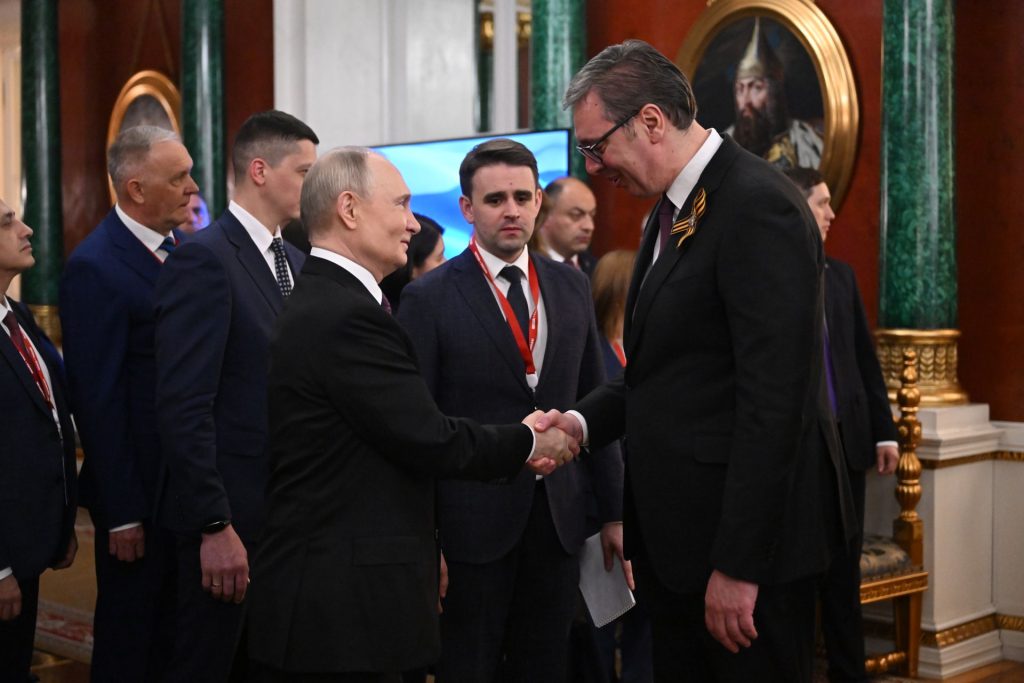
SP: Is the Bulgarian government interested in thwarting this Russian influence, having in mind decisions about the gas transfer, but also in general the pro-Russian sentiments in Bulgaria and among some parties on the one hand, and commitments to EU and NATO on the other hand, at least on a rhetorical level?
KP: What I think the Russians are very good at doing – and I applaud them for their professionalism, even though it’s working against us – they’re able to work with corrupt politicians in our local environments which sound pro-Western.
If you ask our Peevski or Borisov, they’ll tell we’re with the US, we’re with Europe, “till death do us apart”. Yet, they did Turk Stream in two years and the Greek interconnector they could not do for 10 years.
I became prime minister after 10 years of Borisov’s strong pro-European stance and working against Russia. However, we’re 100% dependent on Russian gas, 100% dependent on Russian oil, 100% dependent on Russian nuclear fuel. I had 70 GRU agents working around Bulgaria that we sent back.
So, you wonder, how did this pro-European politician for 10 years leave us in full dependency on Russia? The only answer is that Russia is using corruption as their main foreign policy instrument. They can work with local politicians that are good at making rhetorical and nominal closeness to Europe, but in fact are working for their best interest through corruption to fulfil Russia’s interests.
That’s the deal. And we have to, as populations, recognise that’s the case and say, no, you may be Slavic brothers from the past, but I want to get the same price of gas as the Germans, or: I don’t believe that spheres of influence are a fact anymore, and we should not allow another nation, no matter where it is, to actually meddle with our economies and our political life.