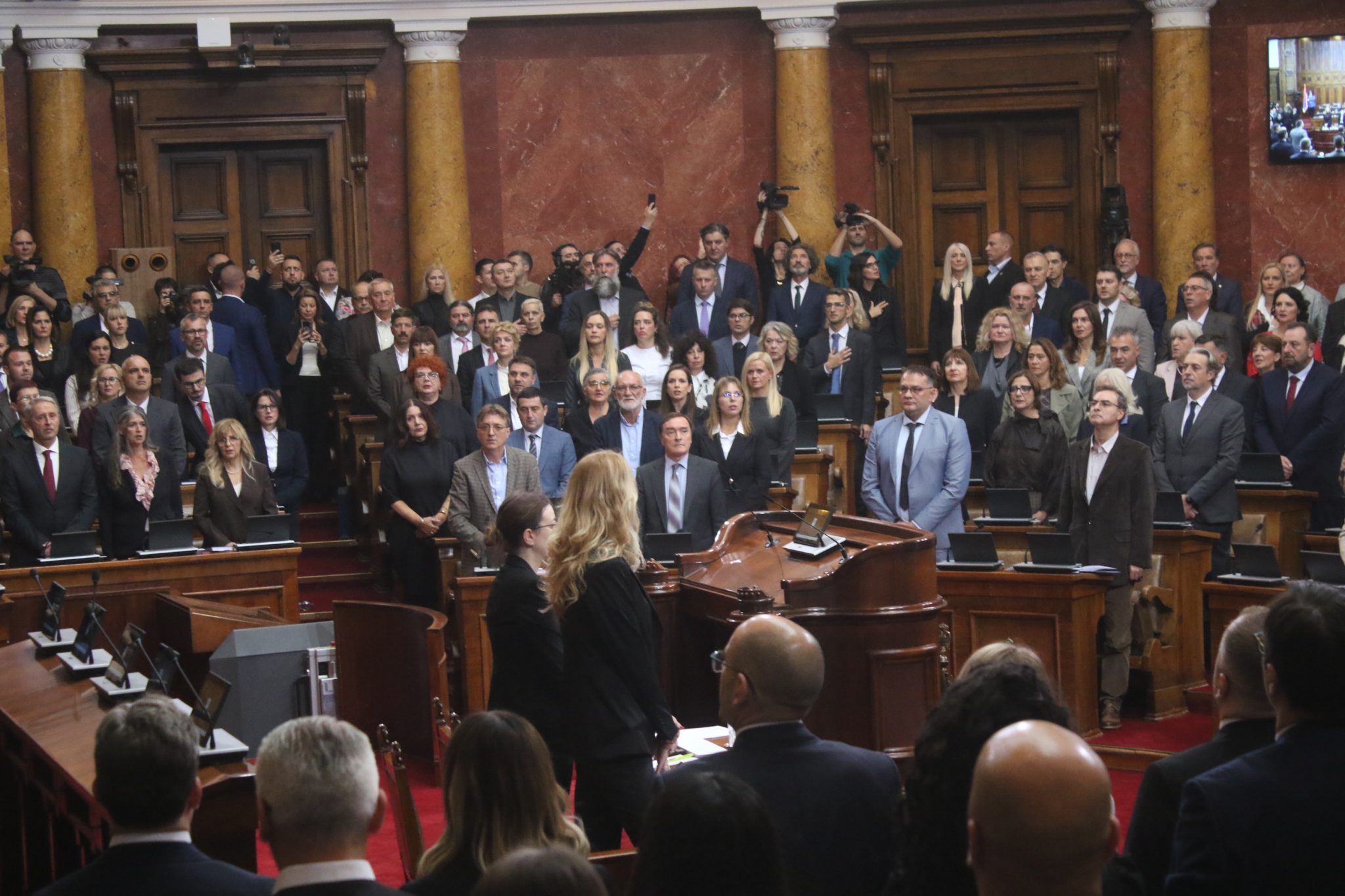
Last week, as the Student List began the process of transition of power following its victory in Serbia’s 25 October parliamentary elections, France’s Minister Delegate for Europe Benjamin Haddad visited Belgrade to take part in the Belgrade Security Conference. In his address to the conference, Haddad emphasised that he was the first minister from a European government to visit Serbia since the election and reaffirmed France’s support for Serbia’s EU accession.
During his visit, Haddad met with representatives of the Student List to discuss the reforms facing the incoming government and Serbia’s path to EU membership.
On the sidelines of the conference, we spoke with Haddad about how the election could reshape relations between France and Serbia, what support Paris can offer the incoming government and whether there is a fresh momentum for opening Cluster 3. We also discussed France’s approach to EU enlargement, including the safeguards proposed for Montenegro’s accession treaty.
European Western Balkans: After the Student List’s election victory, you welcomed Serbia’s democratic momentum and the high voter turnout. What opportunities does the change of government open up for closer cooperation between France and Serbia?
Benjamin Haddad: I am here in Belgrade to convey a message of friendship from the French president, the French government and the French people to the people of Serbia, especially after such an impressive electoral victory.
It was inspiring to see the peaceful movement led by the students over the past two years. The high turnout and decisive victory give Serbia a great deal of hope and create opportunities for its transition and its European path. I am here first to listen and see how we can help make this transition a success and anchor Serbia more firmly on its European path.
That means reforms in many areas, including the rule of law, judicial independence, checks and balances, public administration and the economy. Adopting the acquis communautaire, the body of EU law, is a demanding process. It is clearly in France’s interest to support it. It helps safeguard the unity and geopolitical stability of our continent at a time when we face pressure and interference from hostile powers, including Russia.
Serbia’s European path also presents an opportunity for relations between our two countries. France and Serbia have a long history of friendship. President Macron has strengthened the relationship in recent years through a strategic partnership.
We can now build on that through investment, closer ties between our citizens, exchanges for students and young people, and expertise to support reforms. We already have five French experts in Serbia’s administration helping with reforms across several sectors. We can send more expertise and continue to support Serbia through the reform process.
European Western Balkans: You said you came to hear from new voices in Serbia. What can France offer the incoming authorities, and which EU accession reforms will be your priorities?
Benjamin Haddad: The reforms needed to join the European Union are wide-ranging. They include fighting corruption, strengthening the rule of law and judicial independence, reforming public administration and ensuring effective checks and balances. We have expertise and can help in all these areas.
Our justice minister should visit soon to look at how we can support reform of the justice system, including efforts to make the prosecutor’s office more independent and transparent.
In my conversations today with civil society, think tank experts and people close to the Student List, I made the case that this is also an opportunity to renew ties with the EU institutions.
The EU’s Growth Plan for the Western Balkans supports investment and economic projects in the region in exchange for reforms based on a clear agenda. Serbia has lagged behind, and there is now an opportunity to unlock some of that funding too. This is something we can work on with the Serbian authorities.
We can help Serbia access EU funding, deepen its relationship with France and draw on expertise from our government and civil society. I am here today with two academics and with members of parliament who are eager to contribute. There is a lot we can do to help Serbia through this process.
EWB: Can Serbia’s incoming government count on France to continue advocating for progress in the EU accession talks, including the opening of Cluster 3?
BH: Absolutely. Our approach has always been to support Serbia’s accession on its own merits, based on the reforms it delivers. We have always supported opening Cluster 3 for a simple reason : the European Commission’s report said that Serbia had carried out the reforms needed to open it. Our approach based on merits called for it.
We will continue to support it, and I think we can be optimistic about renewed momentum at the European level. France will work with its partners to advocate for opening Cluster 3 and for opening further clusters as Serbia continues its reforms. We will be there to help.
EWB: Some EU member states remain sceptical because of Serbia’s foreign policy, particularly its decision to stay out of EU sanctions against Russia. That may take time for the incoming government to address. Will France raise the issue with those countries, and do you think they would agree to open another cluster before Serbia aligns with the sanctions?
BH: I want to be frank. The EU accession process is based on reforms, so the ball is also in Serbia’s court. EU member states and institutions will look closely at what happens and assess whether Serbia is aligning with the EU on these issues and whether we can work together.
There can be no political shortcuts, and there should be no political blockages either. If Serbia carries out the reforms needed to open clusters and chapters, France will support it, and I think many other EU countries will do the same. We will make the case for Serbia to join the European family as long as it carries out the reforms, and we will help it along the way.
EWB: There is a perception in Serbia that France stood out among EU member states for its support of Aleksandar Vučić and the SNS government, particularly during the political crisis of the past two years. France backed the opening of Cluster 3, which the European Commission recommended even as it reported backsliding in areas related to the rule of law. Looking back, do you think France’s approach was a mistake?
BH: I respect the question. The relationship between France and Serbia is special. It goes beyond individual leaders and is rooted in the history of our two peoples. Serbia has many friends in France who remember the ties between our countries and Serbia’s role as France’s ally in the First World War. The Statute in the parc across from here speaks for it. Victor Hugo spoke about Serbian nationhood. My sense is that the feeling is mutual and that France has a special place in the hearts of many Serbs.
We worked with the Serbian authorities and were always clear about the reforms we expected, just as I am being clear with you now. We have always believed that Europe would be more stable and united, and the Western Balkans more stable and secure, with Serbia on the European path. We chose to engage with the authorities and speak frankly, openly and transparently so that Serbia would stay on that path.
That explains our relationship over the past few years. It also explains why I am the first minister from Europe to come here, to listen, to talk about our friendship, to offer whatever help we can and to continue making the case for Serbia.
The enthusiasm on election night was striking. You could see it among French politicians, in the French media and in reactions on social media. People could see that something special was happening here, and we want to support it.
EWB: You have said that Europe cannot afford grey zones. What is France’s assessment of the European Commission’s enlargement proposals and its new roadmaps for candidate countries? Will France back the Commission’s objective?
BH: We view the proposals very positively. France and Germany were the main drivers of this approach. Full membership remains the goal for candidate countries.
Today, accession works a bit like an on-off switch. You do all the work to adopt the acquis communautaire. That takes a long time because the process is demanding and we have to be strict about it. Then, overnight, you become a full member.
We want a more gradual approach. Citizens and civil society should be able to see the benefits of closer ties with the European Union, including through growth and prosperity, even before their country becomes a full member. That is why we want more flexibility. When countries open certain clusters or close certain chapters, they could already begin taking part in some EU policies. That could mean parts of the internal market, energy or security. We can decide which areas to include.
Candidate countries could also have a seat at the table and take part in deliberations, even without voting rights, as they progress towards EU membership. We have to keep our ambitions for reform high. Otherwise, we would betray the hopes of the people calling for these reforms. It is also in our geopolitical interest to anchor Serbia and other Western Balkan candidates, as well as Moldova and others, as firmly as possible in Europe.
EWB: There is a debate within the EU about how to ensure that new members continue to meet reform commitments after accession. What is France’s position on the safeguards being discussed for Montenegro’s accession treaty?
BH: I think these safeguards are necessary to ensure respect for the rule of law and allow for a gradual transition in certain sectors after accession. We used safeguards for Croatia as well, so this is an approach we have already tried.
The objective is for Montenegro, which is moving ahead with its reforms, to become a full member soon. Safeguard clauses help ensure that it continues to meet criteria such as those on the rule of law.
EWB: Will France propose any additional safeguards?
BH: We have already worked with the Commission and other member states on the accession treaty. I think the safeguards being proposed go in the right direction. We helped shape them with the European Commission.
EWB: Montenegro is closer to EU membership than any other candidate. How could upcoming elections in EU member states, including France, affect when it joins?
BH: First and foremost, it depends on Montenegro. Like other candidate countries, it needs to continue with reforms. I think the Montenegrin government is doing the right things. It is adopting reforms, implementing them and putting the necessary resources into that work. I have visited Montenegro several times to follow its progress and offer support. The timing really depends on how quickly the reforms advance.
In France, there are two possibilities. The president can call a referendum, or accession can be approved by a three-fifths majority in parliament. In Croatia’s case, parliament voted in favour of accession.
It is in our interest for Europe to be stable and united, and that is the case we will make. The best argument for Montenegro’s accession is for it to continue implementing reforms. That is what we tell the people of Montenegro.
EWB: How does the French public view enlargement, and what is your government doing to build support for it?
BH: We are making the case for it. Look at the world around us. Russia is attacking Ukraine and trying to make it part of Russia, and Ukrainians are heroically resisting. The United States is putting pressure on Canada and Greenland to become part of the United States, and they are pushing back.
Meanwhile, several countries want to join the EU and are undertaking deep and difficult reforms to become members. That says something about the appeal of our institutions. The EU needs reform. It needs to become more competitive and less dependent. That is what France is pushing for at the European level. It says something that more countries are trying to become the 28th member of the European Union than the 51st state of the United States.
Look at Britain ten years after Brexit. It is having a serious debate about the relationship it wants with the EU. It wants closer ties, and it may debate rejoining the EU or at least rejoining the single market. I think that is an important argument.
We also work with governments in the region, including Montenegro and Albania, to engage with the public and make the case for enlargement with parliaments, newspapers, think tanks, civil society and universities. For example, I came to Serbia today with my team, members of both houses of parliament, people from think tanks, journalists and academics. One reason I do that is to bring this story to a wider audience.
EWB: North Macedonia’s accession talks remain stalled over its dispute with Bulgaria. Is France prepared to take a more active diplomatic role in talks between Skopje and Sofia to break the deadlock?
BH: Yes, and I hope we can resolve it. It matters to us because it concerns the European path of the Western Balkans as a whole, and because the compromise was finalised during the French presidency of the Council of the EU in 2022.
North Macedonia’s authorities have already done a great deal. The country changed its name under its agreement with Greece and has made substantial changes to pursue this path. I am convinced that the commitments need to be honoured and implemented. I also believe that bilateral issues should not dominate the process. The focus should be on reforms and the acquis communautaire. We want to work closely with North Macedonia’s authorities on implementing the 2022 compromise and adopting the constitutional amendment.
We need to build trust and give the authorities and the public greater confidence that, once they implement the compromise, the country can move forward on its own merits, based on its reforms, without further bilateral conditions. I think that is an understandable request from North Macedonia.
Our intention is to see the compromise implemented in full and to build greater trust and confidence so the process can move forward.