BLED – “In the coming years, we must prepare the Union for enlargement—through reforms, budget adjustments, and strengthened governance,” said President of the European Council, António Costa, addressing the Bled Strategic Forum (BSF).
He assessed that the EU is not a closed club, adding that the accession paths of the Western Balkans, Moldova, and Ukraine are not just promises.
“They are priorities. These countries are at the heart of Europe, and they are part of Europe’s future,” Costa said.
He underlined that, in the coming years, the European Union must prepare for enlargement through reforms, budget adjustments, and strengthened governance.
“Enlargement will not be easy. But it will be worth it. It is the best investment we can make—to reconcile nations and histories, and to build a more united continent. We will continue to work with all accession partners and take advantage of this positive momentum on enlargement,” Costa said.
According to him, the EU’s Growth Plan for the Western Balkans is a potential game changer—offering financial support and incentives for reforms, regional cooperation, and economic integration.
“We must not lose this momentum. All leaders must do their part. All parties must take responsibility. Because this is not about geography. It is about values—democracy, human rights, freedom and the rule of law,” the President of the European Council said.
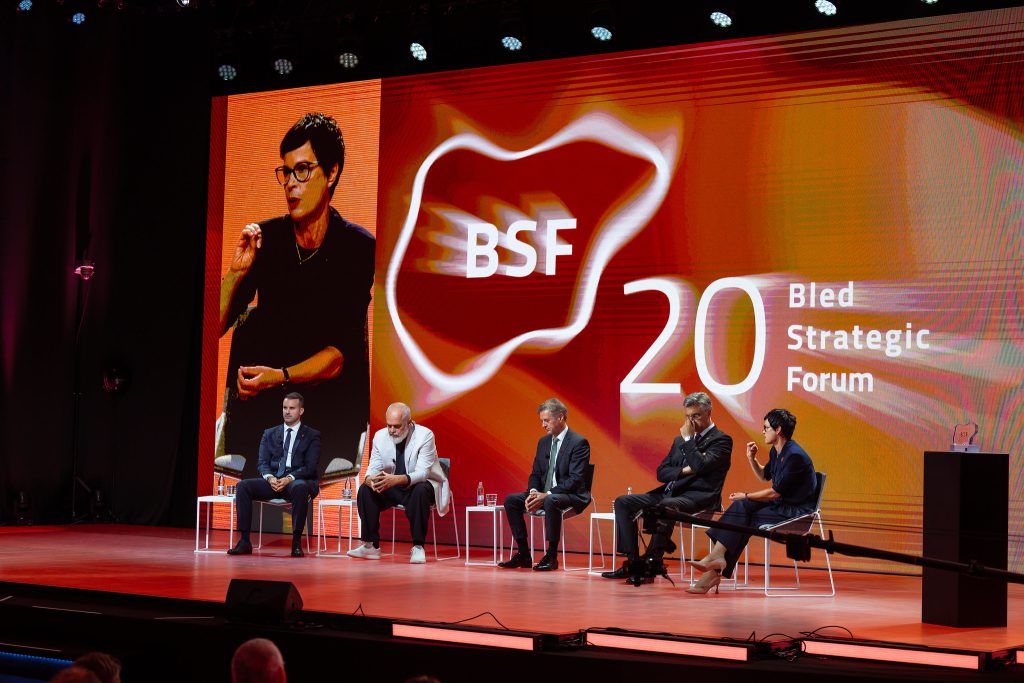
Speaking at a panel alongside the Prime Ministers of Slovenia, Croatia, Montenegro, and Albania, Enlargement Commissioner Marta Kos stated that enlargement remains a priority for the European Commission, announcing that Albania will open two more clusters this year.
“If we finish the technical part of the accession negotiations in 2026, then in 2028 we could get the 28th member of the EU. Albania could join as the 29th member in 2029,” Kos stated.
But she underlined that there must be no shortcuts and added that candidate countries have to deliver in reforms.
“Rule of law, human rights, fight against corruption, and free media are non-negotiable. All this has to be fulfilled,” Kos said.
Montenegrin Prime Minister Milojko Spajić assessed that it is time for the region to turn toward the future, warning that otherwise it risks becoming irrelevant.
Spajić emphasized that Montenegro is building consensus around three key priorities: European integration; the economy; and, third, the rule of law as “equal and fair treatment for everyone, regardless of ethnicity.”
He recalled that Montenegro recently carried out a major reform, with parliament unanimously adopting amendments to electoral legislation, a development he described as a significant achievement.
“For decades, this was impossible. The same applied to the Constitutional Court and many other reforms we could not implement for years. Now we are able to move forward, with the support of more than two-thirds of votes,” Spajić stressed.
Croatian Prime Minister Andrej Plenković is not sure that enlargement is truly a priority in the EU, underlining that the main point of enlargement is preparation and a critical amount of public support.
Speaking about the situation in the Western Balkans, Plenković assessed that countries have to achieve political stabilization.
“You have North Macedonia, which is blocked. You have Serbia, with more than two years of the largest, strongest, and most serious internal unrest and demonstrations. You have BiH with Dodik dragging on the question of separation or no separation for years, and suddenly, he’s out,” Plenković said.