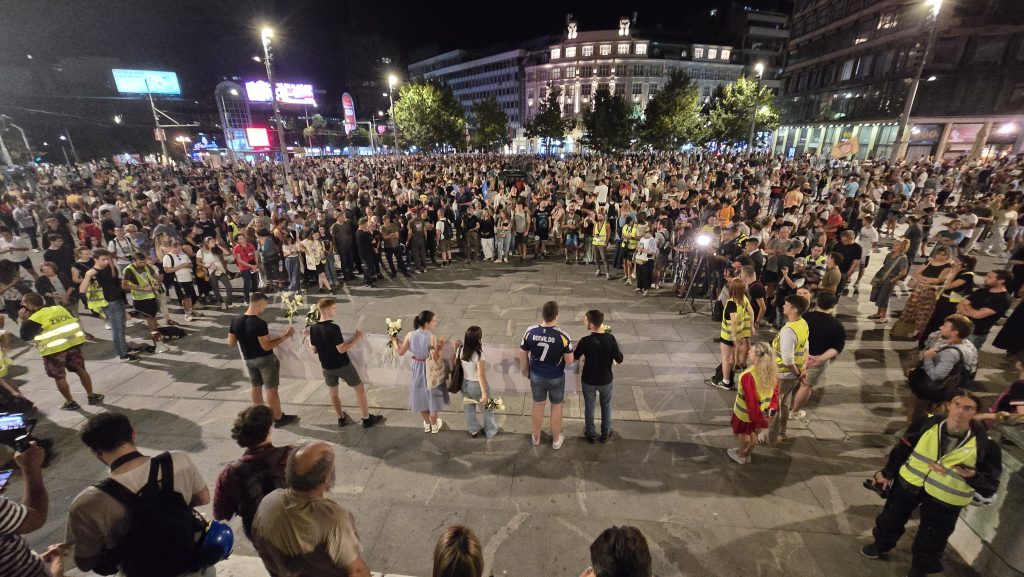
BELGRADE – On 1 September, tens of thousands of people gathered in the streets of Serbian cities to commemorate the victims of the Novi Sad tragedy and to demand early elections. The protests, led by high school and university students, marked 10 months since a concrete canopy collapse at a train station in Novi Sad killed 16 people.
Alongside the snap elections, the protesters’ demands include transparent investigations and criminal prosecutions for those responsible for the canopy collapse, as well as the calls for media freedom, which, according to numerous reports, the government is trying to suppress.
Numerous reports on police brutality in Novi Sad
On Monday evening, police reportedly used batons and shock bombs against peaceful protesters in Novi Sad. According to the media reports, after the commemorative walk to the railway station took place, several police vehicles headed in the direction of the university campus and the police in the riot gear intervened in front of the Faculty of Sports and Physical Education.
The protesters and the witnesses claimed that the police had beaten citizens and students for no apparent reason. It was reported by many people that the intervention of the police was “brutal and unprovoked”, because the protesters stood peacefully in front of the faculty and shouted slogans, and that no one attacked the police.
Witnesses told the media outlets, such as N1, that police used batons, stun grenades and pepper spray, as well as “randomly beat and detained people” in the wider area of the faculty, even though people were running from the police which pushed them all the way to the student campus, located about 300 meters from the faculty.
On the other hand, the police stated that it “timely and professionally reacted to the attempts by a group of people who gathered in front of the main entrance of the faculty, with the intention of forcibly entering the building”.
According to the Ministry of Interior, these protesters “wore masks and insulted police officers”. It was also stated that one police officer was injured during the intervention. However, the number of the injured citizens was not declared by the police.
Prior to the protest in Novi Sad, early in the morning on 1 September, Patrik Drid, the Dean of Faculty of Sports and Physical Education, forcibly entered the faculty building, which had been occupied by student protesters since November 2024. This action was backed by the police, which set up a cordon in front of the building and later intervened to disperse a gathering of protesters.
Some reports from students on social media, specifically from the Faculty of Technical Sciences on X, alleged that masked accomplices broke windows and attacked students during the intrusion, though Drid himself claimed he entered “non-violently”.
The symbolic march in Belgrade
In Belgrade the protesters, led by the high school pupils and students, symbolically marched from the former main railway station to the central Republic Square. Prior to the walk, the pre-recorded speech was broadcast.
“We were called terrorists, traitors and foreign mercenaries, our classmates were kidnapped by the police… Our peers were handcuffed, arrested in a way that has no precedent, during peaceful protests they were shot at with fireworks, firecrackers and tear gas… After all this, institutions are still silent, but we will not be,” the speech notes.
In addition, the names of 16 victims of the Novi Sad tragedy were read, while 16 pupils each held a symbolic white rose to commemorate the victims. During the protest in Belgrade, riot police, some shielded, guarded the headquarters of Serbian President Aleksandar Vučić.
The protests occurred while Vučić was in China for a gathering that included Russian President Vladimir Putin and leaders from China, North Korea, Belarus, and Iran. Vučić has publicly labelled the protesters as “terrorists” aiming to unseat him.
The ongoing protests also highlight deep-seated issues within the Serbian education system, with reports of school principals being dismissed for supporting strikes and teachers facing punishment.