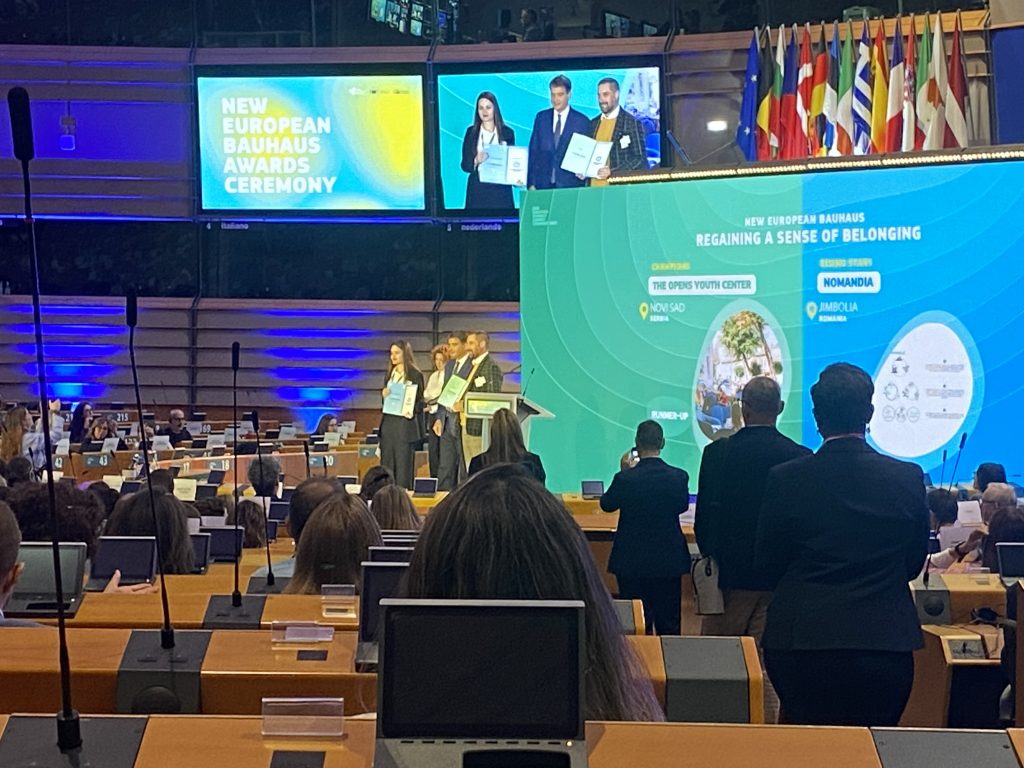
BRUSSELS – On 30 September, the winners of the New European Bauhaus (NEB) prize were revealed at the ceremony held at the European Parliament. The projects from Bosnia and Herzegovina and Serbia are among the champions of the annual competition, launched by the European Commission in 2020.
The NEB connects the European Green Deal to the living spaces. It promotes new ways of living where sustainability matches style, thus accelerating the green transition in various sectors of the economy and in society.
The NEB Prizes are open to projects and concepts implemented in the EU, in the Western Balkans and Ukraine.
In his speech at the awards ceremony, Raffaele Fitto, Executive Vice-President of the European Commission for Cohesion and Reforms, noted that the New European Bauhaus is an important part of the cohesion policy.
He added that the EU is devoted to supporting the projects and concepts which promote sustainable housing, climate actions, and social inclusiveness. According to Fitto, “small municipalities are the essential partners in the cohesion policy”.
The four prize categories reflect the New European Bauhaus transformation themes: “reconnecting with nature”; “regaining a sense of belonging”; “prioritising the places and people that need it the most”, as well as “shaping a circular industrial ecosystem and supporting life-cycle thinking”.
In each category, there are two parallel competition strands: “champions” – existing and completed projects in line with the New European Bauhaus values and principles, as well as the rising stars.
When it comes to “champions”, the winners and runner-ups each receive 30,000 and 20,000 euros, respectively.
The term “rising stars” refers to concepts by young talents under 30, and the winners and runner-ups each receive 15,000 and 10,000 euros, respectively.
OPENS Youth Centre from Serbia is the runner-up in the category “regaining a sense of belonging”. It was awarded for transforming the Petar Drapšin factory in Novi Sad into a vibrant cultural hub for youth.
In addition, “Magbago” fashion brand from BiH is the runner-up in the category “shaping a circular industrial ecosystem and supporting life-cycle thinking”. The project uses innovative materials from agricultural waste and regenerative fabrics.