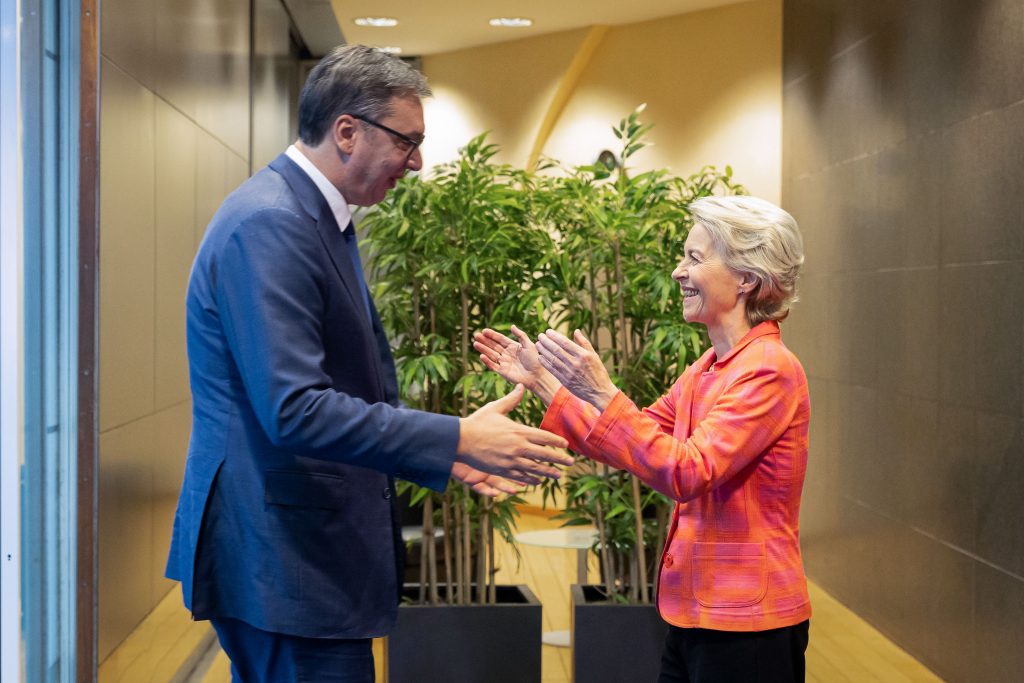
President of the European Commission Ursula von der Leyen will visit Serbia tomorrow as part of her annual Western Balkans tour. Since 2021, almost all her visits to Belgrade have included statements of praise for Serbia’s reforms and progress in the areas of rule of law and democracy.
These statements have created more and more controversy as they were made in the context of prolonged crises in these areas, be it electoral conditions, media pluralism or independence of the judiciary. They triggered negative reactions from a large part of the public, including those who used to regard the European Union as an ally when it comes to these areas.
As von der Leyen visits Serbia this year, the reforms Serbia pledged to implement last December in order to open a new Cluster with the EU, including the election of the new media regulator and revision of the voter register, have still not materialised.
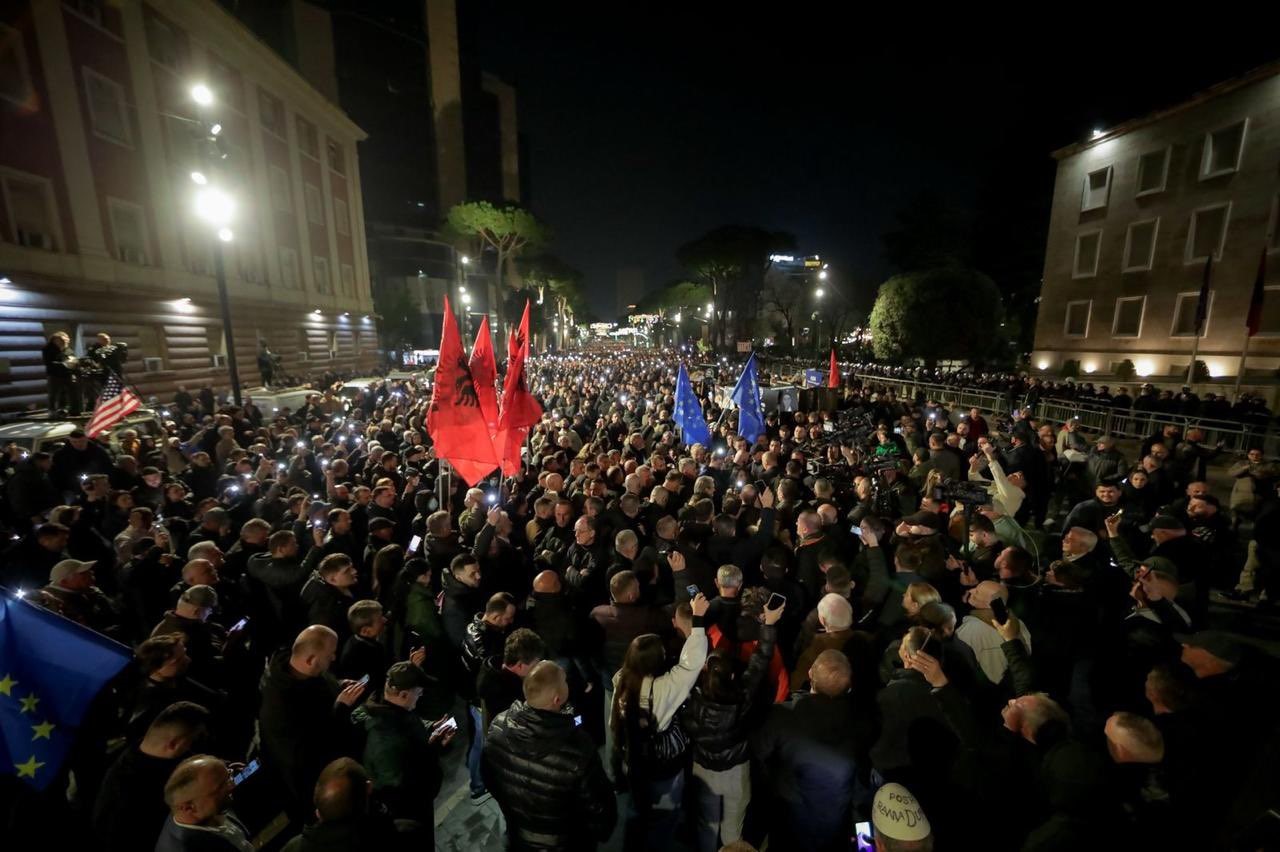
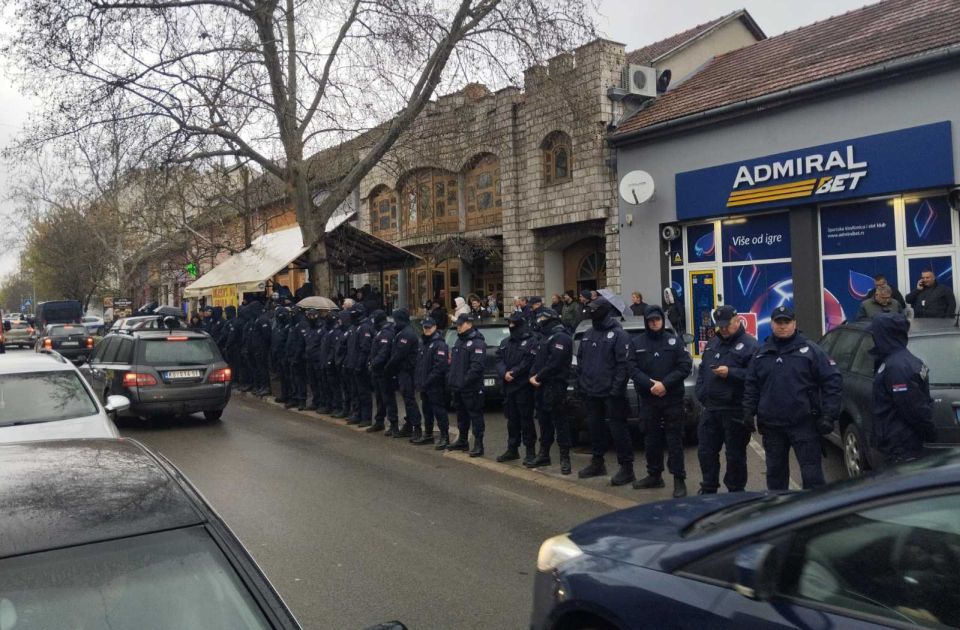
Meanwhile, the country has seen almost a year of protests primarily led by the student movement following the November 2024 deadly collapse of the Novi Sad railway station, which raised the issues of the lack of transparency, respect for procedures and potential corruption. The response of the government to the protests has become more repressive as the year has gone by.
The public is now waiting to see whether tomorrow’s comments from the President of the European Commission will be more reflective of the current political context, or will they cause yet another backlash from pro-European citizens critical of the government.
2021: “It is amazing to see the progress”
In 2021, during her first visit to Serbia as part of her Western Balkan tour, Ursula von der Leyen welcomed, as she said, that Serbia places a strong focus on fundamental reforms.
“I commend you for the steps you have taken. This is enormous. You have done a lot of hard work. This hard work pays off. It is amazing to see the progress”, President von der Leyen said in a press conference with President Vučić.
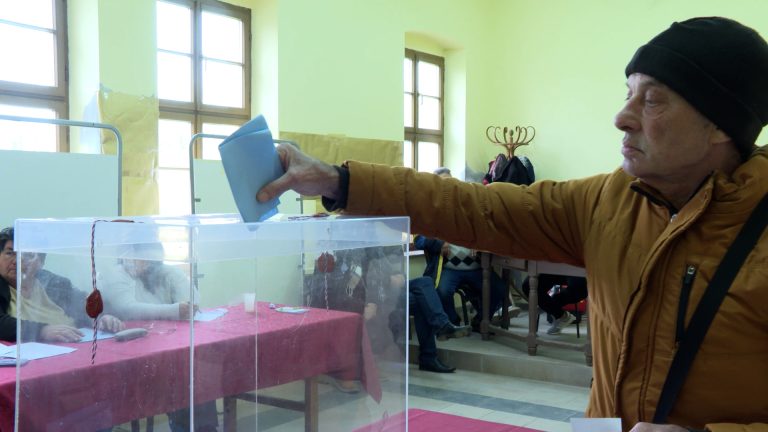
At the time she was saying this, Serbia’s parliament was without opposition parties, as they had boycotted the previous year’s parliamentary elections, citing unfair election conditions. An inter-party dialogue on improving electoral conditions, mediated by the European Parliament, was ongoing at the time, but it yielded very few tangible results. The future elections in Serbia, especially the ones in December 2023, continued to produce a lot of controversy and attract criticism from observers.
The oppositionless parliament enacted a constitutional reform in late 2021 to increase the independence of the judiciary, for which Serbia was rewarded by opening a new Cluster of chapters in negotiations with the EU – the last time this has happened. The 2024 European Commission report on Serbia noted that “undue pressure on the judiciary remains a concern”.
2023: “Congratulations on media reforms”
Von der Leyen’s 2022 speech in Serbia was focused on the country’s diversification of energy sources – another topical issue today – but she also did not miss an opportunity to assess that the Serbian leadership was “very engaged” in topics such as independence of the judiciary and the fight against corruption.
The 2023 visit, however, was more memorable in this regard, as the President of the European Commission congratulated President Vučić on “finalising important reforms on media freedom”. The statement was made in the context of the recent adoption of the new Law on Electronic Media.
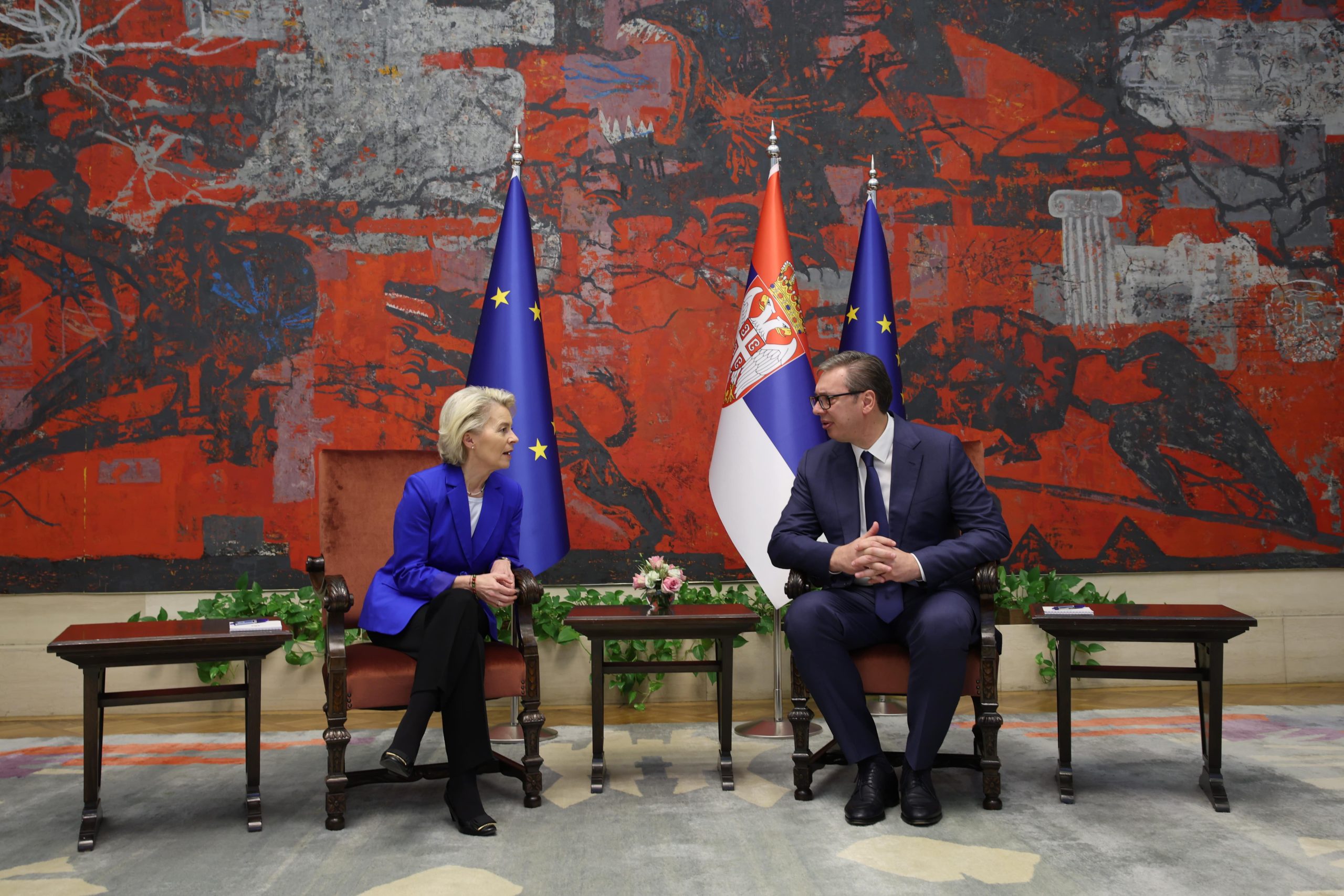
While the adoption of the law was indeed a part of Serbia’s EU agenda, already at the time, the text was criticised by multiple experts for provisions such as allowing the state-owned Telekom company to own media outlets. Telekom had previously been described as a weapon of the ruling party to establish media dominance in Serbia, and its role has once again been questioned in the recent controversy regarding the future of the remaining independent media.
The media law that Ursula von der Leyen praised also terminated the mandate of the Council of the Regulatory Authority for Electronic Media (REM) in 2024. On paper, this is the most important media watchdog in the country. However, the new Council has not been elected since last November, despite the fact that the government promised to do so to open Cluster 3. Critics have accused the ruling party of not wanting to relinquish its influence over the majority of Council members, which it previously had.
2024: “Your deeds follow your words”
In her last year’s speech in Belgrade, Ursula von der Leyen promoted the new Growth Plan for the Western Balkans and assessed that Serbia has shown that it can meet the necessary benchmarks.
“You have committed to delivering on reforms, in particular on the fundamentals, as you just said, of the rule of law and democracy. And you have shown that deeds follow your words”, von der Leyen said.
A few days after this speech, the canopy of the Novi Sad railway station collapsed, triggering the largest wave of anti-government protests so far.
In the early weeks of the protests, Vučić travelled to Brussels to lobby for the opening of Cluster 3, pledging to elect the new REM Council and start implementing OSCE-ODIHR election recommendations, especially the ones related to the revision of the voter registry. Almost a year later, this has not happened, despite the nudging from the President of the European Council, António Costa and Ursula von der Leyen herself during their meeting with Vučić in March.
Will the President of the European Commission, in her tomorrow’s press conference with Vučić, once again assess that he is a model student when it comes to EU fundamental values and that his “deeds follow his words”?