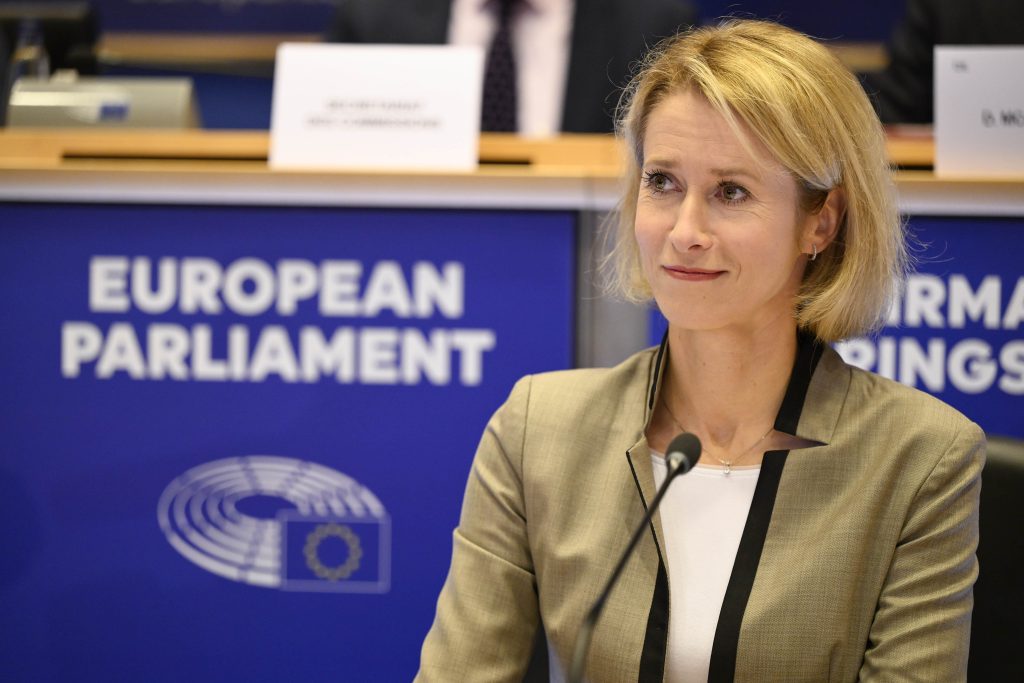
SARAJEVO – The European Union High Representative for Foreign Affairs and Security Policy, Kaja Kallas, stated today in Sarajevo that the European Commission will publish its enlargement report tomorrow, which will include negative elements for Bosnia and Herzegovina, particularly regarding judicial reform and the appointment of the chief negotiator.
Upon arriving in Bosnia and Herzegovina, Kallas visited the European Union Force (EUFOR) Althea mission at Camp Butmir, and later met with members of the Presidency of Bosnia and Herzegovina, Denis Bećirović and Željka Cvijanović.
“International supervision should gradually be phased out once the domestic authorities demonstrate their ability to make decisions. The European Union wants local institutions to take full responsibility for governing the country. Decisions must be made here, in Bosnia and Herzegovina, because this is your country,” Kallas emphasized.
She pointed out that the issue of appointing a chief negotiator remains open, adding that the country’s authorities must decide who will take on that role, since the EU accession process requires one person to coordinate all activities.
“This does not mean that only one person does all the work, but that there is clearly defined responsibility and communication between Bosnia and Herzegovina and the EU,” Kallas clarified.
She stressed that the EU supports Bosnia and Herzegovina, but that decisions must be made by legitimately elected domestic representatives.
In a statement published on the website of the European External Action Service (EEAS), marking 30 years since the Dayton Peace Agreement, it was emphasized that the EU will continue to do everything it can to prevent any security vacuum.
“We will not allow history to repeat itself,” Kallas said.
“When the Constitution is respected and there is the capacity to make decisions, there is no longer a need for international intervention. Only then can we consider the gradual phasing out of international supervision,” Kallas said.
Bećirović thanked High Representative Kallas for the EU’s continued support to Bosnia and Herzegovina and emphasized that, for the citizens of the country, European and Euro-Atlantic integration remain key political, security, and economic priorities.
He pointed out that Bosnia and Herzegovina has demonstrated a clear commitment to full EU membership, among other things, through complete alignment with the EU’s Common Foreign and Security Policy, including its support for Ukraine in defending itself against Russian aggression.
The member of the Presidency of Bosnia and Herzegovina stressed that both Bosnia and Herzegovina and the EU must draw serious lessons from the year 2025.
“It is extremely dangerous to question in any way the mandate and powers of the Office of the High Representative (OHR), as it is an institution established under Annex 10 of the Dayton Peace Agreement. The existence and mandate of the OHR are a very important mechanism for preventing destructive politics that threaten peace and stability in Bosnia and Herzegovina and the region. The High Representative is an essential guarantor of peace and the protection of the Dayton Peace Agreement,” Bećirović’s office said in a statement.
This is Kallas’s second visit to Bosnia and Herzegovina in the past six months.