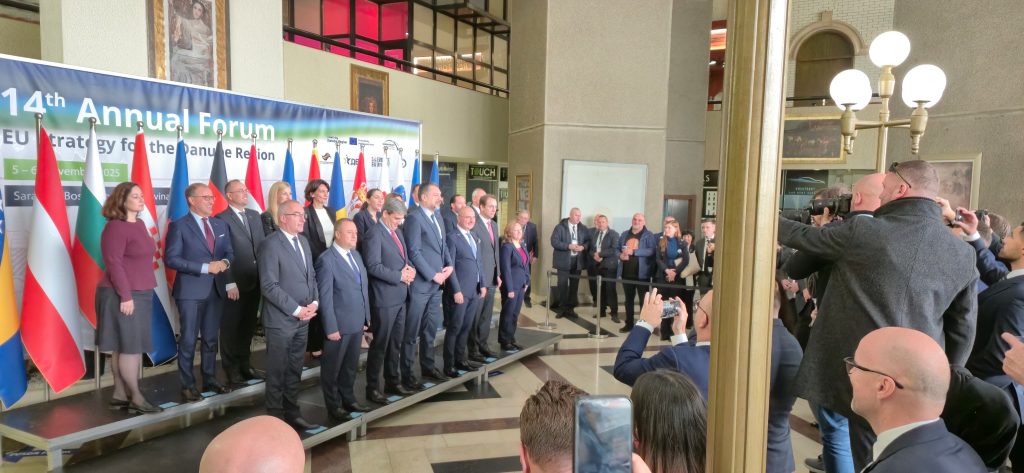
SARAJEVO – In 2025, the Danube region stands at a crucial geopolitical crossroad. While progress has been made on European integration and economic resilience, the region still faces growing security risks, demographic pressures, and complex development disparities, states the Sarajevo Declaration, adopted at the Fourteenth Annual Forum of the EU Strategy for the Danube Region, which takes place from 4 to 6 November in the capital of Bosnia and Herzegovina.
The document notes that the participating countries, both the EU and non-EU member states, “continue to work together to strengthen the rule of law, democratic governance and institutions, and support mechanisms for early warning, mediation, and coordinated crisis response”.
The EU Strategy for the Danube Region (EUSDR) is a macro-regional strategy adopted by the European Commission in December 2010 and endorsed by the European Council in 2011.
The Strategy was jointly developed by the EC, together with the Danube Region countries and stakeholders, in order to address common challenges. It seeks to create synergies and coordination between existing policies and initiatives taking place across the Danube Region.
The participant countries are Austria, BiH, Bulgaria, the Czech Republic, Croatia, Germany, Hungary, Montenegro, the Republic of Moldova, Romania, Serbia, Slovakia, Slovenia, and Ukraine.
“The acceleration of the EU integration process must remain a strategic priority for the EU, not only as a political commitment, but as a powerful driver of peace, prosperity, reforms, cooperation and reconciliation in the region… The EU enlargement is an investment in the security, stability and prosperity of our region”, the Sarajevo Declaration stresses.
In addition, it underlines the importance of a merit-based, credible and predictable enlargement process, “taking fully into account the political commitment, concrete progress and positive track record of each candidate country”.
“We stress the need for all EU candidate countries to enhance their engagement in the implementation of EU reforms. We welcome further support of EU macro-regional strategies in the EU enlargement process, positioning the EUSDR as a tool for gradual EU integration”, the Declaration states.
The Declaration also condemns the Russian Federation’s war of aggression against Ukraine and expresses full solidarity with Ukraine.
“We call for a comprehensive, just and lasting peace based on the principles of the UN Charter and international law between Ukraine and the Russian Federation”, the document notes.
In her opening address at the EUSDR Forum, Elvira Habota, Director of the Directorate for the European Integration of BiH, stated that the BiH Presidency of the EUSDR reflected the country’s devotion to the EU path.
“Like the Danube itself, which connects different countries, cultures and nations, our cooperation goes beyond the borders… Sarajevo has always been a meeting point, and our aim is to build a modern and competitive region”, Habota said.
In a similar vein, Elmedin Konaković, Foreign Minister of BiH, underlined that the Danube region “faces challenges that remind us that only through cooperation we can build a resilient region”.
“We strive for the cooperation, stability and prosperity… These are the essential tools to bridge the gaps in the region, and freedom and democracy are the values that must guide our actions”, Konaković stressed.
Luigi Soreca, Head of the EU Delegation to BiH, noted that the EU integration “remains the most powerful tool for achieving peace, stability and security in this strategically important region”.
“We are determined to the common European future. In this sense, the EU accession remains the most powerful tool against the backdrop of the Russian aggression in Ukraine”, Soreca noted.
According to Soreka, “enlargement is not a technical progress, but a political choice as well”, and the EUSDR provides the platform for the EU candidate countries to engage in the common policies before the membership”.