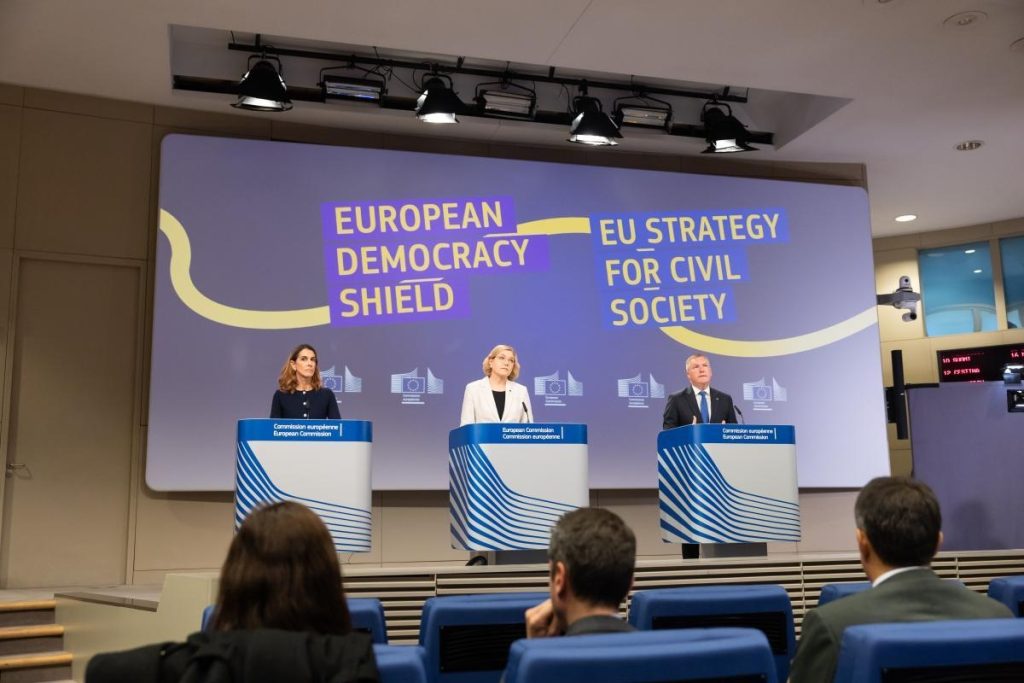
BRUSSELS – On 12 November, the European Commission presented two documents, the European Democracy Shield and the EU Strategy for Civil Society. According to the press release, their goal is to support “key pillars of our democratic systems”. The documents also contain proposals for engagement and support to candidate and potential candidate countries.
The European Democracy Shield focuses on three main pillars: safeguarding the integrity of the information space; strengthening European institutions, fair and free elections, and free and independent media; and boosting societal resilience and citizens’ engagement.
An important deliverable from the European Democracy Shield will be a new European Centre for Democratic Resilience, which will act as a framework to facilitate information sharing and support capacity building to withstand evolving common threats.
Meanwhile, with the EU Strategy for Civil Society, the Commission is stepping up its engagement with civil society and will further support and protect civil society organisations in their work. The objectives of the strategy are to foster engagement with the CSOs, support and protect them, and ensure sustainable and transparent funding.
“Today, the Commission adopted new tools to defend our freedoms. Our new Democracy Shield will help current and future member states to stand as one”, wrote Marta Kos, European Commissioner for Enlragement, on X.
Both documents propose steps to involve enlargement countries. The European Democracy Shield proposes a Media Resilience Programme that will bridge current support to the media with funding programmes proposed in the new Multiannual Financial Framework (MFF).
“This Programme will support independent journalism and media literacy, underlining the Commission’s efforts to strengthen the sustainable news media sector, including local journalism, also in EU candidate countries and potential candidates”, the document reads.
The document also stresses that one of the instruments of the proposed MFF 2028-2034, Global Europe, will provide tools to promote democracy, good governance, the rule of law and respect for human rights and fundamental freedoms in the enlargement and neighbourhood east regions.
The Democracy Shield also proposes closer cooperation with enlargement countries through various platforms. The new European Centre for Democratic Resilience will be open to associate EU candidate countries and potential candidates. The Commission also proposes setting up a European Network of Fact-Checkers, which will operate in the EU and in candidate countries.
The mandate of the European Digital Media Observatory, which provides research and analysis to counter disinformation activities, will be extended to support situational awareness, in particular around elections or in situations of crises. Its monitoring will cover all Member States, candidate countries (e.g. Ukraine, Moldova) and potential candidates.
Another already existing mechanism is the European Cooperation Network on Election (ECNE), which brings together national authorities with responsibilities in electoral matters. The Commission proposes a closer and systematic association with the work of ECNE, including through dedicated meetings.
In the new EU Civil Society Strategy, measures concerning the CSOs in the candidate countries are mentioned in the chapter of the document dedicated to support and protection. It is stated that the Commission will strengthen its early warning systems to enable stronger responses to emerging threats and emerging signs of shrinking civic space.
Regarding the funding, the document states that, in the enlargement region, the EU provides support to CSOs, including through the Instrument for Pre-Accession Assistance (IPA III).