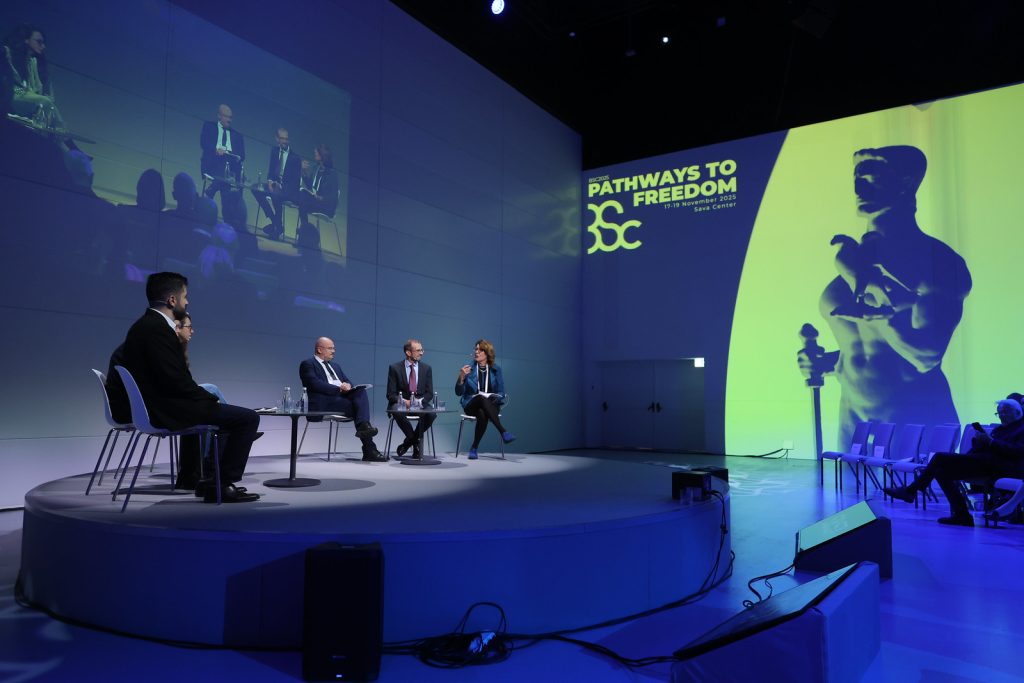
BELGRADE – We witness the drone attacks and Russian disinformation campaigns almost every day, these are multi-layered, “invisible wars”, the most dangerous of which is the one that is fought for the minds and hearts of Europeans, stated the participants of the panel “Unarmed in the Unseen War: How to Counter Hybrid Threats in Europe”, that was held today at the fourth edition of Belgrade Security Conference.
It was stressed that hybrid threats were particularly intense during election campaigns, and Moldova is one example of such practices.
Mihaela Sirițanu, public policy expert at Watchdog Moldova, spoke about the election cycle in the country, in which Russia interfered, using “laundered money”.
”We came out of it stronger and better, but the danger was significant”, she said, noting that Russia was using coercive methods, such as turning gas on Moldova last year, in retaliation for the country’s rapprochement with the European Union.
In her opinion, it is good that the EU is stepping up its efforts in the fight against hybrid threats, but it is important for Europeans to be united and to cooperate on this frontline.
“The fight is not over yet… The great burden in the fight against Russian disinformation campaigns is on civil society, but civil society can also feel fatigue if it is left alone”, Mihaela Sirițanu stressed.
According to Kiril Petkov, Former Prime Minister of Bulgaria and Co-Leader of We Continue the Change, the biggest foreign influence tool for Russia is corruption.
“Russia successfully exports corruption to penetrate power structures – the judiciary, the security system, the electoral processes, in countries like Bulgaria and Serbia. It is no coincidence that Russia controls the oil refineries of both Serbia and Bulgaria, Russia did so to prevent potential investments from the West”, Petkov claimed.
Thomas Röwekamp, Member of the German Bundestag and Chairman of the Defence Committee, warned that neither Germany was immune to bad Russian influences.
“This is a challenge we face on a daily basis… We are in a state between peace and war. In order to tackle the hybrid threats we need more soldiers, more support for Ukraine, more defense capabilities, including sharing of intelligence data, which is why we in Europe have to trust each other more”, Röwekamp assessed, adding that European Democracy Shield, recently launched by the EU “is a good start but not nearly enough”.
Frédéric Petit, Deputy Secretary General of European Democratic Party and Member of the French Parliament, said that “in most countries, we are not on the front of these information wars”, and that the fight for democracy “is larger than any one country or any one election
“It is a daily struggle… What young people in Serbia are doing now, and that is the fight against corruption and disinformation, is the defense not only of Serbia, but of the whole Europe. It is certain that in a few years the democrats in Serbia will have something to teach the European democrats,” Petit remarked.
Enrico Borghi, President of the Institute of European Democrats, noted that despite “a political landscape characterised by division”, the Italian Senate recently reached a consensus on hybrid threats.
“It is our common destiny, our ethical principles, that are at stake, so regulating big tech is of high importance”, Borghi stressed.