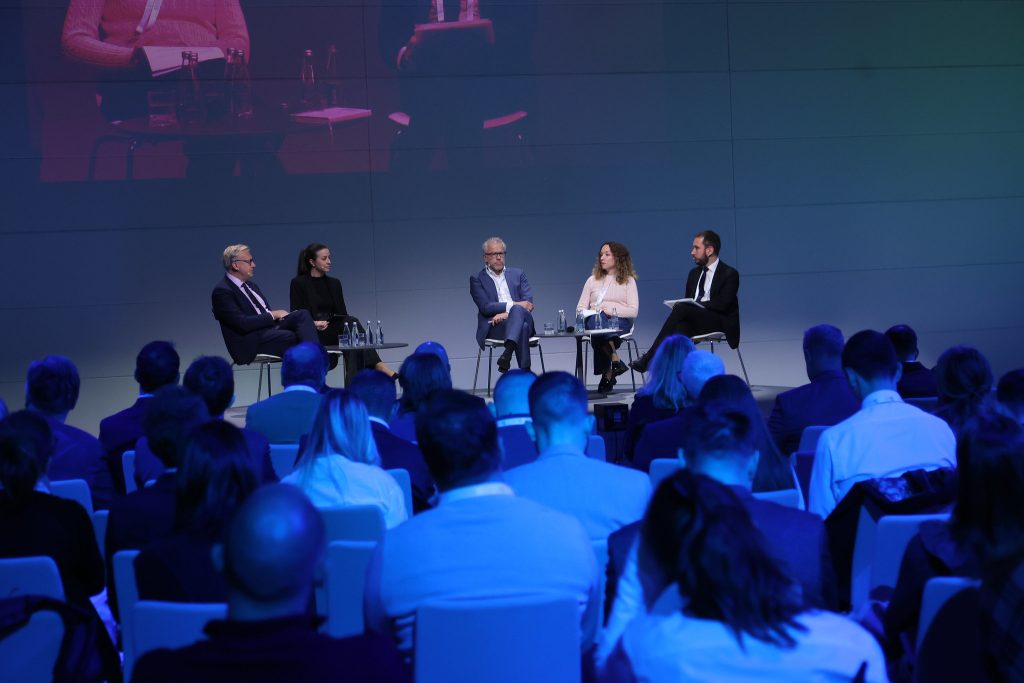
BELGRADE – The EU institutions remain committed to enlargement, but the process also requires reforms within the European Union itself, as well as in the candidate countries, speakers said at the panel “EU Enlargement: Between Momentum and Uncertainty” held at the Belgrade Security Conference (BSC).
Steven Blockmans, Senior Fellow at the Centre for European Policy Studies, noted that the latest European Commission report shows progress in four candidate countries – Montenegro, Albania, Ukraine, and Moldova.
He stressed that the European Commission has adopted a proactive approach in supporting these countries and that the mechanisms for gradual integration create a pathway allowing certain benefits of future membership to open earlier.
“Of course, it remains to be seen whether this will actually speed up the formal accession process. But the Commission’s recognition of expectations and timelines is important: Montenegro by 2026, Albania by 2027, Moldova in early 2028, and Ukraine by the end of that year. That may be optimistic, perhaps overly so, but it is significant that the Commission has identified these targets at all and has expressed readiness to support the countries,” Blockmans said.
He underlined that the technical process must be accompanied by political will, both in the member states and the candidate countries. Asked whether it is realistic to expect new enlargements by the end of the decade, Blockmans said that it is.
“If we take into account the additional 18 months Croatia needed to ratify its accession treaty in all member states, as well as domestically and in the European Parliament, then it is realistic that Montenegro, and perhaps even Albania, could become members before 2030. Still, there are obstacles that need to be overcome,” he added.
Thijs Reuten, a Member of the European Parliament from the Socialists and Democrats (S&D), stressed that candidate countries need a positive signal from the EU and that two or three states should join by 2030.
“I am glad that the European Union realized, after Russia’s invasion of Ukraine, even if it took some time, that we need new momentum in the enlargement process. We in the European Parliament have been calling for this for years,” Reuten said.
He noted that the EU has managed to overcome some blockages, but that concrete steps remain too limited.
“We still see a lack of action, even when it comes to Albania and Montenegro, because many people are still not convinced that this step needs to be taken,” the MEP added.
Speaking about timelines, Reuten said the problem is always the same:
“If you give a date too early, you may slow down the pace of reforms; if you give it too late, you risk losing support. That is exactly what happened in North Macedonia,” he said.
MEP from the Renew Europe group Irena Joveva said that while the political will for enlargement exists, the EU cannot afford “another Orbán” who would block key processes from within. For that reason, she emphasized, internal EU reforms and enlargement must go hand in hand.
She stressed the importance of defending European values both within the EU and in candidate countries.
“I believe the European Parliament is essentially saving the EU’s reputation when it comes to defending European values. Other institutions often selectively decide where these values apply, and where other interests matter more. We have seen this in Serbia as well, especially regarding the relationship between the President of the European Commission and the President of Serbia,” Joveva said.
Commenting on the EU’s approach to the current government in Serbia and the political crisis in the country, Joveva argued that for the citizens of Serbia and the entire region, the European Union remains the best alternative.
She acknowledged that Brussels’ rhetoric has changed but said she expects an even stronger response from the President of the European Commission.
“The European Parliament will certainly remain vocal on this, and I think pressure has already been applied. European values are not for sale and should never be applied selectively,” the MEP added.
Sofija Mandić, a member of the Centre for Judicial Research (CEPRIS), noted that only one-third of Serbian citizens now support EU accession, pointing out that this support has dropped from 78 percent to 33 percent over the past 25 years, and that society must reflect on the reasons behind this decline.
Responding to frequent claims that the decision on enlargement lies solely with Serbia, she said this is not true, as the EU and Serbia have a contractual obligation that Serbia will align itself with European values and the European way of life. Therefore, she stressed, it should not be left to current or future leaders to decide whether the country will join or not.
“The people of Serbia know who is responsible for the lack of reforms in this country, and if a country from the region joins the EU, it will be a signal that membership is indeed possible,” Mandić said, adding that the EU must communicate more directly with Serbian citizens.