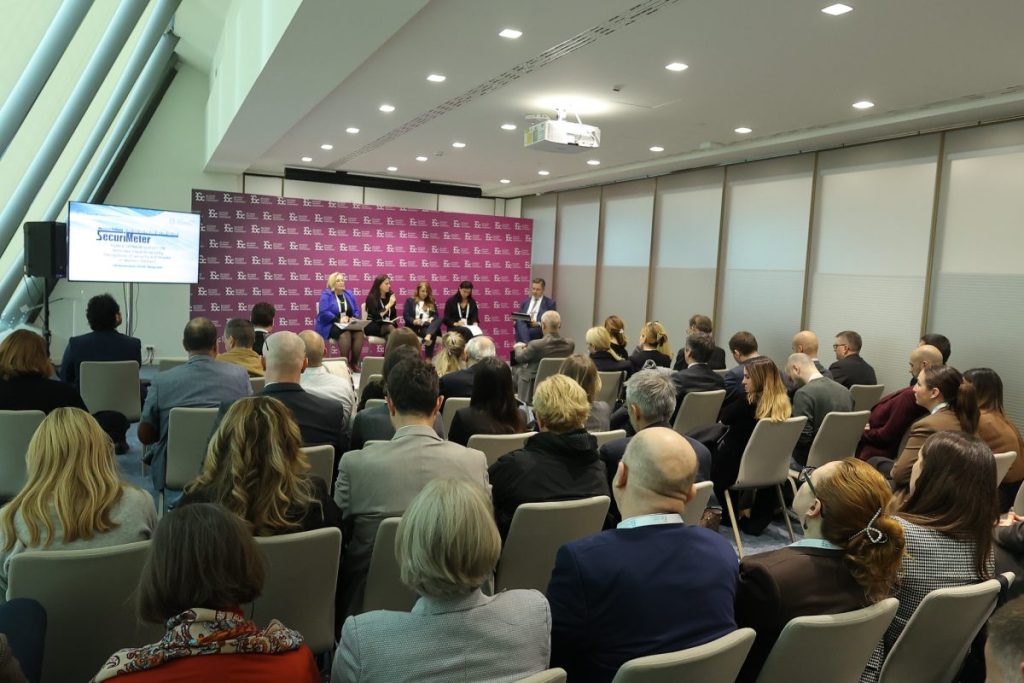
BELGRADE – As much as 81% of the citizens in the Western Balkans see corruption as widespread, while 46% think it has increased in the past three years, according to the Regional Cooperation Council’s SecuriMeter 2025 survey, which was presented yesterday at the Belgrade Security Conference. The report highlights persistent concerns about general security, personal safety, economic pressures, and depopulation.
The 2025 SecuriMeter survey was conducted between 30 May and 18 June 2025, and involved 6,007 respondents across the Western Balkans Six. The questionnaire included 46 thematic and 20 demographic questions.
Presenting some of the results from SecuriMeter 2025 survey, Aner Zuković, Senior Advisor at the RCC, stressed that only 25% of WB citizens are satisfied with the way things are going in their economy. At the same time, 38% believe the Western Balkans is a secure region, while 49% consider their own economy safe.
Zuković added that just 31% are optimistic about regional security over the next 12 months, whereas 46% of WB citizens think the continuation of the war in Ukraine negatively impacts security in the region.
He also noted that 53% of WB citizens feel personally secure, yet everyday fears remain common. For instance, one-third believe domestic violence is widespread, and half of WB citizens carry less cash to avoid being robbed.
When it comes to the concerns about personal safety, 21% of WB citizens have installed security cameras, while 2% own a gun, and around 10% are considering getting one.
Grave concerns about economic opportunities and social stability
According to SecuriMeter 2025, WB citizens are most concerned about the high cost of living (55.7%), inflation (52.8%), and pension levels (52.4%). While nearly half of respondents also express high concern over wages (48.8%) and corruption in society (45.3%), issues such as depopulation and emigration (44.0%) and unemployment (34.3%) remain significant, reflecting broader worries about economic opportunity and social stability.
Overall, the intention to move abroad for living and working is present in just over a quarter of the WB6 population, with 27.3% expressing some level of a plan, ranging from vague to definite action. Despite this significant minority, the large majority, 67.8%, state they do not want to move. Among those who do plan to move, the preferred destinations are overwhelmingly concentrated in Western and Central Europe. The most desired destination regionally is the Germany-Austria bloc (25.4%), followed by Switzerland (15.2%), and the USA (11.9%).
At the other end of the spectrum, issues of political and security stability, such as terrorism (18.1% highly concerned) and ethnic tensions (24.2%), generate far less public concern.
When it comes to the perceptions of the people from other religions, 41% of Western Balkan citizens distrust them. Also, 45% distrust people from other nationalities.
Highest public confidence in security and religious institutions, political parties least trusted
Regarding individual institutions, the public confidence in the Western Balkans Six is highest for security institutions. Religious institutions and the army are the most trusted institutions, with 62% and 57.9% of respondents expressing confidence, respectively.
Educational institutions also enjoy relatively high confidence, with universities at 53.3%. International organisations like the EU (52.1%) and NATO (52.0%) also exceed 50% combined trust.
Confidence is considerably lower for government and political institutions. Political parties are the least trusted, with 76.6% of respondents expressing lack of confidence. Other governance and justice bodies also face significant distrust, such as courts (65.1%), parliament (69.1%), the electoral commission (61.1%), public procurement authorities (64.2%) and the government itself (59.5%), all of which show high levels of public scepticism.
Commenting on the findings, Amer Kapetanović, RCC Secretary General, underlined that trust is the central theme emerging from this year’s survey.
“If SecuriMeter could be summarised in one word, it would be trust. People across the Western Balkans are telling us that their biggest concerns today are not distant threats but the resilience of their institutions, the fairness of governance, and the predictability of their future. The good news is that trust can be rebuilt: when institutions deliver, trust grows; when reforms are visible, confidence grows; and when the European path is credible, trust rises at home as well”, Kapetanović remarked.
Tijana Rečević, Assistant Professor at the Faculty of Political Science, University of Belgrade, remarked that, unfortunately, we live in a society where slogans such as ‘corruption kills’ are “becoming less metaphorical, with issues such as unsafe roads, weakened standards, weak law enforcement, etc., becoming everyday life”.
In a similar vein, Nikolina Stojanovska, Managing Director and Project Manager at Market Vision, underlined the irony of corruption “being normalised as a part of our daily lives”. She emphasised that the recent tragedy in North Macedonia happened exclusively because of corruption.
Iliriana Gjoni, Research Analyst at Carnegie Europe, spoke about the deeply rooted clientelism in societies throughout the Western Balkans. According to her, the EU has to engage more with the young people, and “our region has to move away from nationalism, from the ghosts of the past centuries”.
Sonja Stojanović Gajić, Senior Research Fellow at the Centre for Advanced Studies South East Europe, University of Rijeka, noted that “trauma of wars is still alive in our region, it is s trans-generationally transmitted”, adding that “most of the war mongering is done by the domestic political elites”.